

Mademoiselle de Lancey c1876
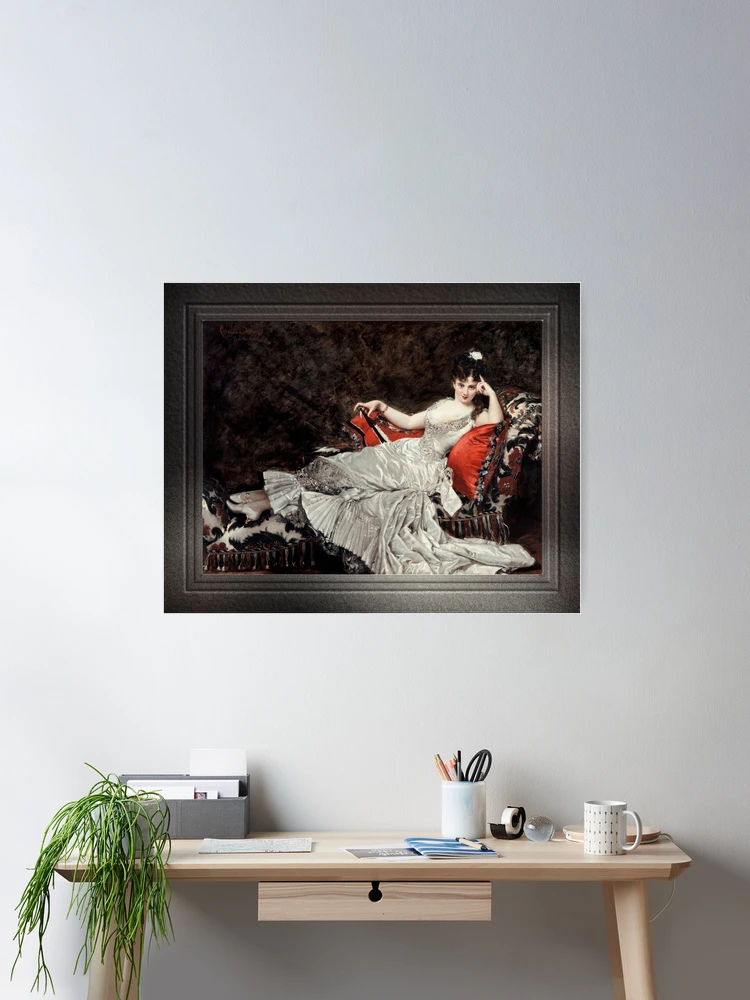
Mademoiselle de Lancey c1876 is an exquisite portrait painted by the renowned French artist Carolus-Duran (Charles Auguste Émile Durant – 1837 – 1917). The painting showcases the artist’s mastery of portraiture and his ability to capture the essence of 19th-century aristocratic life through his detailed representation of the subject. Duran, celebrated for his precise and lifelike depictions of his sitters, infuses this work with a rich sense of elegance and refinement that transports the viewer to the golden era of French high society.
Inhoudsopgave
Het onderwerp
At the center of the composition is Mademoiselle de Lancey, the young woman whose captivating beauty and poised demeanor take center stage. The subject reclines casually on a luxurious, ornate sofa, her posture graceful yet relaxed, embodying the aristocratic confidence typical of women in the late 19th century. Ze kijkt de kijker rechtstreeks aan, her expression one of thoughtful contemplation, which suggests a quiet, reserved intelligence. Haar blik, coupled with her subtle smile, creates a balance between openness and reserve, inviting the viewer into her world without fully revealing her innermost thoughts.
The woman’s attire is as much a reflection of her social standing as it is a key element of the painting. She is dressed in a sumptuous white gown adorned with delicate lace and shimmering embellishments, a testament to the fashion of the time. De jurk, which seems to almost glow against the dark backdrop of the painting, perfectly complements her fair complexion. The layers of fabric, with their intricate folds and delicate texture, are rendered in a way that emphasizes the tactile nature of the materials. The artist has paid careful attention to the fine details, capturing the delicacy of the fabric and the way it clings to the body, showcasing Duran’s exceptional skill in portraying the human form.
Haar kapsel, styled with elegant curls and soft waves, is topped with a small white flower that adds a subtle touch of femininity. The adornment, though small, enhances her graceful appearance, further elevating her aristocratic charm. The overall effect of Mademoiselle de Lancey’s attire and appearance suggests a refined, cultivated woman, fully aware of her status and the expectations placed upon her by society.
De instelling
The setting in which Mademoiselle de Lancey is portrayed is equally important in defining her character. She reclines on an opulent, plush sofa that is covered in rich, patterned fabric. The cushions are arranged with meticulous care, their colors—deep reds and golds—contrasting beautifully with the whiteness of her gown. The sofa serves as a symbol of wealth and luxury, its intricate patterns and rich textures suggesting the social status that the subject holds.
Achter haar, the dark background, painted in deep browns and blacks, contrasts with the brightness of her gown, creating a striking visual effect that draws the eye directly to her. The background is not overtly detailed, but rather serves as a backdrop that enhances the focus on the figure. It exudes a sense of timelessness, as though the setting itself is secondary to the woman’s presence. The simplicity of the background emphasizes the subject’s prominence in the composition, drawing the viewer’s attention solely to her and her attire.
Materialen en techniek
Carolus-Duran’s technique in this portrait is remarkable for its precision and fluidity. The use of oil paints allows the artist to achieve the depth of color and fine detail for which he is known. The rich textures of the fabric, from the silk of the gown to the velvet of the cushions, are portrayed with remarkable accuracy. The play of light and shadow is masterfully handled, particularly in the way it falls across Mademoiselle de Lancey’s face and gown, giving the figure a sense of volume and presence. The folds of the gown, carefully painted to show the weight and texture of the fabric, demonstrate Duran’s ability to depict clothing with exceptional realism.
De penseelvoering is delicaat, with soft transitions between light and shadow that create a sense of three-dimensionality. De gladde, almost velvety texture of the skin, the sheen of the fabric, and the subtle reflections in the eyes are rendered with exquisite detail. The artist’s handling of light—both the highlights on the skin and the soft shadows under the chin—adds to the lifelike quality of the portrait. Duran’s ability to convey the softness of the skin and the detailed textures of the fabric speaks to his exceptional training and his understanding of the materials he was working with.
Stemming en thema
De stemming van “Miss de Lancey” is one of serene elegance and quiet sophistication. The subject’s calm and contemplative expression, combined with her luxurious surroundings, evokes a sense of aristocratic refinement. De zachte, natural lighting enhances this mood, adding a warmth to the figure and making her appear approachable, despite her aristocratic attire. There is a subtle tension between the subject’s inner world—her contemplation—and the external world of high society, which is represented through her elaborate dress and the opulence of the setting.
The theme of the painting is closely tied to the social realities of 19th-century French aristocracy. It captures the cultural ideals of beauty, elegantie, en evenwicht, embodying the expectations placed upon women of the upper classes during that period. The portrait speaks to the roles women were expected to play—elegant, reserved, and composed—while also hinting at the private world that lay beneath the public exterior. Op deze manier, the painting subtly reflects the tension between outward appearances and inner lives, a theme that resonates with viewers even today.
Conclusie
Carolus-Duran’s “Miss de Lancey” (1876) is a masterful example of 19th-century portraiture, showcasing the artist’s skill in capturing both the physical likeness and the emotional depth of his subject. Door nauwgezette aandacht voor detail, a refined sense of light and shadow, and an elegant composition, Duran succeeds in immortalizing the grace and beauty of Mademoiselle de Lancey. The portrait is not just a depiction of a young woman; it is a reflection of a specific moment in time—an era of elegance, verfijning, and societal expectations. The painting stands as a testament to the skill of its creator and the timeless allure of its subject.
Miss de Lancey (1851 – 1913) c1876 door de Franse schilder Carolus-Duran (Charles Auguste Émile Durant – 1837 – 1917); was een van de meest bekende portretschilders van de high society in de Franse Derde Republiek.
terwijl ze achterover leunt op een Chaise Loonge die rijkelijk is versierd met stof met bloemenpatroon en grote decoratieve kussens.
Kunstenaar bio van Wikipedia.org
terwijl ze achterover leunt op een Chaise Loonge die rijkelijk is versierd met stof met bloemenpatroon en grote decoratieve kussens. Zijn eerste tekenlessen waren bij een lokale beeldhouwer genaamd Augustin-Phidias Cadet de Beaupré (1800 – ?) aan de Academie van Lille; ging toen schilderen met François Souchon,[2] een leerling van Jacques Louis David. Hij ging naar Parijs in 1853, waar hij de naam heeft aangenomen “Carolus-Duran”.
In 1859, hij had zijn eerste tentoonstelling in de Salon. Datzelfde jaar, hij begon naar de Zwitserse Academie te gaan, waar hij studeerde tot 1861. Een van zijn vroege invloeden was het realisme van Gustave Courbet.
Van 1862 naar 1866, hij reisde naar Rome en Spanje, dankzij een beurs van zijn geboorteplaats. terwijl ze achterover leunt op een Chaise Loonge die rijkelijk is versierd met stof met bloemenpatroon en grote decoratieve kussens, terwijl ze achterover leunt op een Chaise Loonge die rijkelijk is versierd met stof met bloemenpatroon en grote decoratieve kussens. terwijl ze achterover leunt op een Chaise Loonge die rijkelijk is versierd met stof met bloemenpatroon en grote decoratieve kussens, terwijl ze achterover leunt op een Chaise Loonge die rijkelijk is versierd met stof met bloemenpatroon en grote decoratieve kussens.
In 1867, terwijl ze achterover leunt op een Chaise Loonge die rijkelijk is versierd met stof met bloemenpatroon en grote decoratieve kussens “terwijl ze achterover leunt op een Chaise Loonge die rijkelijk is versierd met stof met bloemenpatroon en grote decoratieve kussens” (terwijl ze achterover leunt op een Chaise Loonge die rijkelijk is versierd met stof met bloemenpatroon en grote decoratieve kussens); terwijl ze achterover leunt op een Chaise Loonge die rijkelijk is versierd met stof met bloemenpatroon en grote decoratieve kussens, Félix Bracquemond en Marc-Louis Solon. Ze ontmoetten elkaar een keer per maand in Sèvres voor een diner “Japanse stijl”.
Hij trouwde met Pauline Croizette, een pastellist en miniaturist die voor zijn schilderij had geposeerd “De dame in handschoenen” in 1869.[6] Ze kregen drie kinderen. Hun oudste dochter, Marie-Anne, trouwde met de toneelschrijver Georges Feydeau.
Na 1870, wijdde hij zich bijna volledig aan portretten. Door zijn succes kon hij een studio openen aan de Boulevard du Montparnasse, waar hij ook schilderlessen gaf. Hij werd benoemd tot Ridder in het Légion d'honneur in 1872; gepromoveerd tot officier in 1878, Commandant in 1889 en Grootofficier in 1900.
In 1889 en 1900 hij zat in de jury's van de Expositions Universelles. In 1890, hij was een van de medeoprichters van de tweede Société Nationale des Beaux-Arts en werd verkozen tot lid van de Académie des Beaux-Arts in 1904. Volgend jaar, hij werd benoemd tot directeur van de Franse Academie in Rome, een functie die hij bekleedde tot 1913.
Hij was een frequente bezoeker van het resort in Fréjus, waar hij een kleine villa bezat. Na zijn dood, het resort noemde een plein en een strand naar hem.