

Mademoiselle de Lancey c1876
Mademoiselle de Lancey c1876 is an exquisite portrait painted by the renowned French artist Carolus-Duran (Charles Auguste Émile Durant – 1837 – 1917). The painting showcases the artist’s mastery of porträtt and his ability to capture the essence of 19th-century aristocratic life through his detailed representation of the subject. Duran, celebrated for his precise and lifelike depictions of his sitters, infuses this work with a rich sense of elegance and refinement that transports the viewer to the golden era of French high society.
Innehållsförteckning
Ämnet
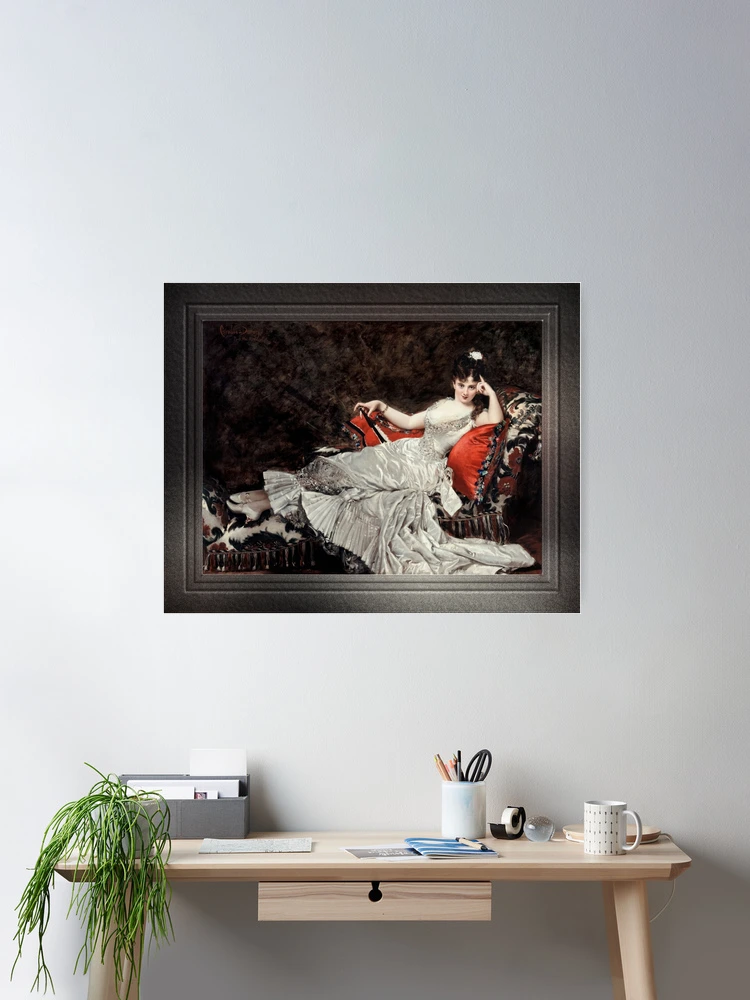
At the center of the composition is Mademoiselle de Lancey, the young woman whose captivating beauty and poised demeanor take center stage. The subject reclines casually on a luxurious, ornate sofa, her posture graceful yet relaxed, embodying the aristocratic confidence typical of women in the late 19th century. She gazes directly at the viewer, her expression one of thoughtful contemplation, which suggests a quiet, reserved intelligence. Hennes blick, coupled with her subtle smile, creates a balance between openness and reserve, inviting the viewer into her world without fully revealing her innermost thoughts.
The woman’s attire is as much a reflection of her social standing as it is a key element of the painting. She is dressed in a sumptuous white gown adorned with delicate lace and shimmering embellishments, a testament to the fashion of the time. Klänningen, which seems to almost glow against the dark backdrop of the painting, perfectly complements her fair complexion. The layers of fabric, with their intricate folds and delicate texture, are rendered in a way that emphasizes the tactile nature of the materials. The artist has paid careful attention to the fine details, capturing the delicacy of the fabric and the way it clings to the body, showcasing Duran’s exceptional skill in portraying the human form.
Her hairstyle, styled with elegant curls and soft waves, is topped with a small white flower that adds a subtle touch of femininity. The adornment, though small, enhances her graceful appearance, further elevating her aristocratic charm. The overall effect of Mademoiselle de Lancey’s attire and appearance suggests a refined, cultivated woman, fully aware of her status and the expectations placed upon her by society.
Inställningen
The setting in which Mademoiselle de Lancey is portrayed is equally important in defining her character. She reclines on an opulent, plush sofa that is covered in rich, patterned fabric. The cushions are arranged with meticulous care, their colors—deep reds and golds—contrasting beautifully with the whiteness of her gown. The sofa serves as a symbol of wealth and luxury, its intricate patterns and rich textures suggesting the social status that the subject holds.
Bakom henne, the dark background, painted in deep browns and blacks, contrasts with the brightness of her gown, creating a striking visual effect that draws the eye directly to her. The background is not overtly detailed, but rather serves as a backdrop that enhances the focus on the figure. It exudes a sense of timelessness, as though the setting itself is secondary to the woman’s presence. The simplicity of the background emphasizes the subject’s prominence in the composition, drawing the viewer’s attention solely to her and her attire.
Material och teknik
Carolus-Duran’s technique in this portrait is remarkable for its precision and fluidity. The use of oil paints allows the artist to achieve the depth of color and fine detail for which he is known. The rich textures of the fabric, from the silk of the gown to the velvet of the cushions, are portrayed with remarkable accuracy. The play of light and shadow is masterfully handled, particularly in the way it falls across Mademoiselle de Lancey’s face and gown, giving the figure a sense of volume and presence. The folds of the gown, carefully painted to show the weight and texture of the fabric, demonstrate Duran’s ability to depict clothing with exceptional realism.
Penseln är känslig, with soft transitions between light and shadow that create a sense of three-dimensionality. Den släta, almost velvety texture of the skin, the sheen of the fabric, and the subtle reflections in the eyes are rendered with exquisite detail. The artist’s handling of light—both the highlights on the skin and the soft shadows under the chin—adds to the lifelike quality of the portrait. Duran’s ability to convey the softness of the skin and the detailed textures of the fabric speaks to his exceptional training and his understanding of the materials he was working with.
Humör och tema
Stämningen av “Fröken de Lancey” is one of serene elegance and quiet sophistication. The subject’s calm and contemplative expression, combined with her luxurious surroundings, evokes a sense of aristocratic refinement. Den mjuka, natural lighting enhances this mood, adding a warmth to the figure and making her appear approachable, despite her aristocratic attire. There is a subtle tension between the subject’s inner world—her contemplation—and the external world of high society, which is represented through her elaborate dress and the opulence of the setting.
The theme of the painting is closely tied to the social realities of 19th-century French aristocracy. It captures the cultural ideals of beauty, nåd, och balans, embodying the expectations placed upon women of the upper classes during that period. The portrait speaks to the roles women were expected to play—elegant, reserved, and composed—while also hinting at the private world that lay beneath the public exterior. På detta sätt, the painting subtly reflects the tension between outward appearances and inner lives, a theme that resonates with viewers even today.
Slutsats
Carolus-Duran’s “Fröken de Lancey” (1876) is a masterful example of 19th-century portraiture, showcasing the artist’s skill in capturing both the physical likeness and the emotional depth of his subject. Through meticulous attention to detail, a refined sense of light and shadow, and an elegant composition, Duran succeeds in immortalizing the grace and beauty of Mademoiselle de Lancey. The portrait is not just a depiction of a young woman; it is a reflection of a specific moment in time—an era of elegance, raffinemang, and societal expectations. The painting stands as a testament to the skill of its creator and the timeless allure of its subject.
Fröken de Lancey (1851 – 1913) c1876 av franska målaren Carolus-Duran (Charles Auguste Émile Durant – 1837 – 1917); var en av de mest kända porträttmålarna i det höga samhället i Franska tredje republiken.
Mademoiselle de Lancey är en retuscherad digital konst gammal mästare reproduktion av en offentlig egendom.
Artist Bio från Wikipedia.org
Carolus-Duran var son till en hotellägare. Hans första teckningstimmar var med en lokal skulptör vid namn Augustin-Phidias Cadet de Beaupré (1800 – ?) vid Lillehögskolan; började sedan måla med François Souchon,[2] en elev av Jacques Louis David. Han åkte till Paris in 1853, där han antog namnet “Carolus-Duran”.
I 1859, han hade sin första utställning på salongen. Samma år, han började gå på Swiss Academy, där han studerade tills 1861. En av hans tidiga influenser var Gustave Courbets realism.
Från 1862 till 1866, han reste till Rom och Spanien, tack vare ett stipendium som hans hemstad beviljat. Under tiden, han gick bort från Courbets stil och blev mer intresserad av Diego Velázquez. Vid återkomsten till Frankrike, han tilldelades sin första guldmedalj på salongen.
I 1867, han blev en av de nio medlemmarna i “Japanska Jinglar Society” (en typ av vin); en grupp som inkluderade Henri Fantin-Latour, Félix Bracquemond och Marc-Louis Solon. De skulle träffas en gång i månaden i Sèvres för en middag “japansk stil”.
Han gifte sig med Pauline Croizette, en pastellist och miniatyrist som hade poserat för sin målning “Damen i handskar” i 1869.[6] De fick tre barn. Deras äldsta dotter, Marie-Anne, gifte sig med dramatikern Georges Feydeau.
Efter 1870, han ägnade sig nästan helt åt porträtt. Hans framgång tillät honom att öppna en studio på Boulevard du Montparnasse, där han också gav målarlektioner. Han utsågs till en riddare i Légion d’honneur in 1872; befordras till officer i 1878, Befälhavare i 1889 och Grand Officer i 1900.
I 1889 och 1900 han tjänstgjorde i juryn vid Expositions Universelles. I 1890, han var en av grundarna till den andra Société Nationale des Beaux-Arts och han valdes till medlem i Académie des Beaux-Arts i 1904. Det följande året, han utsågs till direktör för den franska akademin i Rom, en position han innehade fram till 1913.
Han var en frekvent besökare på orten i Fréjus, där han ägde en liten villa. Efter hans död, orten namngav en torg och en strand efter honom.