

Marchesa Marianna Florenzi
Marchesa Marianna Florenzi (1802 – 1870) c1824 por el pintor alemán Heinrich Maria von Hess (1798 – 1863); Miembro del Movimiento Nazareno y principalmente pintor de temas religiosos y mitológicos..
Esta retrato of Marchesa Marianna Florenzi shows her at the age of 22, sitting in alcove of a large garden, surrounded by circular blueish-green marble columns and off white rectangular columns that form a wall behind her.
She is sitting on a cushioned stone bench, wearing a full length red coat with black buttons on the far outside, that is trimmed with blue fur accents along the collar, espalda, wrist and bottom; and an orange belt with a diamond rectangular buckle that keeps the coat closed.
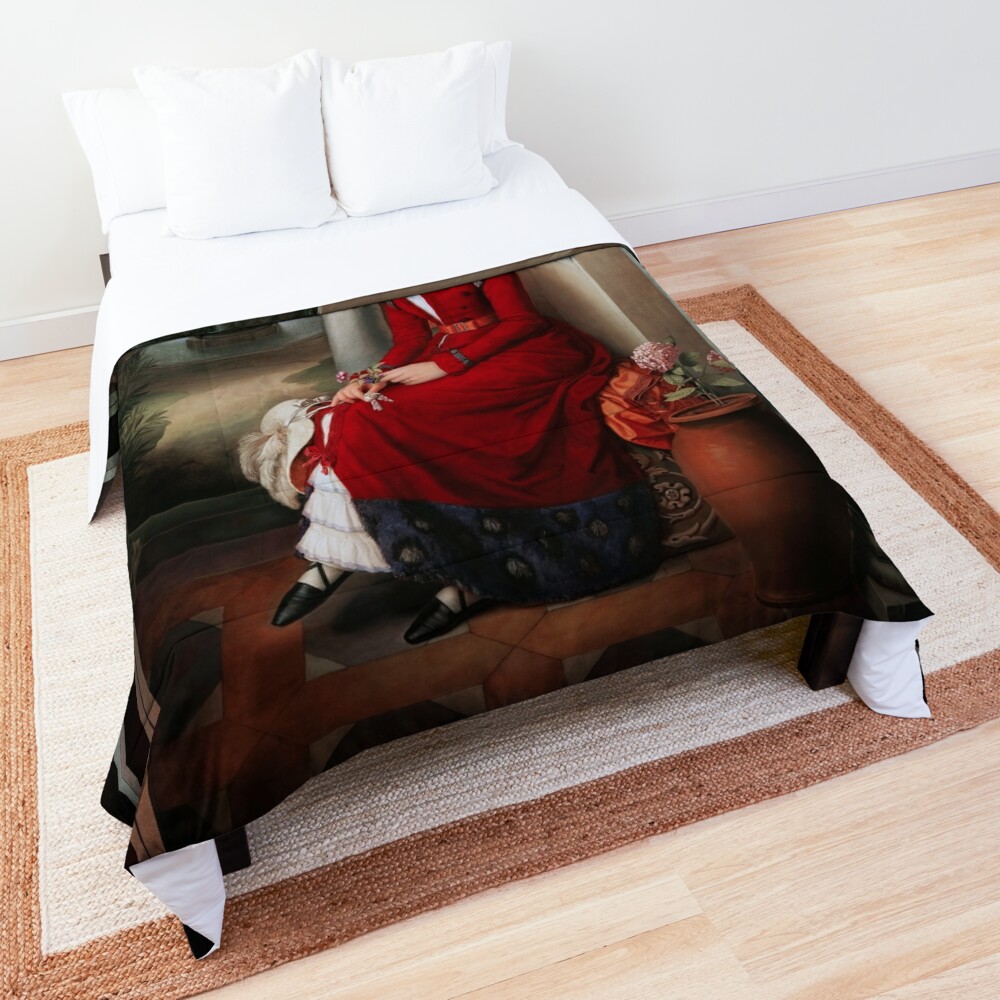
Beneath the coat we can see a full length white dress that is ruffled in three layers below the knee, and that she is wearing white stockings and black leather shoes.
While in her left hand that has a gold ring on her fourth finger she is holding a pink and violet flower, and with her right hand that has green gemstone and gold ring on her fourth finger she is holding on to a bone white hat with feathers on the side and a lace ribbon across the top that also forms a chin strap.
To her left is a very large potted vase that rest on a beautiful tiled floor, that has two large pink ball flowers growing from the soil in it; and to her right is the pathway that opens on to a garden with a large functional water fountain, trees that have been trimmed to form an arch for a beautiful view from the balcony that overlooks the city in the far distance.
Marchesa Marianna Florenzi is a retouched digital art old masters reproduction of a public domain image.
Información a continuación derivada de Wikipedia.org
Ludwig was the son of the classicist (classical study of antiquity) and philhellene (intellectual movement for the admiration of Greece at the turn of 19th century) Friedrich Thiersch, who was born in Munich Germany in 1825.
He had two older brothers; one was the surgeon Karl Thiersch (1822 – 1895) and the other was the theologian H. W. J. Thiersch (1817 – 1885).
Ludwig began is artistic education as an attendee of the Academy of Fine Arts in Munich, studying sculpture; but after a few years changed over to painting and became the student of three German Painters; Heinrich Maria von Hess (1798 – 1863) of the Nazarene Movement (a German Romantic Movement who’s aim was to revive spirituality in art); Julius Schnorr von Carolsfeld (1794 – 1872 ), primarily a painter of biblical subjects, and Karl Schorn (1803 – 1850), as well as a painter he was also a chess master.
After completing his studies at the Academy of Fine Arts 1848, he painted the pieces Sakuntala (is the wife of Dushyanta and the mother of Emperor Bharata), and a scene of Camissards (were Huguenots or French Protestants who held to the Reformed, or Calvinist, tradition of Protestantism. n the early 1700s, they raised a resistance against the persecutions which followed Louis XIV’s Edict of Fontainebleau, making Protestantism illegal.)
On the completion of these works he then ventured off to Rome, Italia; where he sketched scenes of the daily lives of the Italian people and painted the piece Hiob unter seinen Freunden (Job among his friends ).
En 1852 he made he traveled to Athens, Greece with his father, donde reemplazó al pintor italiano, Médico y arqueólogo aficionado Rafaello Ceccoli (1800 – 1850); en la Escuela de Bellas Artes de Atenas; interesarse por el arte bizantino.
Durante este de 1852 – 1855 Ludwig pintaría varios frescos en iglesias griegas y fue un miembro destacado del movimiento para modernizar el arte bizantino mediante la introducción de elementos occidentales., como la perspectiva naturalista y la anatomía; que se encontró con una feroz oposición griega de aquellos que veían tales reformas como un medio para reemplazar las tradiciones griegas de larga data por otras extranjeras..
Durante el resto de su vida, Ludwig viajaría a diferentes ciudades pintando para mecenas y creando frescos para iglesias., que fue particularmente notable junto con el trabajo realizado por el pintor italiano Ludwig Seitz (1844 – 1908) y el francés Jean-Hippolyte Flandrin (1809 – 1864); Se considera que lideró el resurgimiento del arte eclesiástico de Europa occidental..