

Meditation on the History of Italy
Meditation on the History of Italy: A Detailed Examination
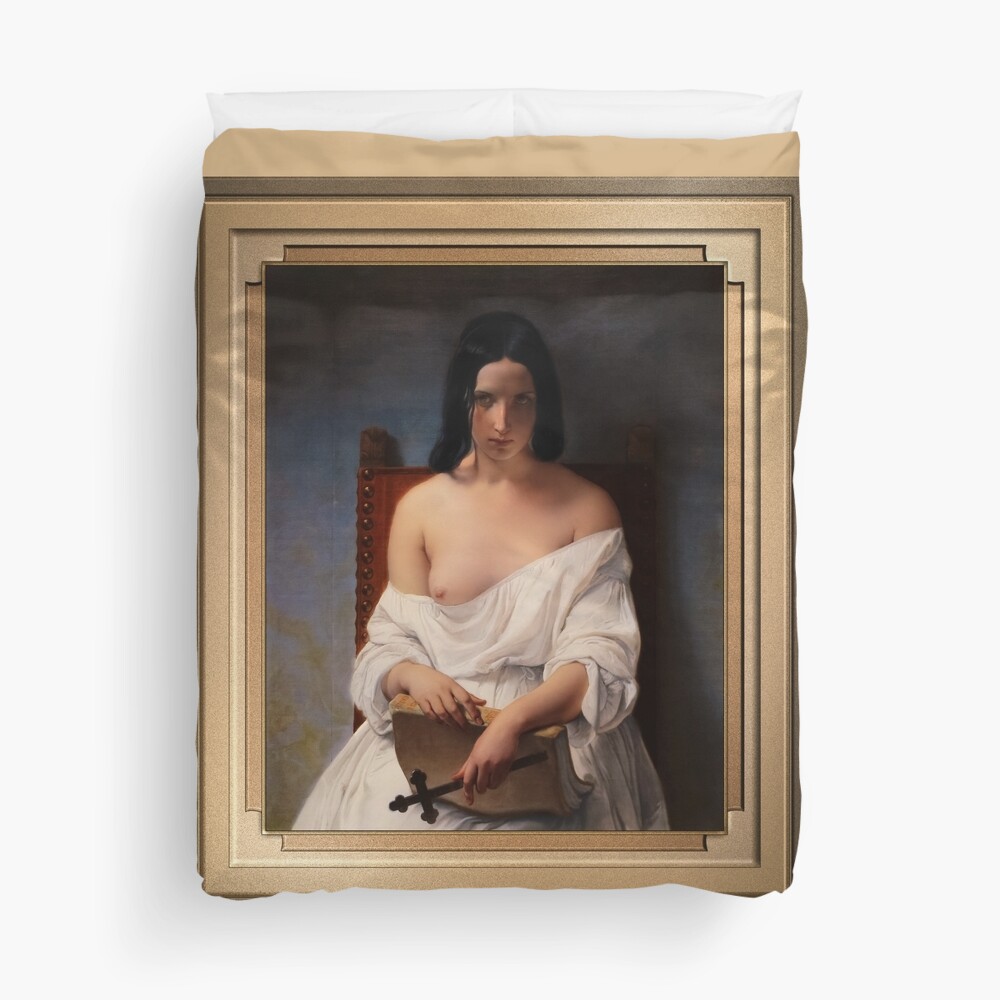
Francesco Hayez’s “Meditation on the History of Italy,” malt rundt 1851, is a compelling work within the Romantic tradition, deeply rooted in Italian nationalism and historical allegory. Maleriet, currently housed at the Pinacoteca di Brera in Milan, transcends a simple portrait to become a complex visual narrative reflecting the yearning for a unified and independent Italy during a period of political fragmentation and foreign domination. Hayez was a leading figure in the Risorgimento, the 19th-century movement that led to Italian unification, and his art frequently served as a vehicle for expressing patriotic sentiments.
Innholdsfortegnelse
Komposisjonsstruktur & Setting
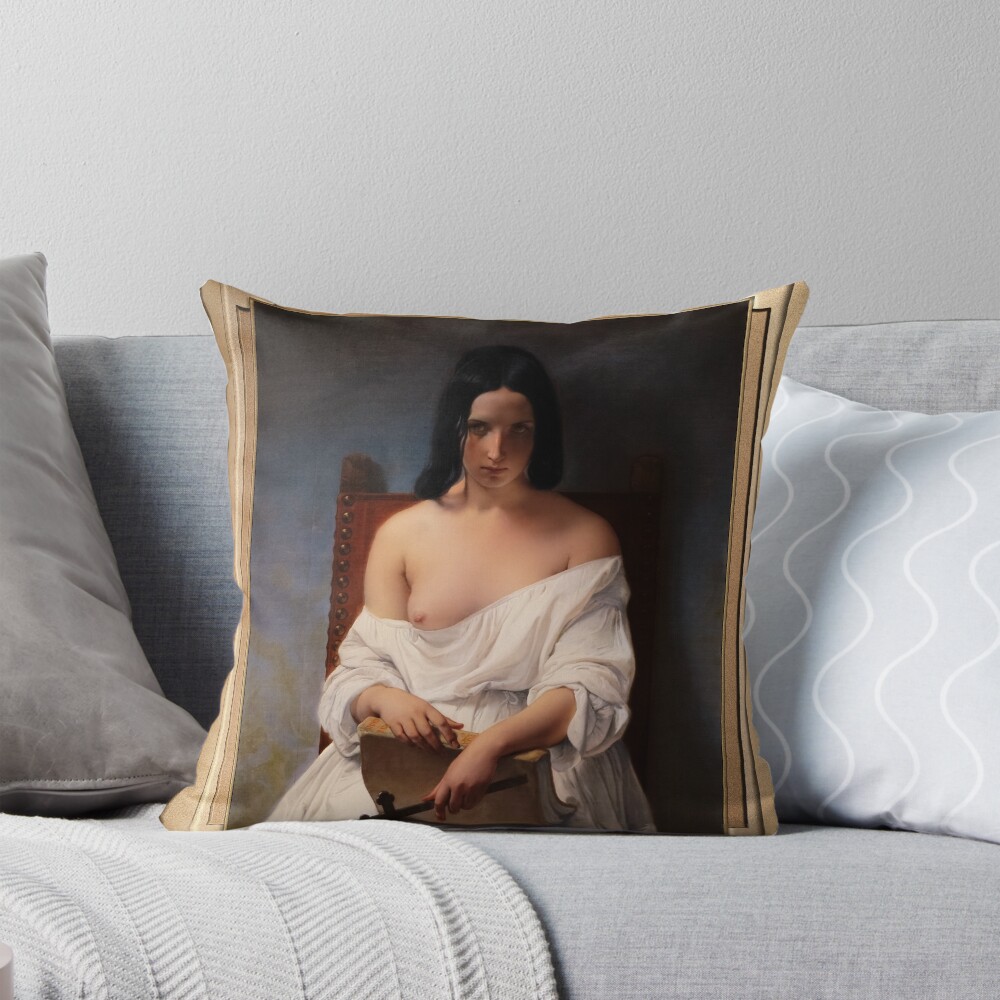
The composition is dominated by a single female figure seated upon an ornate chair against a backdrop of muted blues and grays. The chair itself appears aged and slightly dilapidated, hinting at the decline of past glories. The background fades into obscurity, suggesting a timeless setting rather than a specific historical location. This ambiguity allows for broader interpretation, encompassing Italy’s long and turbulent history. Figuren er sentralt plassert, drawing immediate attention to her contemplative state. The overall effect is one of quiet introspection within a space that feels both intimate and monumental.
Figuren: Identity & Antrekk
The woman depicted possesses striking features – dark hair cascading down her shoulders, pale skin, and intense, melancholic eyes. Her gaze is directed downwards, suggesting deep thought or sorrow. She is draped in a simple white gown, partially slipped from one shoulder, revealing the upper portion of her chest. The fabric appears soft and flowing, adding to the sense of vulnerability and grace. The lack of elaborate ornamentation on her attire contrasts with the ornate chair, further emphasizing her individual presence and internal focus. Her bare feet rest upon the floor, grounding her in a tangible reality despite the allegorical nature of the scene.
The Book & Cross: Symbolic Elements
Held within her hands is an open book, its pages filled with text that remains largely illegible to the viewer. This book clearly represents Italian history and literature – the accumulated knowledge and cultural heritage of the nation. Lying across the book’s cover is a large, dark cross. The presence of the cross introduces a layer of religious significance, referencing Italy’s strong Catholic tradition and potentially alluding to the role of faith in shaping national identity. derimot, its placement atop the historical record suggests a complex relationship between religion and Italian history – perhaps a commentary on how faith has both supported and sometimes hindered the nation’s progress.
Belysning & Fargepalett
Belysningen inn “Meditation on the History of Italy” is carefully orchestrated to enhance the painting’s emotional impact. En myk, diffused light illuminates the woman from above, highlighting her face and upper body while leaving much of the background shrouded in shadow. This creates a sense of mystery and emphasizes the figure’s isolation within her thoughts. The color palette is restrained, dominated by muted tones of white, gray, blå, and brown. These colors contribute to the painting’s somber mood and reinforce the themes of reflection and melancholy. The limited use of vibrant hues draws attention to specific details, such as the dark cross and the woman’s eyes.
Kunstnerisk stil & Influences
Hayez’s style is characteristic of Italian Romanticism, emphasizing emotion, individualisme, and a fascination with history and mythology. The painting exhibits meticulous detail in rendering the figure’s features and clothing, demonstrating Hayez’s technical skill as an artist. There are echoes of Neoclassical influences in the composition’s balance and clarity, but the overall tone is decidedly Romantic, prioritizing emotional expression over strict adherence to classical ideals. The work shares affinities with other allegorical paintings of the period, particularly those exploring themes of national identity and historical memory.
Historical Context & Tolkning
Painted during a time when Italy was divided into numerous states under foreign rule or dominated by regional powers, “Meditation on the History of Italy” served as a powerful symbol of hope for unification. The woman’s contemplative pose and sorrowful expression can be interpreted as representing the Italian people reflecting upon their past struggles and yearning for a brighter future. The book symbolizes the nation’s rich cultural heritage, while the cross suggests the enduring influence of religion in Italian life. Hayez deliberately avoided explicitly depicting specific historical events or figures, allowing viewers to project their own interpretations onto the painting and connect with its broader themes of national identity and aspiration.
Artistbio avledet fra Wikipedia.org
Francesco Hayez var fra en relativt fattig familie fra Venezia. Hans far, Giovanni, var av fransk opprinnelse mens moren hans, Chiara Torcella, var fra Murano. Francesco var den yngste av fem sønner.
Han ble oppdratt av sin mors søster, som hadde giftet seg med Giovanni Binasco, en velstående reder og kunstsamler. Hayez viste en disposisjon for å tegne siden barndommen. Onkelen hans, etter å ha lagt merke til hans forgjengelige talent, lærte ham til en kunstgjenoppretter i Venezia. Hayez skulle senere bli elev av maleren Francesco Maggiotto som han fortsatte studiene med i tre år.
Han ble tatt opp på malerkurset ved New Academy of Fine Arts i Venezia i 1806, hvor han studerte under Teodoro Matteini. I 1809 han vant en konkurranse fra Academy of Venice for et års opphold på Accademia di San Luca i Roma.
Han ble i Roma til 1814, flyttet deretter til Napoli hvor han fikk i oppdrag av Joachim Murat å male et større verk som skildrer Ulysses ved hoffet i Alcinous. På midten av 1830-tallet deltok han på Maffei-salongen i Milano, arrangert av Clara Maffei. Maffeis ektemann skulle senere gi Hayez et portrett av kona. I 1850 Hayez ble utnevnt til direktør for Brera Academy.
I løpet av en lang karriere, Hayez viste seg å være spesielt produktiv. Hans produksjon inkluderte historiske malerier designet for å appellere til patriotiske følsomheten til hans lånetakere, så vel som verk som gjenspeiler ønsket om å følge en nyklassisk stil til store temaer, enten fra bibelsk eller klassisk litteratur.
Han malte også scener fra teaterpresentasjoner. Påfallende fraværende fra hans verk, derimot, er altertavler – muligens på grunn av Napoleons invasjoner som dekonerte mange kirker og klostre i Nord -Italia. Kunsthistoriker Corrado Ricci beskrev Hayez som en klassiker som deretter utviklet seg til en stil med følelsesmessig tumult. Francesco Hayez, Kysset (1859)
Portrettene hans har intensiteten til Ingres og Nazarene -bevegelsen. Sitter ofte, Hayezs emner er ofte kledd i strenge, svart -hvite klær, med lite eller ingen utstyr. Mens Hayez laget portretter for adelen, han utforsket også andre emner som andre artister og musikere. Sent i karrieren, han er kjent for å ha jobbet med fotografier.
Et av Hayezs favoritttemaer var halvkledd Odalisque som stemte for orientalske temaer-et favorittemne for romantiske malere.[3] Skildringene av haremer og deres kvinner tillot kunstnere muligheten til å male scener som ellers ikke var akseptable i samfunnet. Selv Hayezs Mary Magdalene har mer sensualitet enn religiøs inderlighet.
Hayezs maleri The Kiss ble ansett blant hans beste arbeider av hans samtidige, og er muligens hans mest kjente innsats. Den anonyme, upåvirket gest fra paret krever ikke kunnskap om myte eller litteratur for å tolke, og appellerer til et moderne blikk.
En vitenskapelig vurdering av Hayez karriere er blitt komplisert av hans tilbøyelighet til ikke å signere eller date verkene hans. Ofte indikerer datoer i maleriene hans når verket ble anskaffet eller solgt, ikke tidspunktet for opprettelsen. Dessuten, han malte ofte de samme komposisjonene flere ganger med minimale variasjoner hvis noen i det hele tatt.
Blant elevene hans fra Brera Academy var Carlo Belgioioso, Amanzio Cattaneo, Alessandro Focosi, Giovanni Battista Lamperti, Livo Sau, Angelo Pietrasanta, Antonio Silo, Carlo Antonio Tavella, Ismaele Teglio Milla og Francesco Valaperta.
Hayez døde i Milano, alder 91. Atelieret hans ved Brera Academy er merket med en tallerken.
Dette er en retusjert digital kunst, gamle mesters reproduksjon av et offentlig domenebilde som er tilgjengelig for kjøp online som en rullet lerretstrykk.