

Melancholy
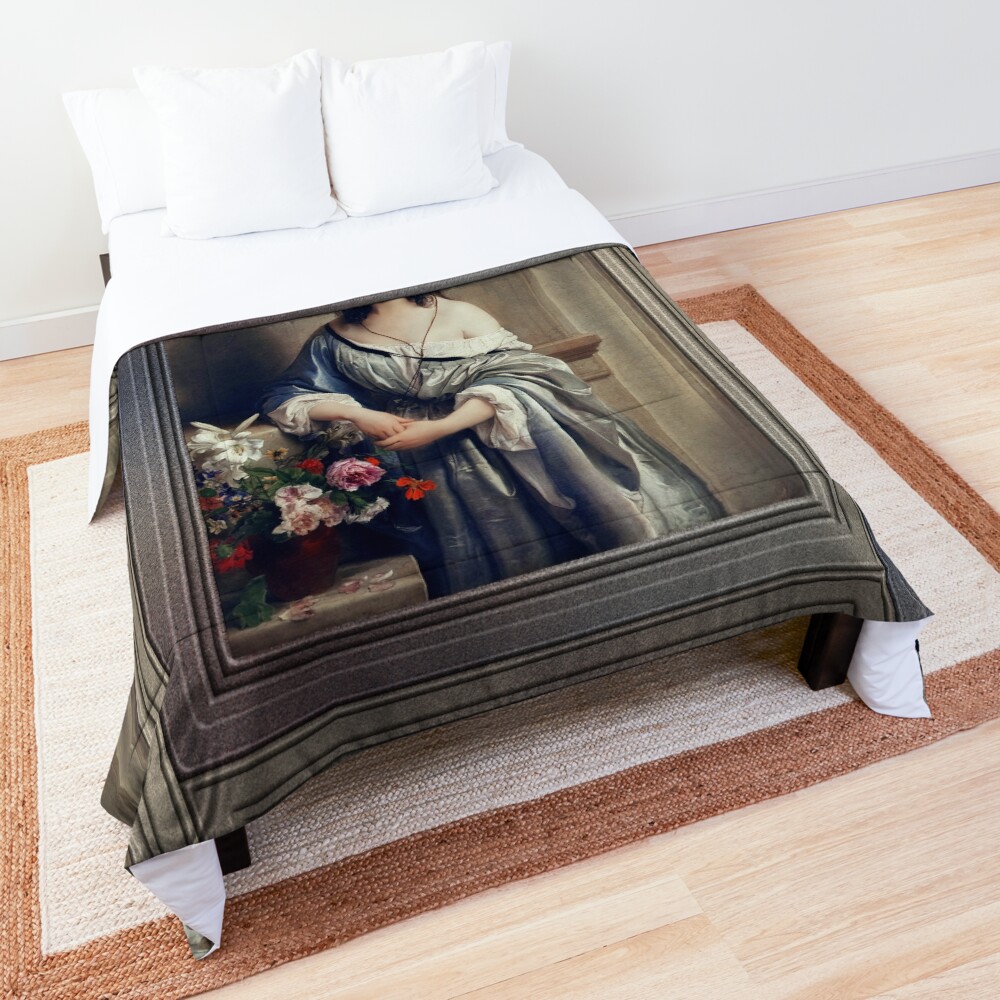
Melancholy c1841-42 by Italian Painter Francesco Hayez (1791 – 1882); who was viewed as the leading painter of the Romanticism Period in the mid 19th Century in Milan Italy. Era conegut per les seves grans pintures històriques, al·legories polítiques i retrats excepcionals.
Francesco Hayez, a prominent Italian painter of the Romantic period, captured the emotive power of human expression and drama in his renowned work “Melancholy”. This poignant portrait, created around 1841-42, epitomizes the Romantic ideals of intense emotional depth, ric simbolisme, and the exploration of human inner turmoil. The painting features a young woman in a reflective pose, her body angled slightly away from the viewer, yet her gaze directly engages with the observer. Her expression is one of deep contemplation and melancholy, a theme that resonates throughout much of Hayez’s oeuvre.

The primary subject of the artwork is a woman dressed in a luxurious yet simple gown of muted silvery-blue fabric. Her attire is both modest and elegant, indicative of her high social standing but also suggesting a restrained, subdued personality.
The material of her gown is rendered with Hayez’s signature meticulous brushwork, which gives the fabric a soft, almost translucent quality. It reflects light in such a way that one can almost feel its weight and texture. The delicacy of the gown contrasts with the weight of her expression, reinforcing the thematic tension of the painting.
The subject’s hair, dark and glossy, falls in loose waves around her shoulders, framing her face. Her posture is demure yet sorrowful, her hand gently resting on a vase of flowers placed on a table to her side. The inclusion of flowers—likely meant to symbolize transience and the fragility of life—adds a layer of complexity to the emotional narrative.
The flowers themselves are rendered with meticulous detail, a hallmark of Hayez’s technical prowess. They appear lifelike, as if they could be plucked from the canvas at any moment. This detailed rendering contrasts sharply with the somber tone of the subject, creating a sense of fragility in both the floral elements and the human form.
Darrere del tema, the setting is an interior space, subtly lit to evoke a sense of isolation and introspection. The light seems to enter from an unseen source, casting soft shadows that envelop the subject, further intensifying the feeling of seclusion. The muted colors of the background, which include soft earth tones and shades of gray, highlight the figure of the woman, making her the focal point of the composition.
The architectural features of the room, particularly the classical columns that frame the space, suggest a timeless quality. This classical influence also evokes a sense of the past and the passage of time, which ties in with the theme of melancholy.
L'estat d'ànim de “Melancholy” is one of introspective sadness. The woman’s expression is not one of overt grief or despair but rather a quiet, contemplative sorrow. La seva mirada, though distant, suggests a mind lost in thought—perhaps reflecting on personal loss, unfulfilled desires, or an existential longing. Hayez was deeply interested in the psychological states of his subjects, and this painting showcases his ability to capture the complexity of emotion through subtle facial expressions and body language.
While the subject’s melancholy could be interpreted in various ways, it is important to consider the broader cultural and historical context of the painting. Created during the early 1840s, the work was produced at a time of political and social unrest in Italy.
The Romantic movement, with its emphasis on emotion, individualisme, and rebellion against societal norms, had a profound impact on the intellectual climate of the time. Hayez’s “Melancholy” could be seen as a reflection of the inner turmoil experienced by many individuals living through the tensions of political upheaval, as well as the personal, emotional struggles that often accompanied such periods of uncertainty.
The symbolism within the painting also speaks to broader themes of romanticism. The wistful nature of the subject, combined with the classical elements of the room and the natural motifs of the flowers, suggests an idealization of the past and an awareness of life’s fleeting nature. The woman’s contemplative pose and the stillness of the surrounding environment suggest an acceptance of these fleeting moments, evoking a sense of resignation that is characteristic of many Romantic works.
Hayez’s use of light and shadow in this painting further enhances the emotional tone. The light that falls gently across the woman’s face and gown creates a sense of intimacy, almost as if we are intruding on a private moment. No obstant això, the shadows that play across her figure suggest something darker—perhaps an unspoken sadness or the weight of an unvoiced emotion. This interplay of light and shadow is a powerful tool in conveying the internal conflict of the subject, highlighting the emotional depth and complexity that Hayez was able to achieve in this piece.
Pel que fa a l'estil, “Melancholy” is quintessentially Romantic in its focus on emotion and individual experience. Hayez’s technical mastery is evident in his handling of texture and light, and his ability to convey psychological depth through subtle details is what makes this painting a standout example of Romantic portraiture. The realism with which he renders his subject, coupled with the idealization of the woman’s form, reflects the Romantic ideal of the artist as a master of both technique and emotional expression.
En definitiva, “Melancholy” is a masterpiece of emotional and psychological depth. Through the figure of the young woman, Hayez explores themes of introspection, pèrdua, and the complexity of human emotion. His masterful use of light, color, and composition creates a timeless portrait that continues to resonate with viewers, evoking feelings of empathy and contemplation. The painting remains one of the most iconic representations of Romantic portraiture and exemplifies Francesco Hayez’s ability to capture the profound emotional states of his subjects.
Informació a continuació de Wikipedia.org
Francesco Hayez era d'una família relativament pobra de Venècia. El seu pare, Giovanni, era d'origen francès mentre la seva mare, Chiara Torcella, era de Murano. Francesco era el petit de cinc fills.
Va ser criat per la germana de la seva mare, que s'havia casat amb Giovanni Binasco, un armador acomodat i col·leccionista d'art. Hayez va mostrar una predisposició per dibuixar des de la infància. El seu oncle, havent notat el seu talent precoç, el va fer aprenent d'un restaurador d'art a Venècia. Més tard, Hayez esdevindrà alumne del pintor Francesco Maggiotto amb qui va continuar els seus estudis durant tres anys..
Va ser admès al curs de pintura de la Nova Acadèmia de Belles Arts de Venècia 1806, on va estudiar amb Teodoro Matteini. En 1809 va guanyar un concurs de l'Acadèmia de Venècia per a una residència d'un any a l'Accademia di San Luca de Roma.
Va romandre a Roma fins a 1814, després es va traslladar a Nàpols, on va rebre l'encàrrec de Joachim Murat de pintar una obra important que representés Ulisses a la cort d'Alcino.. A mitjan dècada de 1830 va assistir al Saló Maffei de Milà, a càrrec de Clara Maffei. El marit de Maffei més tard encarregaria a Hayez un retrat de la seva dona. En 1850 Hayez va ser nomenat director de l'Acadèmia Brera.
Al llarg d’una llarga carrera, Hayez va demostrar ser particularment prolífic. La seva producció va incloure pintures històriques dissenyades per atreure la sensibilitat patriòtica dels seus patrons, així com obres que reflecteixen el desig d’acompanyar un estil neoclàssic als grans temes., ja sigui de literatura bíblica o clàssica.
També va pintar escenes de presentacions teatrals. Consistentment absent de la seva obra, malgrat això, són retaules – possiblement a causa de les invasions napoleòniques que van desconsacrar moltes esglésies i convents al nord d’Itàlia. L'historiador de l'art Corrado Ricci va descriure Hayez com un classicista que després va evolucionar cap a un estil de tumult emocional. Francesco Hayez, El Petó (1859)
Els seus retrats tenen la intensitat d'Ingres i del moviment natzarè. Sovint assegut, Els súbdits de Hayez solen vestir-se d'austeritat, roba en blanc i negre, amb poc o cap equipament. Mentre que Hayez feia retrats per a la noblesa, també va explorar altres temes com els companys artistes i músics. Al final de la seva carrera, se sap que va treballar amb fotografies.
Un dels temes preferits de Hayez era l’dalisca semi vestit que evocava temes orientals, un tema preferit dels pintors romàntics.[3] Les representacions d’harems i les seves dones permetien als artistes la possibilitat de pintar escenes que d’altra manera no eren acceptables a la societat. Fins i tot la Maria Magdalena de Hayez té més sensualitat que fervor religiós.
La pintura de Hayez El petó va ser considerada una de les seves millors obres pels seus contemporanis, i és possiblement el seu esforç més conegut. L’anònim, el gest de la parella no afectat no requereix coneixement del mite ni de la literatura per interpretar, i apel·la a una mirada moderna.
Una avaluació científica de la carrera de Hayez s’ha complicat pel seu proclivisme per no signar ni datar les seves obres. Sovint les dates de les seves pintures indiquen quan es va adquirir o vendre l'obra, no el moment de la seva creació. A més, sovint pintava les mateixes composicions diverses vegades amb variacions mínimes, si n’hi havia cap.
Entre els seus alumnes de l'Acadèmia Brera hi havia Carlo Belgioioso, Amanzio Cattaneo, Alessandro Focosi, Giovanni Battista Lamperti, Ovelles Livo, Angelo Pietrasanta, Antonio Silo, Carlo Antonio Tavella, Ismaele Teglio Milla i Francesco Valaperta.
Hayez va morir a Milà, edat 91. El seu estudi a l'Acadèmia Brera està marcat amb un plat.
Aquesta creació d'art digital, com amb totes les obres d'art que es poden trobar al lloc web de Xzendor7, es poden comprar en línia en una varietat de formats de material, incloses impressions de llenç, impressions acríliques, estampes de metall, estampes de fusta, impressions emmarcades, cartells, i com impressions de lona enrotllada en una varietat de mides des de 12 polzades a 72 polzades depenent de la mida de l'obra d'art real i de la botiga d'impressió sota demanda on trieu comprar l'art.