

Ripplin Rythm
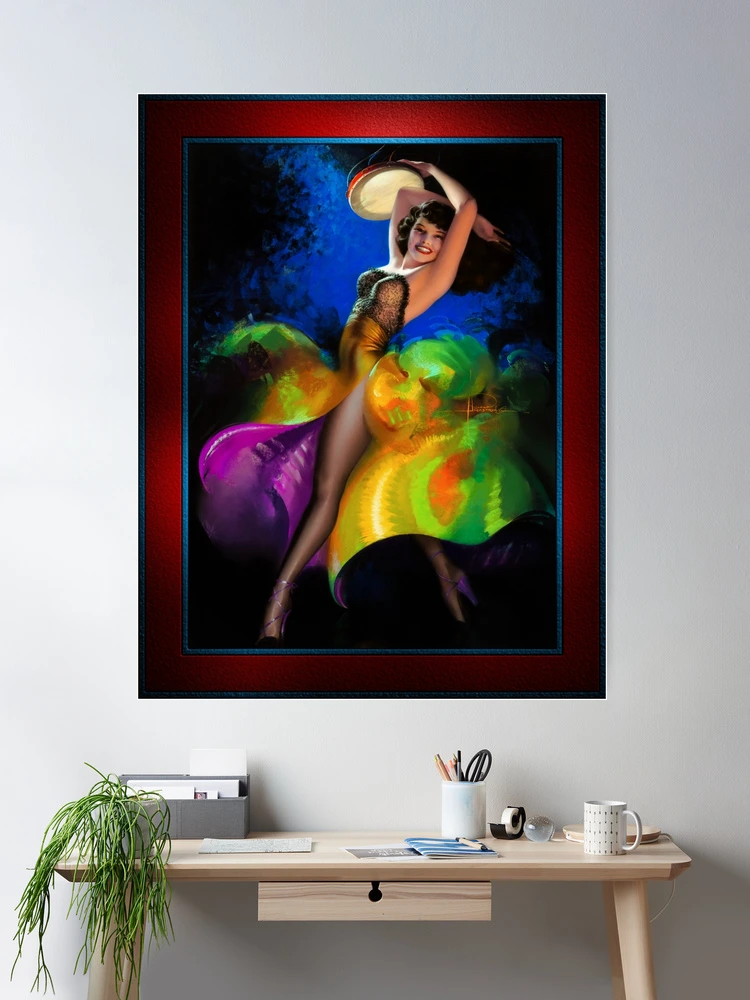
“Ripplin Rhythm,” created by the renowned American artist Rolf Armstrong (1889 – 1960), stands as a testament to the vibrant beauty of pin-up art during the mid-20th century. Armstrong, a prominent figure in the golden era of American commercial art, expertly merges movement, color, and emotion within this piece, offering a glimpse into the glamour and sensuality that defined the era.
Nascut a 1889, Armstrong’s work was marked by a mastery of light and color, making his images highly sought after in advertisements, illustrations, and fine art. He utilized a unique blend of techniques that brought dynamism to his subjects, i “Ripplin Rhythm” encapsulates this with its fluid and energetic portrayal of a woman in motion.
Taula de continguts
Tema principal: The Vibrant Dancer
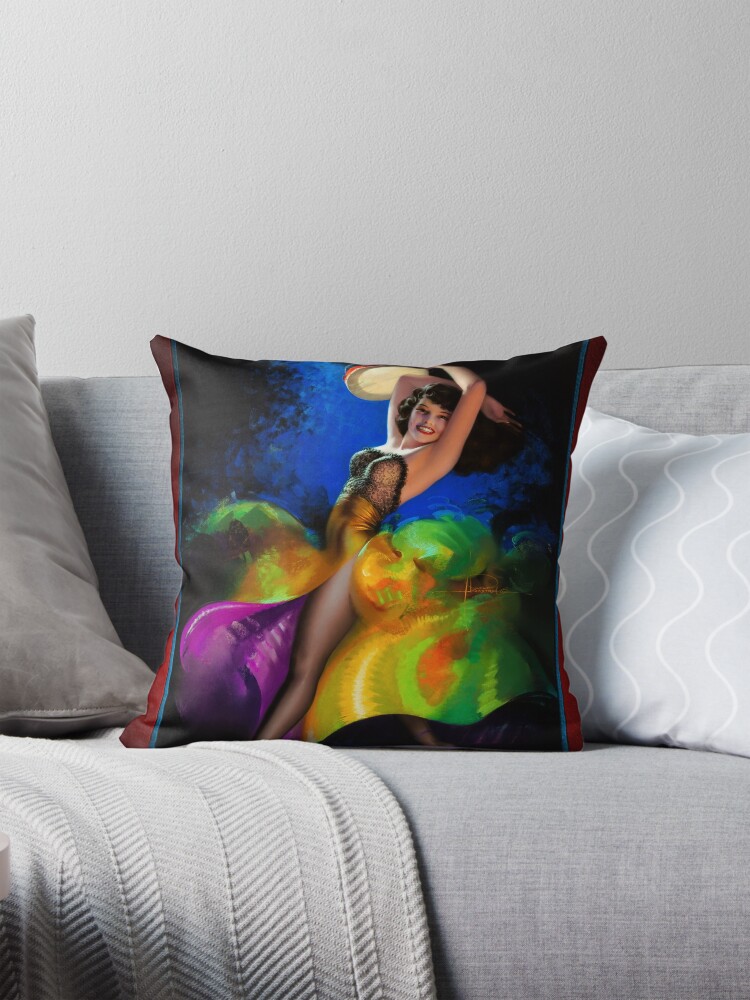
Al cor de “Ripplin Rhythm” is a captivating depiction of a dancer in mid-performance. El tema, a woman, exudes confidence and joy as she spins gracefully, her flowing dress rippling around her body like the waves of an ocean. The dancer’s attire is a burst of color, with swirling shades of green, groc, and purple creating a striking contrast against the deep blue background.
The woman’s posture is elegant yet exuberant, her arms raised in a celebratory gesture as she holds a tambourine above her head. Her face radiates happiness, a wide smile revealing her playful spirit. Armstrong has captured not only her motion but also her essence, making her appear as though she is alive with energy and rhythm.
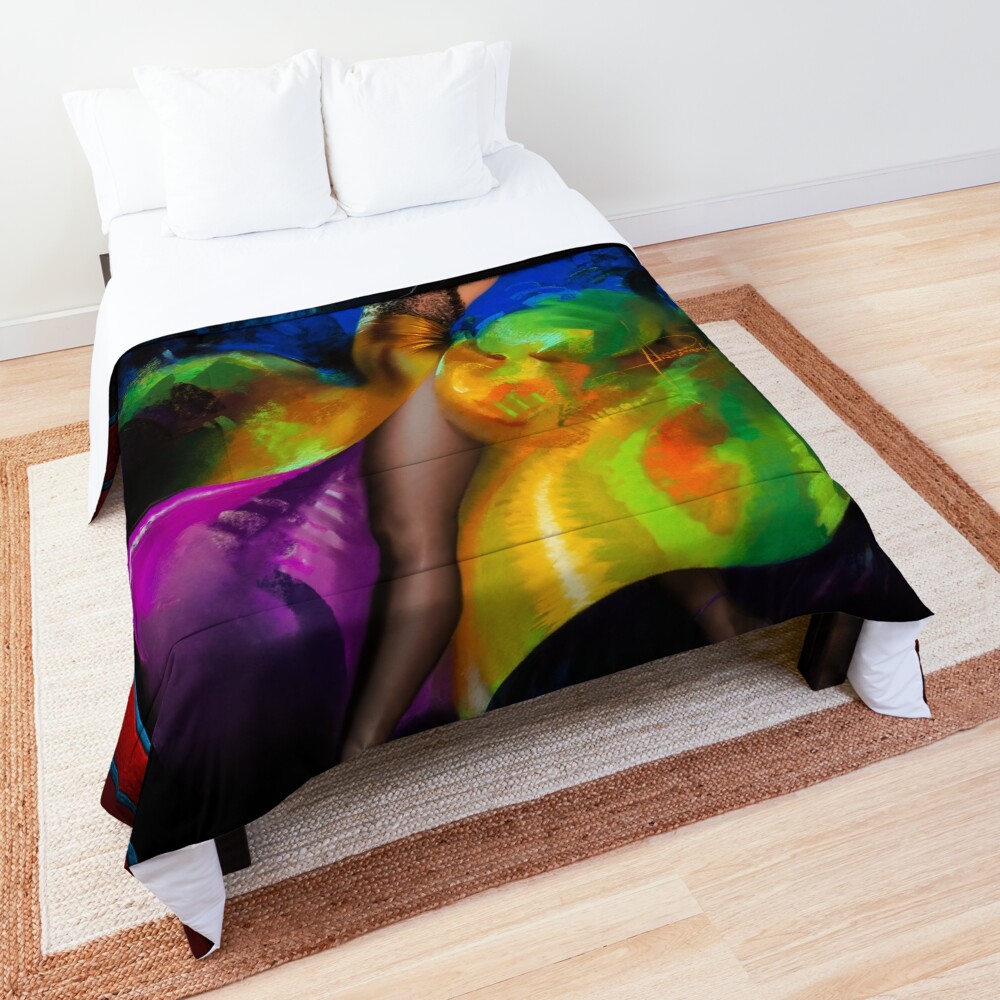
The woman’s vibrant costume, designed to reflect the rhythm of her movements, is a fusion of bold colors. The soft metallic sheen of her golden bodice catches the light, enhancing the dynamic flow of her skirt. Armstrong’s use of color in this piece is masterful, with each hue seemingly chosen to emphasize the woman’s graceful spinning and the lively atmosphere of her performance. The skirt, which flares out around her like an explosive flower, ripples with energy, suggesting the dancer’s movement and the pulse of the music she is engaged with.
The Objects: Tambourine and Flowing Garments
The tambourine held by the dancer is a key object in the painting, not only because it symbolizes the musical rhythm she embodies but also because it ties the composition together. The tambourine’s small yet intricate form contrasts the large, swirling mass of the dancer’s gown, yet it maintains a presence that complements the overall movement within the scene.
The circular shape of the tambourine subtly mirrors the curves and flow of her garments, creating a visual harmony between the two. This object, while seemingly simple, amplifies the sense of rhythm and dance in the composition.
The cascading layers of the dancer’s gown are another vital aspect of the work. Armstrong’s skillful handling of fabric and texture brings the dress to life, with each fold and curve appearing as if it is caught mid-movement. El vestit, with its vibrant, rippling folds, seems to echo the fluidity of the dancer’s form. The luxurious colors and glossy textures of the skirt create a feeling of both elegance and freedom, enhancing the theme of lively celebration.
Terreny: The Colorful Background
El fons de “Ripplin Rhythm” is one of the key elements that contribute to the piece’s overall mood. A deep blue hue forms the backdrop, providing a striking contrast to the warm colors of the dancer’s attire. This color choice highlights the subject and makes her appear as if she is emerging from a dreamlike or fantastical environment.
Armstrong uses the swirling shapes and dark tones in the background to evoke movement and rhythm, as if the air itself is alive with the same energy that drives the dancer. The fluidity of the colors in the background suggests motion, blending with the dancer’s own movements, creating a seamless connection between subject and environment.
Estil: Art Deco and Glamour
“Ripplin Rhythm” is a quintessential example of Armstrong’s signature style, which draws heavily from Art Deco influences. The streamlined elegance of the figure, the dynamic compositions, and the use of bold, contrasting colors all reflect the Art Deco movement, which was characterized by its celebration of modernity, luxe, i glamour.
El suau, graceful lines of the dancer’s body and the geometric shapes within the composition convey a sense of sophistication and energy that are central to the Art Deco aesthetic. Al mateix temps, the work also embodies the exuberance and glamour of the pin-up style, which Armstrong helped define. His portrayal of women was not only sensual but celebratory, i “Ripplin Rhythm” is a perfect example of this, as it captures a moment of joyous self-expression.
The dancer’s radiant smile and energetic pose speak to the optimistic and carefree mood of the era. Armstrong’s work is imbued with a sense of youthful vitality, and this painting exemplifies the vibrant energy of American culture during the 1940s. It reflects a time of confidence and joy, set against the backdrop of a world on the cusp of dramatic change.
Tema i estat d’ànim: Celebration of Movement and Music
El tema de “Ripplin Rhythm” is centered around the celebration of movement, música, i feminitat. Armstrong captures the essence of dance as an expression of joy and liberation, highlighting the dynamism and beauty of the human form in motion.
The artist has skillfully conveyed the idea that rhythm is not just a sound but a force that can be seen and felt in the movements of the body. The dancer’s bright smile and the lively swirl of her dress communicate a sense of freedom, playfulness, and enthusiasm, making the painting feel like an invitation to partake in the celebration.
The overall mood of the artwork is one of joy and excitement. Armstrong’s use of color and form conveys a sense of lightness and exuberance, and the dancer herself appears to be in the midst of a joyous performance, lost in the music and her own movement. The piece encapsulates a spirit of happiness, optimisme, and youthful vitality, evoking a time when life seemed to be filled with endless possibilities.
Conclusió
“Ripplin Rhythm” by Rolf Armstrong is more than just a beautiful portrait of a woman in motion; it is a vibrant celebration of life, color, and music. The dynamic composition, bold use of color, and joyful expression of the dancer all contribute to a sense of energy and rhythm that makes the painting come alive. Armstrong’s mastery of movement and his ability to capture the spirit of an era make this work a timeless example of American art. Through the use of elegant forms, flowing garments, and vibrant hues, Armstrong successfully conveys the joy of dance, the celebration of femininity, and the power of music to inspire movement and expression.
The Enchantress és una reproducció d'art retocada de vells mestres d'una imatge de domini públic.
Artista Bio de Wikipedia.org
Rolf Armstrong va néixer John Scott Armstrong a Bay City, Michigan l’abril 21, 1889, a Richard i Harriet (Scott) Armstrong. El seu pare era propietari de la Boy-Line Fire Boat Company, que incloïa una línia de vaixells de passatgers. Alguns es van desplegar a Chicago per utilitzar-los a la Fira Mundial de Chicago, allà 1893.
malgrat això, els negocis i la família del pare tenien problemes, i la propietat familiar es va perdre a causa de l'execució hipotecària. En 1899, la família es va traslladar a Detroit, Michigan. El pare de Rolf va morir a 1903, i un any després, ell i la seva mare es van traslladar a Seattle, Washington, seguint els passos del seu germà gran, Guillem, que s’hi havia mudat un any abans. A hores d’ara, els interessos artístics de Rolf emergien a més d’un plaer a temps parcial.
Es va traslladar a Chicago a 1908, on posteriorment va estudiar a l'Institut d'Art. Després va anar a Nova York, on va estudiar amb Robert Henri. Després d 'un viatge a París a París 1919 per estudiar a l'Académie Julian, va tornar a Nova York i va establir un estudi. En 1921 he went to Minneapolis to study calendar production at Brown & Bigelow.
Durant els anys 1920 i 1930, la seva obra va aparèixer en moltes partitures, així com a les portades de moltes revistes, més famós per a revistes de fans de cinema com Photoplay i Screenland. La seva obra està formada majoritàriament per dones; Mary Pickford, Beu Daniels, i Greta Garbo són només alguns dels nombrosos que va pintar.
Armstrong’s work for the Pictorial Review was largely responsible for that magazine achieving a circulation of more than two million by 1926. Un any després, va ser l'artista de calendari més venut a Brown & Bigelow. En 1930, RCA el va contractar per pintar pin-ups per anunciar els seus productes, i dins 1933 el Thomas D. Murphy Calendar Company el va signar per produir una sèrie de pintures per a la seva línia.
In March 1940, Jewel Flowers, a girl from Lumberton, North Carolina, sent a picture of herself to Armstrong in response to an advert he had placed in the New York Times. Armstrong, 50 at the time, had been based at the Hotel des Artistes on West 67th Street in Manhattan since 1939, and was looking for new models.
He invited Flowers for an interview. On March 25, 1940, Flowers started modeling for Armstrong. Their professional collaboration and friendship lasted for two decades. El primer quadre, titulat “Com estic??”, segons es diu, perquè Flowers, poc acostumat a modelar, -va preguntar repetidament a Armstrong “Com estic??” durant la sessió de modelatge, es va publicar per primera vegada després de començar la Segona Guerra Mundial.
Era Brown & El calendari més venut de Bigelow per a 1942 en un moment en què la companyia venia milions de calendaris a Amèrica, i es va convertir en una de les imatges d’Armstrong més reproduïdes. Flowers va ser popular entre els militars nord-americans durant la Segona Guerra Mundial, alguns dels quals li van enviar cartes proposant-li matrimoni. Els calendaris i les siluetes de Flors d’Armstrong es van copiar a bombarders i altres avions com a art nasal i es van pintar sobre torretes de tancs.
Es va fer tan coneguda durant la guerra, encara que més com una cara famosa que per nom, que la carta d’un militar s’adreçava simplement com “Jewel Flowers, Nova York” s'ha lliurat correctament. Per a molts militars nord-americans a l'estranger, va representar el “Per què lluitem?” esperit. nosaltres. El president Franklin D.. El govern de Roosevelt la va contractar per ajudar a promoure els bons de guerra.
El gener 1, 1945 edition of TIME magazine included Armstrong’s “Toast of the Town” painting of Flowers in an article about Calendar Art. The article noted that calendars with “girl paintings” were “bought heavily by foundries, machine shops, auto-supply dealers.”
Flowers married in 1946. She and her husband lived in several places while he tried a number of business ventures, including Laguna Beach, California, Greenville, South Carolina, Reno, Nevada, where she reportedly worked in as a card dealer for a time, and New York City. According to Michael Wooldridge, coauthor of Pin up Dreams: The Glamour Art of Rolf Armstrong, Armstrong called her a number of times during the period she was following her husband from place to place, to try to persuade her to return to New York and model for him.
Her modeling career ended with Armstrong’s death in 1960. He left a large proportion of his personal wealth to Flowers. In total, Armstrong created around fifty to sixty works using Flowers as the model.
Rolf Armstrong va morir a 1960 a l'illa d'Oahu, Hawaii as one of the best “pin-up” artistes de la primera meitat del segle XX.