

Melancholy
Melancholy c1841-42 by Italian Painter Francesco Hayez (1791 – 1882); who was viewed as the leading painter of the Romanticism Period in the mid 19th Century in Milan Italy. Era ben cunnisciutu per i so grandi pitture storichi, allegorie politiche e ritratti eccezionali.
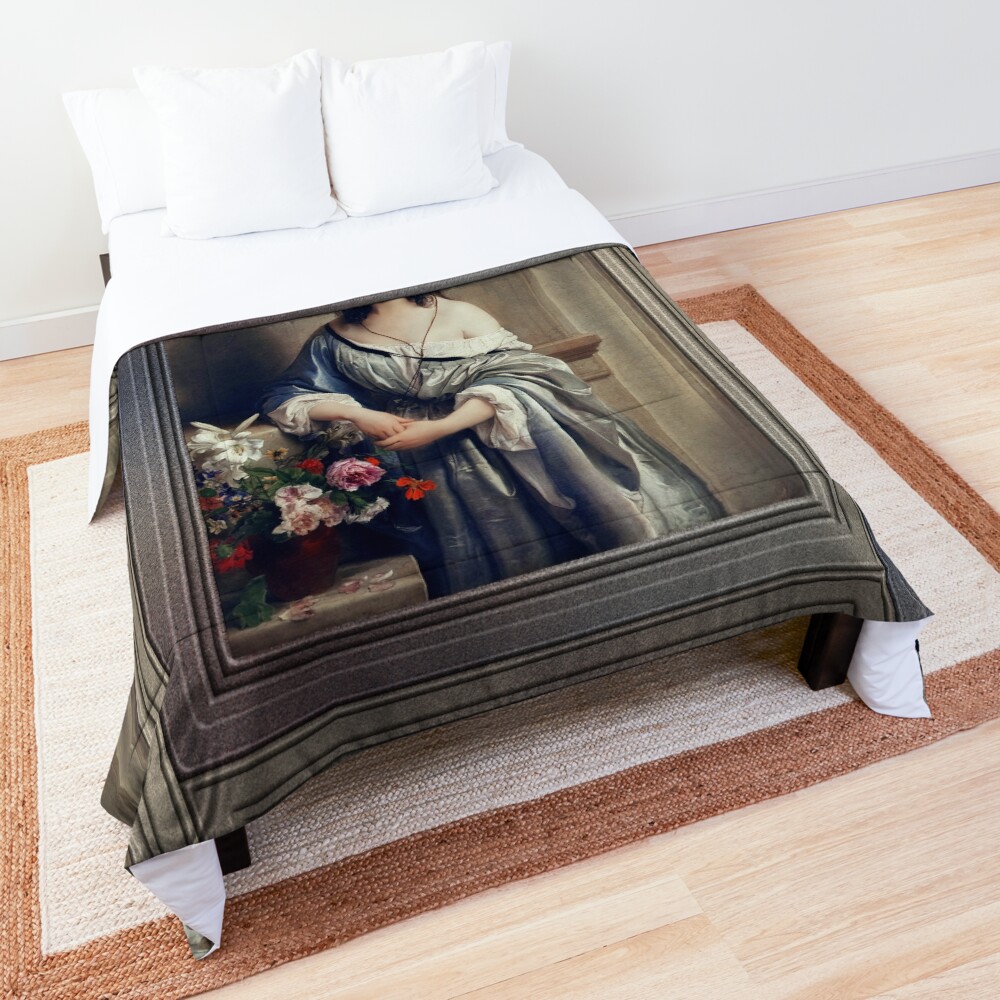
Francesco Hayez, a prominent Italian painter of the Romantic period, captured the emotive power of human expression and drama in his renowned work “Melancholy”. This poignant portrait, created around 1841-42, epitomizes the Romantic ideals of intense emotional depth, rich symbolism, and the exploration of human inner turmoil. The painting features a young woman in a reflective pose, her body angled slightly away from the viewer, yet her gaze directly engages with the observer. Her expression is one of deep contemplation and melancholy, a theme that resonates throughout much of Hayez’s oeuvre.

The primary subject of the artwork is a woman dressed in a luxurious yet simple gown of muted silvery-blue fabric. Her attire is both modest and elegant, indicative of her high social standing but also suggesting a restrained, subdued personality.
The material of her gown is rendered with Hayez’s signature meticulous brushwork, which gives the fabric a soft, almost translucent quality. It reflects light in such a way that one can almost feel its weight and texture. The delicacy of the gown contrasts with the weight of her expression, reinforcing the thematic tension of the painting.
The subject’s hair, dark and glossy, falls in loose waves around her shoulders, inquadra a so faccia. Her posture is demure yet sorrowful, her hand gently resting on a vase of flowers placed on a table to her side. The inclusion of flowers—likely meant to symbolize transience and the fragility of life—adds a layer of complexity to the emotional narrative.
The flowers themselves are rendered with meticulous detail, a hallmark of Hayez’s technical prowess. They appear lifelike, as if they could be plucked from the canvas at any moment. This detailed rendering contrasts sharply with the somber tone of the subject, creating a sense of fragility in both the floral elements and the human form.
Daretu à u sughjettu, the setting is an interior space, subtly lit to evoke a sense of isolation and introspection. The light seems to enter from an unseen source, casting soft shadows that envelop the subject, further intensifying the feeling of seclusion. The muted colors of the background, which include soft earth tones and shades of gray, highlight the figure of the woman, making her the focal point of the composition.
The architectural features of the room, particularly the classical columns that frame the space, suggest a timeless quality. This classical influence also evokes a sense of the past and the passage of time, which ties in with the theme of melancholy.
L'umore di “Melancholy” is one of introspective sadness. The woman’s expression is not one of overt grief or despair but rather a quiet, contemplative sorrow. U so sguardu, though distant, suggests a mind lost in thought—perhaps reflecting on personal loss, unfulfilled desires, or an existential longing. Hayez was deeply interested in the psychological states of his subjects, and this painting showcases his ability to capture the complexity of emotion through subtle facial expressions and body language.
While the subject’s melancholy could be interpreted in various ways, it is important to consider the broader cultural and historical context of the painting. Created during the early 1840s, the work was produced at a time of political and social unrest in Italy.
The Romantic movement, with its emphasis on emotion, individualism, and rebellion against societal norms, had a profound impact on the intellectual climate of the time. Hayez’s “Melancholy” could be seen as a reflection of the inner turmoil experienced by many individuals living through the tensions of political upheaval, as well as the personal, emotional struggles that often accompanied such periods of uncertainty.
The symbolism within the painting also speaks to broader themes of romanticism. The wistful nature of the subject, combined with the classical elements of the room and the natural motifs of the flowers, suggests an idealization of the past and an awareness of life’s fleeting nature. The woman’s contemplative pose and the stillness of the surrounding environment suggest an acceptance of these fleeting moments, evoking a sense of resignation that is characteristic of many Romantic works.
Hayez’s use of light and shadow in this painting further enhances the emotional tone. The light that falls gently across the woman’s face and gown creates a sense of intimacy, almost as if we are intruding on a private moment. Eppuru, the shadows that play across her figure suggest something darker—perhaps an unspoken sadness or the weight of an unvoiced emotion. This interplay of light and shadow is a powerful tool in conveying the internal conflict of the subject, highlighting the emotional depth and complexity that Hayez was able to achieve in this piece.
In termini di stile, “Melancholy” is quintessentially Romantic in its focus on emotion and individual experience. Hayez’s technical mastery is evident in his handling of texture and light, and his ability to convey psychological depth through subtle details is what makes this painting a standout example of Romantic portraiture. The realism with which he renders his subject, coupled with the idealization of the woman’s form, reflects the Romantic ideal of the artist as a master of both technique and emotional expression.
In fine, “Melancholy” is a masterpiece of emotional and psychological depth. Through the figure of the young woman, Hayez explores themes of introspection, loss, and the complexity of human emotion. His masterful use of light, culore, and composition creates a timeless portrait that continues to resonate with viewers, evoking feelings of empathy and contemplation. The painting remains one of the most iconic representations of Romantic portraiture and exemplifies Francesco Hayez’s ability to capture the profound emotional states of his subjects.
Info sottu Da Wikipedia.org
Francesco Hayez era di una famiglia relativamente povera di Venezia. U so babbu, Giovanni, era di origine francese mentre a so mamma, Chiara Torcella, era di Muranu. Francescu era u più chjucu di cinque figlioli.
Hè statu criatu da a surella di a so mamma, qui avait épousé Giovanni Binasco, un armatore benestante è un cullezzione d'arte. Hayez hà mostratu una predisposizione per u disegnu da a zitiddina. U so ziu, avendu nutatu u so talentu precoce, L'apprentice à un restauratore d'arte in Venezia. Hayez devint plus tard l'élève du peintre Francesco Maggiotto avec lequel il poursuivit ses études pendant trois ans..
Hè ammissu à u cursu di pittura di a Nova Accademia di Belle Arti di Venezia in 1806, induve hà studiatu cù Teodoru Matteini. In 1809 il a gagné un concours de l'Académie de Venise pour une résidence d'un an à l'Accademia di San Luca à Rome.
Firmò in Roma finu à 1814, puis s'installe à Naples où il fut chargé par Joachim Murat de peindre une œuvre majeure représentant Ulisse à la cour d'Alcinous.. À a mità di l'anni 1830 hà assistitu à u Salone Maffei in Milanu, ospitata da Clara Maffei. U maritu di Maffei hà cumandatu dopu à Hayez un ritrattu di a so moglia. In 1850 Hayez hè statu numinatu direttore di l'Accademia di Brera.
In u cursu di una longa carriera, Hayez hà pruvatu à esse particularmente prolificu. A so pruduzzione includeva pitture storichi pensate per appellu à a sensibilità patriottica di i so patroni, è ancu opere chì riflettenu u desideriu di accumpagnà un stile neoclassicu à grandi temi., sia da letteratura biblica sia classica.
Hà pittatu ancu scene da presentazioni teatrali. Évidemment absent de son œuvre, però, sò retabuli – forsi per via di l'invasioni napuleoniche chì deconsacrà parechje chjese è cunventi in l'Italia di u Nordu. U storicu di l'arte Corrado Ricci hà descrittu Hayez cum'è un classicista chì poi evoluzione in un stile di tumultu emotivo. Francesco Hayez, U baciu (1859)
I so ritratti anu l'intensità di Ingres è di u muvimentu Nazarenu. Spessu à pusà, I sughjetti di Hayez sò spessu vestiti in austeru, vestiti bianchi è neri, cù pocu o micca accoutrements. Mentre Hayez facia ritratti per a nubiltà, hà ancu esploratu altri sugetti cum'è altri artisti è musicisti. Tardi in a so carriera, hè cunnisciutu per avè travagliatu cù e fotografie.
Unu di i temi prediletti di Hayez era l'Odalisca semi-vestita evocativa di temi orientali - un tema predilettu di i pittori romantichi.[3] E raffigurazioni di harem è di e so donne permettenu à l'artisti a capacità di pitture scene altrimenti micca accettabili in a sucità.. Ancu Maria Maddalena di Hayez hà più sensualità cà fervore religiosu.
A pittura di Hayez U Baciu hè stata cunsiderata trà u so megliu travagliu da i so cuntimpuranii, è hè forsi u so sforzu più cunnisciutu. L'anonimatu, u gestu micca affettatu di a coppia ùn hà micca bisognu di cunniscenza di u mitu o di a literatura per interpretà, è appellu à un sguardu mudernu.
Una valutazione scientifica di a carriera di Hayez hè stata cumplicata da a so propensione per ùn firmà o datate e so opere.. Spessu e date in i so pittura indicanu quandu l'opera hè stata acquistata o venduta, micca u tempu di a so creazione. In più, hà spessu pittatu e listessi cumpusizioni parechje volte cù variazioni minima s'ellu ci hè.
Parmi ses élèves de l'Académie de Brera figuraient Carlo Belgioioso, Amanzio Cattaneo, Alessandru Focosi, Giovanni Battista Lamperti, Livo Pecora, Angelu Pietrasanta, Antonio Shiloh, Carlo Antonio Tavella, Ismaele Teglio Milla et Francesco Valaperta.
Hayez hè mortu in Milanu, età 91. U so studiu à l'Academia di Brera hè marcatu cù un piattu.
Questa creazione d'arte digitale, cum'è cù tutte l'opere d'arte chì ponu esse truvate nantu à u situ web di Xzendor7 hè dispunibule per cumprà in linea in una varietà di formati di materiale cumprese stampe di tela., stampe acriliche, stampe metalliche, stampe di lignu, stampe in cornice, manifesti, è cum'è stampe su tela arrotolata in una varietà di dimensioni da 12 centimetri à 72 centimetri secondu a dimensione di l'opera d'arte attuale è a stampa nantu à a tenda chì sceglite di cumprà l'arte da.