

Peonies In A Vase
Peonies In A Vase by Austrian Painter Hans Zatzka (1859 – 1945); also known as P. Ronsard, Pierre de Ronsard, o H. Zabateri and he signed many of his works as Joseph Bernard, J. Bernard, or Bernard Zatzka to avoid the penalties of braking contracts that limited how many works he could sell.
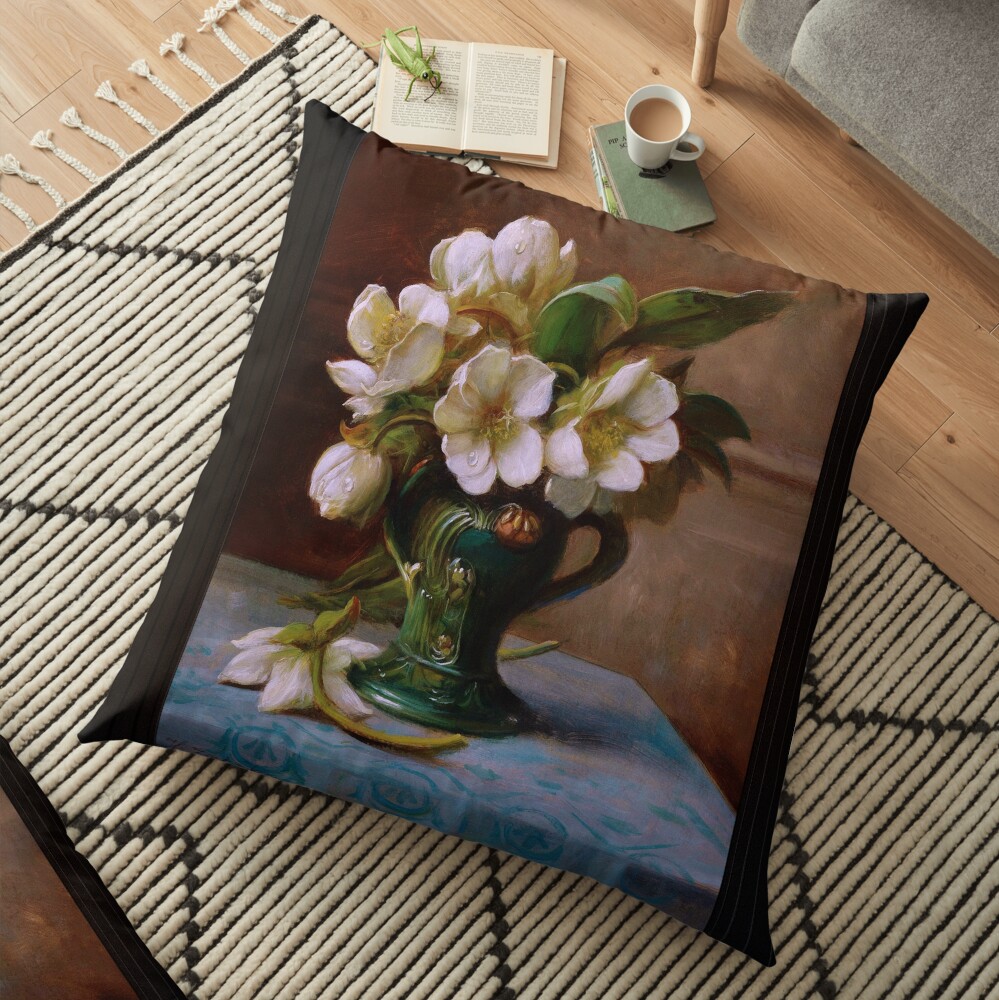
This is a simple and beautiful still life painting of white Tree Peonies (which are a woody Perennial Shrub that bloom in early spring); that have been places in a glazed ceramic emerald green and cobalt blue vase with a handle.
The vase has a floral relief along its wide base and across half of the body of the vase with a wonder orange plant bulb that provides a nice colorful accent.
The peonies for the most part, are in full bloom and appear to have been freshly cut and watered; as we can see large water droplets on some of the flowers.
The flowers are also accompanied with there large green leaves of which there are a few behind the vase, along with a part of a peony that is in front to the left side with its stem attached.
The vase is sitting on a table with a pattern table cloth on it; with the table being placed up against a textured brown wall; with light streaming in from the left at a high angle, illuminate the vase of flowers
Questa hè una ripruduzzione di l'antichi maestri d'arte digitale rimasterizzata di una maghjina di duminiu publicu chì hè dispunibule cum'è a canvas rolled art print in linea.

Info sottu Derivatu da Wikipedia.org
Hans Zatzka era qualchì volta cunnisciutu cum'è P. Ronsard, Pierre de Ronsard, o H. Batteria, è hà firmatu assai di e so opere cum'è Joseph Bernard, J. Bernard, o Bernard Zatzka.
U scopu di a vasta gamma di pseudonimi di Zatzka era di evità penalità di rupture di cuntratti chì limitavanu a quantità di opere d'arte chì puderia vende..
This has caused some art databases to conflate Zatzka’s work under the pseudonym Joseph Bernard with the French sculptor with the same name.
Hans Zatzka hè natu 8 Marzu 1859 in Viena. U so babbu Bartholomaüs era un travagliadore di custruzzione, è a so mamma era Marie Karpischek Zatzka.
Trà 1877 è 1882, studiò à l'Académie des Beaux-Arts, sottu Christian Griepenkerl, Carl Wurzinger, è Karl von Blaas.
Zatzka hà sappiutu guadagnà a vita attraversu a pruduzzione di affreschi per e chjese è altre istituzioni.
In 1885, Zatzka hè statu incaricatu di creà a fresca di u tettu A Naiade di Baden in Kurhaus Baden.
Many of Zatzka’s works were religious paintings and altar pieces dedicated to various churches in Austria.
Tuttavia, hè più cunnisciutu per i so pitture di donne, fate, e altre scene fantastiche.
Often, he would draw inspiration from the works of Richard Wagner and the fairy tales of the Brothers Grimm.
In the late 19th and early 20th century, several pieces by Zatzka were photographed and made into commercial and collectable postcards.
During the 1920s, Zatzka’s style became the decor of choice throughout Europe. In più, the previous thirty years held a resurgence for Zatzka.