

Millicent Duchess Of Sutherland
John Singer Sargent’s portrait Millicent Duchess of Sutherland, pintado 1904, captures the essence of late 19th and early 20th-century portraiture in its sophisticated portrayal of aristocracy. El artista, born in Italy to American parents, is known for his masterful technique, which is on full display in this oil painting. The portrait features Millicent, Duchess of Sutherland, who was an English aristocrat and socialite of the time.
Millicent Duchess Of Sutherland born Millicent Saint Clair Erskine (1867 – 1955); was the eldest daughter of the fourth Earl of Rosslin and Blanche Fitzroy. Cuando ella era 17 años, she married Cromartie Sutherland Leveson-Gower, who inherited the title of Duke of Sutherland in 1892.
The Duchess is depicted in a moment of poised elegance, embodying both her title and her societal role, which adds layers of intrigue and gravitas to the composition. The painting’s theme and mood suggest a balance between refinement and the underlying strength of character that was expected of such women of high society.
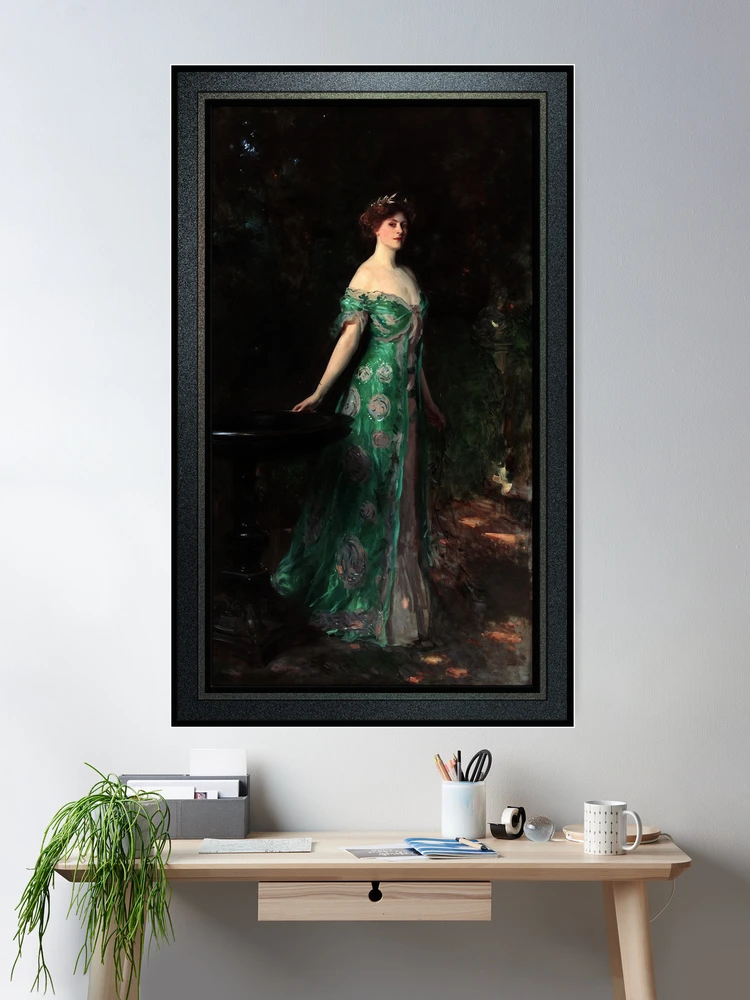
Tabla de contenido
El tema principal: Millicent Duchess of Sutherland
At the heart of this masterpiece is Millicent herself, who stands regal and composed in a commanding yet graceful pose. The Duchess is dressed in a lavish gown that catches the viewer’s eye. The rich green color of her gown complements the darker tones of the background, creating a stark contrast that draws attention to her figure. Her gown is adorned with delicate floral motifs that add a touch of softness to the otherwise formal attire.
The exquisite detailing of the dress reveals Sargent’s mastery in portraying fabric textures, every fold and curve of the gown is rendered with remarkable precision, reflecting both light and shadow in ways that evoke the grandeur of the aristocratic world. Su postura, with one hand resting on a table, gives the impression of quiet confidence, as though she is both part of her surroundings and above them, a fitting representation of her high status.
The Duchess’s face is illuminated with soft, yet confident features, giving her an ethereal quality. Her hair is styled in an elegant updo, topped with a crown of delicate flowers, which subtly underscores her aristocratic position. The face, sin emabargo, is not overly made up, allowing her natural beauty and inner character to shine through.
Her gaze is slightly turned towards the viewer, but it carries an air of contemplation, as though she is reflecting on something far beyond the scope of the immediate surroundings. Sargent’s ability to capture this subtle expression adds an emotional depth to the portrait, making the Duchess more than just an object of admiration but rather a subject worthy of reflection.
La configuración y el fondo
The background of the portrait is a darker, almost abstract composition that contrasts with the finely detailed figure of the Duchess. The deep greens and blacks in the backdrop suggest a garden or outdoor scene, yet the lack of clear definition means the viewer’s attention remains firmly on the subject.
There are subtle hints of foliage and natural elements, perhaps trees or shrubs, that give the impression of an elegant, private space, reinforcing the idea of the Duchess as part of the high society’s cultivated and refined world. The ambiguity of the background helps elevate the figure of Millicent, keeping her at the center of attention and ensuring that her character is the primary focus of the piece.
This blending of the subject with a loosely painted environment allows the viewer to focus on the Duchess’s personality rather than the setting, which serves to emphasize her social status and her connection to nature, perhaps suggesting her high-standing as someone who effortlessly blends with the world around her. The blurred background, por lo tanto, functions not as a mere backdrop, but as a reflection of the Duchess’s connection to both the natural world and the elevated social stratum she occupies.
Materiales y técnica
Sargent’s technique is characterized by his keen observation of light and form, and this portrait is a perfect example of his skill in these areas. The oil paint is applied in rich layers, with soft brushstrokes used for the delicate fabrics of the Duchess’s gown and more defined strokes used for the facial features and crown. The overall effect is one of depth and texture, with the use of light creating a sense of volume and space around the figure. Sargent’s mastery in rendering the fabrics of the dress, particularly the play of light on the smooth, luxurious silk, is a testament to his expertise in capturing the textures of the material world.
The use of color is another vital component of this portrait. The rich green of the gown is juxtaposed with the darker tones of the background, but it is also contrasted with the lighter tones of Millicent’s face and hands, which glow in the light. This strategic use of color not only directs the viewer’s attention but also symbolizes the Duchess’s social position, as if to say that she is the shining jewel in the darker world of aristocracy.
Estilo, Tema, y estado de ánimo
The painting exemplifies the formal portraiture style that was prevalent in Sargent’s era. It carries the hallmarks of high-society portraiture, with its focus on elegance, detalle, and the ability to convey the subject’s personality and social status through pose and setting. The mood is one of serenity and contemplation, yet there is also an underlying strength and dignity in the Duchess’s expression and posture.
Sargent manages to capture the juxtaposition of femininity and authority, allowing the viewer to sense both the external refinement and the inner strength that Millicent must have possessed as a woman of such high social standing.
The theme of aristocracy is explored through the careful balance between the subject’s physical beauty and the symbol of her social position. Sargent has not only painted a woman of high rank but has also captured the essence of her identity, portraying her as both a representative of the British aristocracy and an individual with her own quiet dignity and complexity.
Conclusión
Millicent Duchess of Sutherland is an exemplary piece of portraiture by John Singer Sargent, capturing both the external beauty and the internal strength of a woman who was at once an individual and a symbol of aristocracy. The artist’s brilliant use of light, color, y textura, along with his ability to convey emotion through a subtle expression, makes this portrait a timeless masterpiece.
It stands as a reflection of the social hierarchy of the time, but also as a powerful tribute to the individual personality of the Duchess herself. This portrait encapsulates the grandeur of its subject, while also presenting her in a way that is both intimate and dignified, inviting the viewer to consider not just the surface, but the depths of her identity.
Millicent Duchess Of Sutherland is a retouched digital art old masters reproduction of a public domain image.
Biografía del artista derivada de Wikipedia.org
John Singer Sargent era un artista expatriado estadounidense, considerado el “principal retratista de su generación” por sus evocaciones del lujo de la era eduardiana.
Él creó aproximadamente 900 pinturas al óleo y más de 2,000 acuarelas, así como innumerables bocetos y dibujos al carboncillo.
Su obra documenta viajes por todo el mundo, de Venecia al Tirol, Corfú, el medio Oriente, Montana, Maine, y Florida.
Nacido en Florencia de padres estadounidenses, se formó en París antes de mudarse a Londres, viviendo la mayor parte de su vida en Europa.
In the 1880s he made an early submission to the Paris Salon of his Madame X Portait c1884, que la intención de consolidar su posición como pintor de sociedad en París; pero en cambio la pintura resultó en un escándalo.
El retrato de Madame X fue de una destacada socialité, Madame Pierre Gautreau vestida con un vestido de noche negro con escote pronunciado y tirantes de cadena de diamantes dorados, que le acariciaba la cintura con fuerza. (Follow this link to view the Señora X Portrait.)
Por los tiempos, it suggusted to many Parisians, una pose indiscreta en atuendo revelador y provocó una tormenta de indignación, obligando a Sargent a salir del país.
Al año siguiente, Sargent partió hacia Inglaterra, donde continuó una exitosa carrera como retratista.; y gozó de la aclamación internacional como retratista.
Desde el principio, Sargent’s work wass characterized by remarkable technical facility, particularmente en su habilidad para dibujar con un pincel; que en años posteriores inspiró admiración y crítica por una supuesta superficialidad.
Sus obras encargadas estaban en consonancia con la gran forma de retratar., mientras que sus estudios informales y pinturas de paisajes mostraron una familiaridad con el impresionismo.
Más tarde, Sargent expresó su ambivalencia sobre las restricciones del trabajo de retrato formal., y dedicó gran parte de su energía a la pintura mural y al trabajo en plein air.