

Millicent Duchess Of Sutherland
John Singer Sargent’s portrait Millicent Duchess of Sutherland, peint en 1904, captures the essence of late 19th and early 20th-century portraiture in its sophisticated portrayal of aristocracy. L'artiste, born in Italy to American parents, is known for his masterful technique, which is on full display in this oil painting. The portrait features Millicent, Duchess of Sutherland, who was an English aristocrat and socialite of the time.
Millenium Duchesse De Sutherland né Millicent Saint Clair Erskine (1867 – 1955); était la fille aînée du quatrième comte de Rosslin et Blanche Fitzroy. Quand elle était 17 ans, elle a épousé Cromartie Sutherland Leveson-Gower, qui a hérité du titre de duc de Sutherland en 1892.
The Duchess is depicted in a moment of poised elegance, embodying both her title and her societal role, which adds layers of intrigue and gravitas to the composition. The painting’s theme and mood suggest a balance between refinement and the underlying strength of character that was expected of such women of high society.
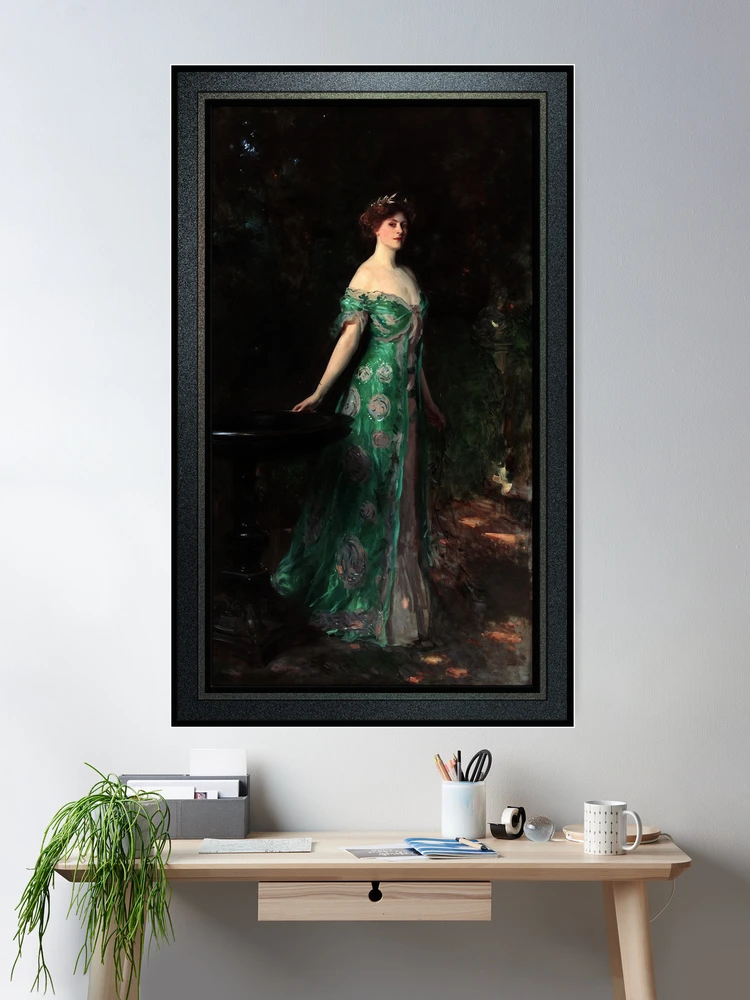
Table des matières
Le sujet principal: Millicent Duchess of Sutherland
At the heart of this masterpiece is Millicent herself, who stands regal and composed in a commanding yet graceful pose. The Duchess is dressed in a lavish gown that catches the viewer’s eye. The rich green color of her gown complements the darker tones of the background, creating a stark contrast that draws attention to her figure. Her gown is adorned with delicate floral motifs that add a touch of softness to the otherwise formal attire.
The exquisite detailing of the dress reveals Sargent’s mastery in portraying fabric textures, every fold and curve of the gown is rendered with remarkable precision, reflecting both light and shadow in ways that evoke the grandeur of the aristocratic world. Sa posture, with one hand resting on a table, gives the impression of quiet confidence, as though she is both part of her surroundings and above them, a fitting representation of her high status.
The Duchess’s face is illuminated with soft, yet confident features, giving her an ethereal quality. Her hair is styled in an elegant updo, topped with a crown of delicate flowers, which subtly underscores her aristocratic position. The face, pourtant, is not overly made up, allowing her natural beauty and inner character to shine through.
Her gaze is slightly turned towards the viewer, but it carries an air of contemplation, as though she is reflecting on something far beyond the scope of the immediate surroundings. Sargent’s ability to capture this subtle expression adds an emotional depth to the portrait, making the Duchess more than just an object of admiration but rather a subject worthy of reflection.
Le cadre et le contexte
The background of the portrait is a darker, almost abstract composition that contrasts with the finely detailed figure of the Duchess. The deep greens and blacks in the backdrop suggest a garden or outdoor scene, yet the lack of clear definition means the viewer’s attention remains firmly on the subject.
There are subtle hints of foliage and natural elements, perhaps trees or shrubs, that give the impression of an elegant, private space, reinforcing the idea of the Duchess as part of the high society’s cultivated and refined world. The ambiguity of the background helps elevate the figure of Millicent, keeping her at the center of attention and ensuring that her character is the primary focus of the piece.
This blending of the subject with a loosely painted environment allows the viewer to focus on the Duchess’s personality rather than the setting, which serves to emphasize her social status and her connection to nature, perhaps suggesting her high-standing as someone who effortlessly blends with the world around her. The blurred background, donc, functions not as a mere backdrop, but as a reflection of the Duchess’s connection to both the natural world and the elevated social stratum she occupies.
Matériaux et techniques
Sargent’s technique is characterized by his keen observation of light and form, and this portrait is a perfect example of his skill in these areas. The oil paint is applied in rich layers, with soft brushstrokes used for the delicate fabrics of the Duchess’s gown and more defined strokes used for the facial features and crown. The overall effect is one of depth and texture, with the use of light creating a sense of volume and space around the figure. Sargent’s mastery in rendering the fabrics of the dress, particularly the play of light on the smooth, luxurious silk, is a testament to his expertise in capturing the textures of the material world.
The use of color is another vital component of this portrait. The rich green of the gown is juxtaposed with the darker tones of the background, but it is also contrasted with the lighter tones of Millicent’s face and hands, which glow in the light. This strategic use of color not only directs the viewer’s attention but also symbolizes the Duchess’s social position, as if to say that she is the shining jewel in the darker world of aristocracy.
Style, Thème, et humeur
The painting exemplifies the formal portraiture style that was prevalent in Sargent’s era. It carries the hallmarks of high-society portraiture, with its focus on elegance, détail, and the ability to convey the subject’s personality and social status through pose and setting. The mood is one of serenity and contemplation, yet there is also an underlying strength and dignity in the Duchess’s expression and posture.
Sargent manages to capture the juxtaposition of femininity and authority, allowing the viewer to sense both the external refinement and the inner strength that Millicent must have possessed as a woman of such high social standing.
The theme of aristocracy is explored through the careful balance between the subject’s physical beauty and the symbol of her social position. Sargent has not only painted a woman of high rank but has also captured the essence of her identity, portraying her as both a representative of the British aristocracy and an individual with her own quiet dignity and complexity.
Conclusion
Millicent Duchess of Sutherland is an exemplary piece of portraiture by John Singer Sargent, capturing both the external beauty and the internal strength of a woman who was at once an individual and a symbol of aristocracy. The artist’s brilliant use of light, Couleur, et texture, along with his ability to convey emotion through a subtle expression, makes this portrait a timeless masterpiece.
It stands as a reflection of the social hierarchy of the time, but also as a powerful tribute to the individual personality of the Duchess herself. This portrait encapsulates the grandeur of its subject, while also presenting her in a way that is both intimate and dignified, inviting the viewer to consider not just the surface, but the depths of her identity.
Millicent Duchess Of Sutherland est une reproduction de maîtres anciens d'art numérique retouchée d'une image du domaine public.
Biographie de l'artiste dérivée de Wikipedia.org
John Singer Sargent était un artiste américain expatrié, considéré comme le “le plus grand portraitiste de sa génération” pour ses évocations du luxe de l'époque édouardienne.
Il a créé à peu près 900 peintures à l'huile et plus de 2,000 aquarelles, ainsi que d'innombrables croquis et dessins au fusain.
Son œuvre documente les voyages à travers le monde, de Venise au Tyrol, Corfou, Moyen-orient, Montana, Maine, et Floride.
Né à Florence de parents américains, il a été formé à Paris avant de déménager à Londres, vivant la majeure partie de sa vie en Europe.
Dans les années 1880, il a fait une première soumission au Salon de Paris de son Madame X Portrait c1884, dont l'intention de consolider sa position de peintre mondain à Paris; mais au lieu de cela la peinture a entraîné un scandale.
Le portrait de Madame X était celui d'un éminent socialiste, Madame Pierre Gautreau vêtue d'une robe de soirée noire à décolleté plongeant avec des bretelles en chaîne de diamants dorés, qui lui caresse étroitement la taille. (Suivez ce lien pour voir le Madame X Portrait.)
Pour les temps, il a suggéré à de nombreux parisiens, une pose indiscrète en tenue révélatrice et a provoqué une tempête d'indignation, forcer Sargent à quitter le pays.
L'année suivante, Sargent part pour l'Angleterre où il poursuit une brillante carrière de portraitiste.; et a bénéficié d'une renommée internationale en tant que portraitiste.
Depuis le début, Le travail de Sargent était caractérisé par une facilité technique remarquable, en particulier dans sa capacité à dessiner avec un pinceau; qui plus tard a inspiré l'admiration ainsi que la critique pour une prétendue superficialité.
Ses œuvres commandées étaient conformes à la grande manière du portrait, tandis que ses études informelles et ses peintures de paysage affichaient une familiarité avec l'impressionnisme.
Plus tard dans sa vie, Sargent a exprimé son ambivalence à propos des restrictions du travail de portrait formel, et a consacré une grande partie de son énergie à la peinture murale et au travail en plein air.