

Victoria, Duchesse de Kent (1786 – 1861) c1935
Le portrait intitulé “Victoria, Duchesse de Kent (1786 – 1861) c1935” was created by the British painter George Hayter (1792 – 1871) during the early 19th century, capturing the likeness of the Duchess of Kent in a dignified and regal fashion. Known for his ability to render portraits with great accuracy and lifelike quality, Hayter’s painting demonstrates his mastery in depicting not just the physical appearance of his subjects, but their character and presence as well. Painted during a pivotal time in British history, this piece serves as a historical record of the Duchess of Kent, the mother of Queen Victoria, and as an artistic reflection of the royal court’s fashion and elegance in the 19th century.
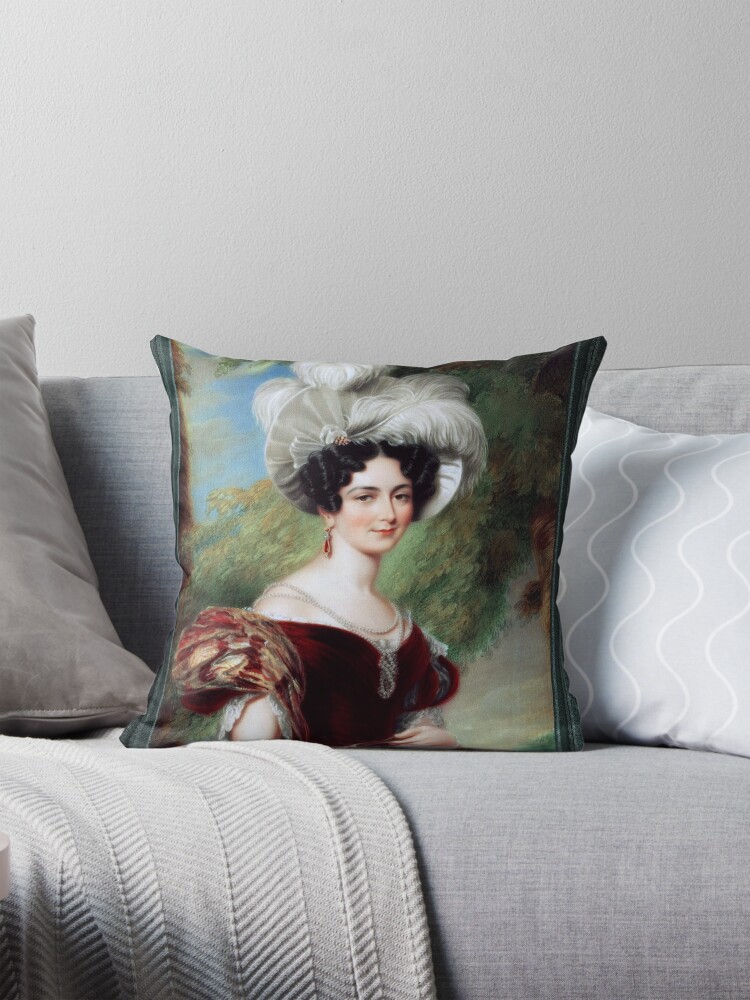
Table des matières
Sujet et composition
The central figure in the portrait is Victoria, Duchesse de Kent, whose refined countenance and noble demeanor are captured in stunning detail. The Duchess is presented in a half-length pose, wearing an elegant gown made of luxurious velvet in a rich shade of crimson. The gown features intricate folds and delicate textures that are indicative of the high-fashion styles of the period. The neckline of the gown is cut low, revealing a soft lace trim and a double row of pearls that encircle her neck, adding a touch of opulence to the overall attire. Her shoulders are draped with a lavish shawl, which flows loosely and elegantly from her arms, accentuating the royal grace and aristocratic finesse of her presence.
The Duchess’ visage, with its soft yet commanding expression, radiates both warmth and authority. Her features are finely painted with a gentle glow, accentuating her serene yet regal expression. The soft curve of her cheeks, the delicate arch of her eyebrows, and the finely detailed curls of her hair all contribute to a sense of aristocratic beauty. Ses cheveux, styled in a voluminous arrangement, is crowned with a large feathered hat, which adds a touch of drama and height, symbolizing the height of fashion and elegance in the royal circles of the time.
The Duchess’ bijoux, including a pair of red earrings and a multi-strand pearl necklace, further elevate her status and reflect her aristocratic background. The gleaming red of the earrings adds a striking contrast to the rich colors of her gown and the serene background, drawing the viewer’s attention to the details of her ensemble.
Contexte et cadre
The background of the portrait features a tranquil natural setting, with soft green foliage and hints of blue sky visible through the trees. The delicate rendering of the landscape contrasts the opulence of the Duchess’ attire and creates a serene and almost dreamlike atmosphere. The natural elements in the background seem to symbolize the Duchess’ connection to both the royal household and the British land, invoking a sense of timelessness and continuity. The balance between the opulent attire and the tranquil scenery adds a sense of harmony, reinforcing the calm yet commanding presence of the Duchess.
Style artistique et technique
George Hayter’s style is characterized by his meticulous attention to detail, which is evident in the rendering of fabrics, bijoux, and facial expressions in the portrait. The artist’s use of light and shadow plays a significant role in bringing the Duchess to life, with soft highlights illuminating her face and gown, contrasting with deeper shadows that give the piece a sense of depth. Hayter’s technique reflects the classical approach of 19th-century portraiture, where realism was emphasized through careful observation of the human form and surroundings.
The fine details of the velvet gown, the textured shawl, and the fluidity of the Duchess’ hair are all rendered with precision, showcasing Hayter’s ability to capture the textures of fabric and the softness of the skin. The careful brushwork on the background foliage adds depth and realism, enhancing the portrait’s three-dimensionality. The inclusion of such background detail suggests a connection between the subject and her environment, further emphasizing the Duchess’ rootedness in her royal context.
Thème et humeur
The portrait captures a theme of royal elegance and dignity. The Duchess of Kent, as the mother of the future Queen Victoria, is depicted with a sense of quiet strength and grace. Her calm expression and poised posture reflect her aristocratic status and her role within the royal family. There is an air of nobility in her portrayal, conveying not only the status of her position but also the responsibilities that came with it. The mood of the artwork is one of serenity and composed elegance, with a subtle undercurrent of power conveyed through her poised expression and regal attire.
The mood is also one of reflection, as the portrait seems to capture a moment frozen in time. Le doux, luminous colors of the gown, the gentle light that falls on her face, and the peaceful background suggest an atmosphere of introspection, as though the Duchess is contemplating the future of her family and her role within the monarchy. This sense of poised reflection adds a layer of emotional depth to the work, making it more than just a visual representation of her physical appearance but also an exploration of her inner dignity and strength.
Matériaux et Techniques
The medium used for this portrait appears to be oil on canvas, a common medium for royal portraiture in the 19th century. The smooth texture of the canvas allows Hayter to achieve a high level of detail in both the clothing and facial features of the Duchess. The layering of oil paints is evident in the depth of the colors, particularly in the velvet gown and the subtle modeling of the Duchess’ visage. The artist’s delicate use of glazes adds a sense of luminosity to the painting, enhancing the realistic portrayal of the subject.
Conclusion
“Victoria, Duchesse de Kent (1786 – 1861)” by George Hayter is a magnificent example of 19th-century royal portraiture, capturing both the physical likeness and the dignified presence of one of Britain’s most prominent royal figures. The artist’s skillful use of light and shadow, attention to fabric textures, and the harmonious combination of regal attire and serene natural surroundings all contribute to the timeless quality of the portrait. The Duchess of Kent is depicted not only as a woman of beauty and grace but also as a figure of strength and influence, reflecting her role as the mother of Queen Victoria and her place within the broader narrative of British history.
Il s'agit d'une reproduction de maîtres anciens d'art numérique retouchée d'une image du domaine public.
Biographie de l'artiste avec l'aimable autorisation Wikipedia.org
George Hayter était le fils de Charles Hayter (1761 – 1835), peintre en miniature et maître de dessin populaire et professeur de perspective qui a été nommé professeur de perspective et de dessin à la princesse Charlotte et a publié une introduction bien connue à la perspective et à d'autres œuvres.
Initialement tutoré par son père, il est allé aux écoles de la Royal Academy au début de 1808, mais la même année, après un désaccord sur ses études d'art, s'est enfui en mer en tant qu'aspirant dans la Royal Navy. Son père a obtenu sa libération, et ils sont parvenus à un accord que Hayter devrait l'aider tout en poursuivant ses propres études.
Aux écoles de la Royal Academy, il a étudié sous Fuseli, et en 1815 a été nommé Peintre de Miniatures et de Portraits par la Princesse Charlotte. Hayter a reçu la prime de la British Institution pour la peinture d'histoire pour le prophète Ezra (1815; Château de Downton), acheté par Richard Payne Knight.