

Millicent Duchess Of Sutherland
John Singer Sargent’s portrait Millicent Duchess of Sutherland, péinteáilte i 1904, captures the essence of late 19th and early 20th-century portraiture in its sophisticated portrayal of aristocracy. An t-ealaíontóir, born in Italy to American parents, is known for his masterful technique, which is on full display in this oil painting. The portrait features Millicent, Duchess of Sutherland, who was an English aristocrat and socialite of the time.
Millicent Duchess Of Sutherland born Millicent Saint Clair Erskine (1867 – 1955); was the eldest daughter of the fourth Earl of Rosslin and Blanche Fitzroy. Nuair a bhí sí 17 bliana d'aois, she married Cromartie Sutherland Leveson-Gower, who inherited the title of Duke of Sutherland in 1892.
The Duchess is depicted in a moment of poised elegance, embodying both her title and her societal role, which adds layers of intrigue and gravitas to the composition. The painting’s theme and mood suggest a balance between refinement and the underlying strength of character that was expected of such women of high society.
Clár na nÁbhar
An príomh -ábhar: Millicent Duchess of Sutherland
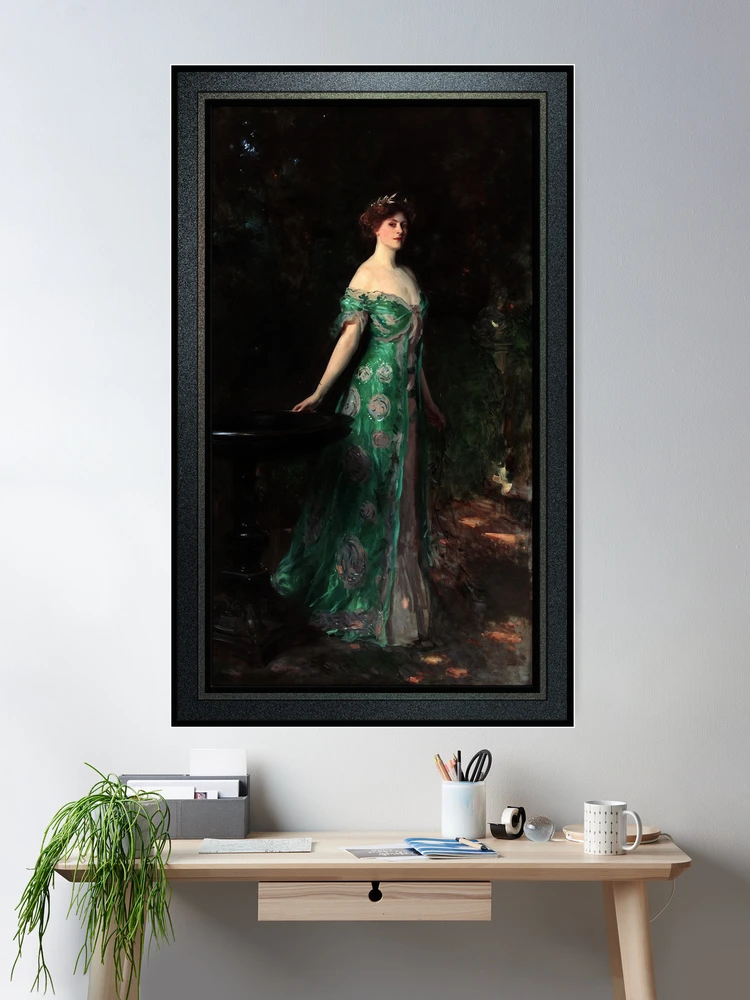
At the heart of this masterpiece is Millicent herself, who stands regal and composed in a commanding yet graceful pose. The Duchess is dressed in a lavish gown that catches the viewer’s eye. The rich green color of her gown complements the darker tones of the background, creating a stark contrast that draws attention to her figure. Her gown is adorned with delicate floral motifs that add a touch of softness to the otherwise formal attire.
The exquisite detailing of the dress reveals Sargent’s mastery in portraying fabric textures, every fold and curve of the gown is rendered with remarkable precision, reflecting both light and shadow in ways that evoke the grandeur of the aristocratic world. A posture, with one hand resting on a table, gives the impression of quiet confidence, as though she is both part of her surroundings and above them, a fitting representation of her high status.
The Duchess’s face is illuminated with soft, yet confident features, giving her an ethereal quality. Tá a cuid gruaige styled i updo galánta, topped with a crown of delicate flowers, which subtly underscores her aristocratic position. The face, ach, is not overly made up, allowing her natural beauty and inner character to shine through.
Her gaze is slightly turned towards the viewer, but it carries an air of contemplation, as though she is reflecting on something far beyond the scope of the immediate surroundings. Sargent’s ability to capture this subtle expression adds an emotional depth to the portrait, making the Duchess more than just an object of admiration but rather a subject worthy of reflection.
An Socrú agus Cúlra
The background of the portrait is a darker, almost abstract composition that contrasts with the finely detailed figure of the Duchess. The deep greens and blacks in the backdrop suggest a garden or outdoor scene, yet the lack of clear definition means the viewer’s attention remains firmly on the subject.
There are subtle hints of foliage and natural elements, perhaps trees or shrubs, that give the impression of an elegant, private space, reinforcing the idea of the Duchess as part of the high society’s cultivated and refined world. The ambiguity of the background helps elevate the figure of Millicent, keeping her at the center of attention and ensuring that her character is the primary focus of the piece.
This blending of the subject with a loosely painted environment allows the viewer to focus on the Duchess’s personality rather than the setting, which serves to emphasize her social status and her connection to nature, perhaps suggesting her high-standing as someone who effortlessly blends with the world around her. The blurred background, mar sin, functions not as a mere backdrop, but as a reflection of the Duchess’s connection to both the natural world and the elevated social stratum she occupies.
Ábhair agus Teicníc
Sargent’s technique is characterized by his keen observation of light and form, and this portrait is a perfect example of his skill in these areas. The oil paint is applied in rich layers, with soft brushstrokes used for the delicate fabrics of the Duchess’s gown and more defined strokes used for the facial features and crown. The overall effect is one of depth and texture, with the use of light creating a sense of volume and space around the figure. Sargent’s mastery in rendering the fabrics of the dress, particularly the play of light on the smooth, luxurious silk, is a testament to his expertise in capturing the textures of the material world.
The use of color is another vital component of this portrait. The rich green of the gown is juxtaposed with the darker tones of the background, but it is also contrasted with the lighter tones of Millicent’s face and hands, which glow in the light. This strategic use of color not only directs the viewer’s attention but also symbolizes the Duchess’s social position, as if to say that she is the shining jewel in the darker world of aristocracy.
Stíl, Téama, agus Mood
The painting exemplifies the formal portraiture style that was prevalent in Sargent’s era. It carries the hallmarks of high-society portraiture, with its focus on elegance, detail, and the ability to convey the subject’s personality and social status through pose and setting. The mood is one of serenity and contemplation, yet there is also an underlying strength and dignity in the Duchess’s expression and posture.
Sargent manages to capture the juxtaposition of femininity and authority, allowing the viewer to sense both the external refinement and the inner strength that Millicent must have possessed as a woman of such high social standing.
The theme of aristocracy is explored through the careful balance between the subject’s physical beauty and the symbol of her social position. Sargent has not only painted a woman of high rank but has also captured the essence of her identity, portraying her as both a representative of the British aristocracy and an individual with her own quiet dignity and complexity.
Conclúid
Millicent Duchess of Sutherland is an exemplary piece of portraiture by John Singer Sargent, capturing both the external beauty and the internal strength of a woman who was at once an individual and a symbol of aristocracy. The artist’s brilliant use of light, dath, agus uigeacht, along with his ability to convey emotion through a subtle expression, makes this portrait a timeless masterpiece.
It stands as a reflection of the social hierarchy of the time, but also as a powerful tribute to the individual personality of the Duchess herself. This portrait encapsulates the grandeur of its subject, while also presenting her in a way that is both intimate and dignified, inviting the viewer to consider not just the surface, but the depths of her identity.
Millicent Duchess Of Sutherland is a retouched digital art old masters reproduction of a public domain image.
Ealaíontóir Bith Díorthaithe Ó Wikipedia.org
Bhí John Singer Sargent ina ealaíontóir easaoránach Meiriceánach, mheas an “Péintéir portráidí ceannródaíoch dá ghlúin” Mar gheall ar a chuid athghabhálacha ar só ré Edwardian.
Chruthaigh sé go garbh 900 pictiúir ola agus níos mó ná 2,000 uiscedhathanna, chomh maith le sceitsí gan áireamh agus líníochtaí gualaigh.
A dhoiciméid oeuvre taisteal ar fud an domhain, ón Veinéis go dtí an Tyrol, Corr, An Meánoirthear, Montana, Mainn, agus Florida.
Rugadh i bhFlórans do thuismitheoirí Mheiriceá, Cuireadh oiliúint air i bPáras sular bhog sé go Londain, Ag maireachtáil an chuid is mó dá shaol san Eoraip.
In the 1880s he made an early submission to the Paris Salon of his Madame X Portait c1884, an rún a sheasamh mar phéintéir sochaí i bPáras a chomhdhlúthú; Ach ina ionad sin bhí scannal mar thoradh ar an bpéintéireacht.
Bhí an phortráid Madame X de phríomhshóisialach ceannródaíoch, Madame Pierre Gautreau cóirithe i gúna tráthnóna muineál dubh plunging le strapaí gualainn slabhra diamaint óir, a chuir cúram docht ar a choim. (Follow this link to view the Madame X Portrait.)
Don amanna, it suggusted to many Parisians, indiscreet a chruthaíonn feisteas a nochtadh agus a spreag stoirm an -ghéar, ag cur iallach ar Sargent an tír a fhágáil.
The following year Sargent departed for England where he continued a successful career as a portrait artist; and enjoyed international acclaim as a portrait painter.
From the beginning, Sargent’s work wass characterized by remarkable technical facility, particularly in his ability to draw with a brush; which in later years inspired admiration as well as criticism for a supposed superficiality.
His commissioned works were consistent with the grand manner of portraiture, while his informal studies and landscape paintings displayed a familiarity with Impressionism.
In later life Sargent expressed ambivalence about the restrictions of formal portrait work, and devoted much of his energy to mural painting and working en plein air.