

Rêverie au clair de lune: Une étude sur la lumière et la forme par Luis Ricardo Falero
Luis Ricardo Falero"Nymphe de la Lune"," peint vers 1896, est un exemple captivant de la peinture académique de la fin du XIXe siècle, mêlant les idéaux classiques à une sensibilité romantique naissante. L'œuvre présente une figure féminine solitaire suspendue sur fond d'un vaste, ciel nocturne étoilé et croissant de lune lumineux.
L’utilisation magistrale du clair-obscur par Falero – l’interaction dramatique de la lumière et de l’ombre – est immédiatement apparente., attirant l'œil du spectateur sur le sujet central tout en soulignant l'immensité du cosmos environnant. La peinture évoque un sentiment de beauté éthérée et de contemplation tranquille, invitant les spectateurs dans un royaume onirique où les préoccupations terrestres s'estompent.
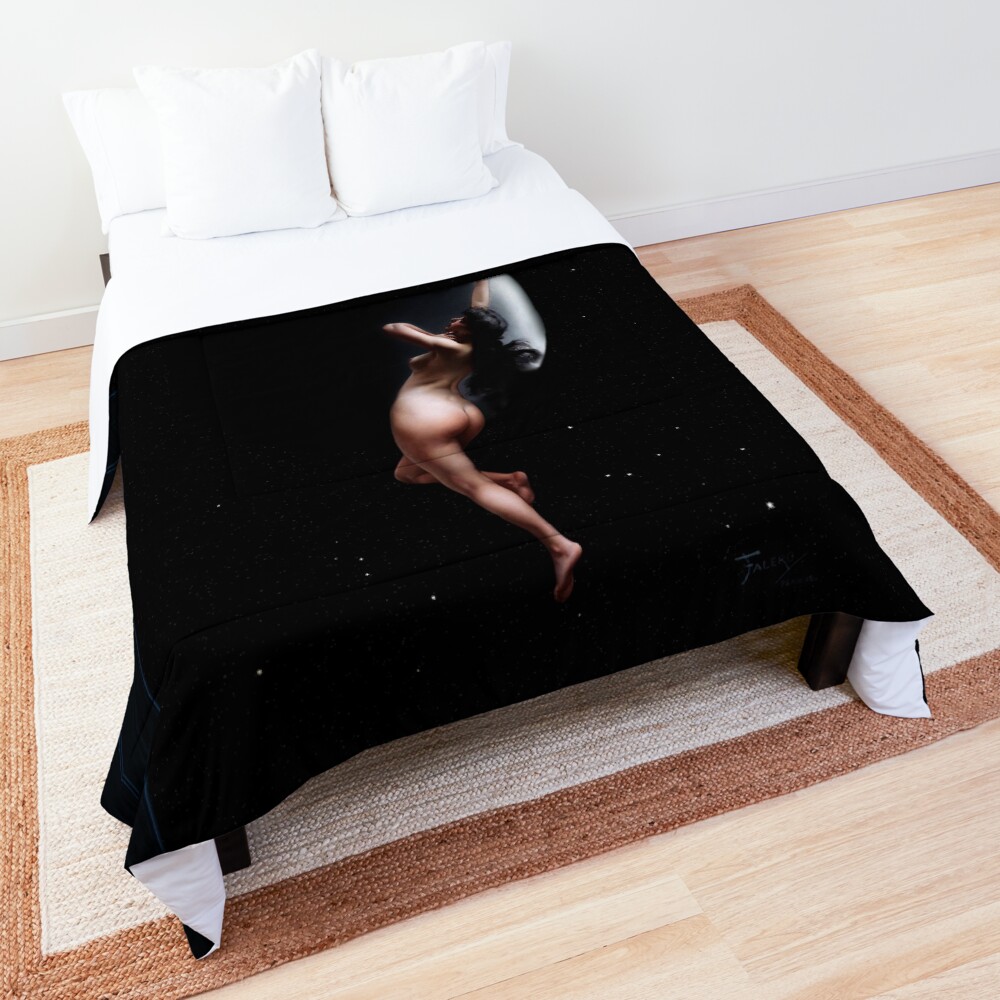
Table des matières
Éléments de composition & Technique
La composition est étonnamment simple mais profondément efficace. Le personnage occupe la partie inférieure de la toile, sa forme s'incline gracieusement vers la lune. Cette trajectoire ascendante crée un flux visuel qui guide l'œil de l'obscurité en bas vers la lumière rayonnante au-dessus.. La technique de Falero démontre une compréhension claire de la précision anatomique et de la beauté idéalisée, les caractéristiques de la formation académique.
Alors que le personnage est nu, la présentation évite tout sentiment de sensualité manifeste; plutôt, il met l'accent sur sa forme en tant qu'incarnation de la grâce naturelle et de l'harmonie avec l'environnement céleste. Le lisse, les coups de pinceau mélangés contribuent à la douceur générale et à la qualité onirique de la peinture. Il y a un calme palpable dans la scène, accentué par l'absence de toute autre figure ou objet au-delà de la lune et des étoiles.
Palette de couleurs & Éclairage
La palette de couleurs est volontairement restreinte, dominé par des noirs et des bleus profonds représentant le ciel nocturne, ponctué par la lueur argentée de la lune et les tons chair subtils de la silhouette. La manipulation habile de la lumière par Falero est au cœur de l’impact du tableau. Le clair de lune projette un doux rayonnement sur le corps de la femme, mettant en valeur ses contours tout en laissant une grande partie de sa forme dans l'ombre.
Cela crée un sentiment de mystère et ajoute de la profondeur à la composition.. Les étoiles dispersées dans le ciel sont représentées par de minuscules points lumineux, ajouter de la texture et un intérêt visuel à un arrière-plan autrement sombre. Le contraste entre l'obscurité de l'espace et la figure illuminée est dramatique, mettant l'accent sur l'isolement de la femme et son lien avec la sphère lunaire.
Symbolisme & Interprétation
Même si le travail de Falero ne véhicule pas explicitement un récit, il résonne avec une signification symbolique enracinée dans la mythologie classique et les idéaux romantiques. La lune a longtemps été associée à la féminité, intuition, et le subconscient, ce qui rend son importance dans la peinture significative. La portée ascendante du personnage vers la lune suggère une aspiration ou un désir ardent pour quelque chose au-delà du royaume terrestre – peut-être une illumination spirituelle ou une connexion à une puissance supérieure..
Sa pose évoque un sentiment d'apesanteur et de liberté, comme si elle n'était pas liée par la gravité et les limitations terrestres. L'effet global est celui d'une transcendance tranquille, invitant les spectateurs à contempler les mystères de l'existence et la beauté du monde naturel. Le manque de narration manifeste du tableau permet de multiples interprétations, ce qui en fait une œuvre d'art profondément personnelle et évocatrice.
Le contexte artistique de Falero

Luis Ricardo Falero était un peintre argentin formé en Europe, étudie à l'Académie Royale des Beaux-Arts de San Fernando à Madrid. Son style artistique reflète l'influence des traditions de peinture académique qui prévalaient à la fin du 19e siècle., caractérisé par une concentration sur les compétences techniques, précision anatomique, et la beauté idéalisée.
pourtant, Le travail de Falero démontre également une appréciation de l’accent mis par le romantisme sur l’émotion., imagination, et le pouvoir sublime de la nature. « Moon Nymph » illustre cette synthèse d’influences, mettant en valeur la capacité de Falero à créer des œuvres à la fois techniquement compétentes et émotionnellement résonnantes. Ses peintures représentent souvent des sujets mythologiques ou allégoriques, reflétant un intérêt culturel plus large pour les thèmes classiques à son époque.
Héritage & Importance
"Moon Nymph" témoigne du talent artistique de Falero et de l'attrait durable des idéaux romantiques.. La beauté intemporelle et les images évocatrices du tableau continuent de captiver les spectateurs aujourd’hui.. Il constitue un exemple précieux de la peinture académique de la fin du XIXe siècle., démontrant la maîtrise de la technique de l’artiste et sa capacité à créer des œuvres à la fois esthétiques et intellectuellement stimulantes. La popularité durable de l’œuvre témoigne de ses thèmes universels de beauté., aspiration, et connexion avec le monde naturel.
Biographie de l'artiste dérivée de Wikipedia.org
Falero est né à Grenade et a d'abord poursuivi une carrière dans la marine espagnole, mais l'a abandonné à ses parents’ déception. Il s'est rendu à pied à Paris, où il a étudié l'art, chimie et génie mécanique.
Les expériences qu'il dut mener dans ces deux derniers étaient dangereuses, l'amenant à décider de se concentrer sur la peinture seul.[3] Il était un élève de Gabriel Ferrier.[4] Après Paris, il a étudié à Londres, où il finit par s'installer.[2]
Falero avait un intérêt particulier pour l'astronomie et a incorporé des constellations célestes dans plusieurs de ses œuvres, tel que “Le mariage d'une comète” et “Étoiles jumelles”. Son intérêt et sa connaissance de l'astronomie l'ont également amené à illustrer les œuvres de Camille Flammarion.
Dans 1896, l'année de sa mort, Maud Harvey a poursuivi Falero pour paternité. La poursuite alléguait que Falero avait séduit Harvey alors qu'elle était 17, servant d'abord de femme de chambre, puis modèle. Quand il a découvert qu'elle était enceinte, il l'a renvoyée.
Elle a gagné l'affaire et a reçu cinq shillings par semaine pour soutenir leur enfant. Falero est décédé au University College Hospital, Londres, à l'âge de 45
Moon Nymph est une reproduction d'art numérique retouchée d'une image du domaine public qui est disponible à l'achat en tant que impression d'art sur toile.