

Mrs Abington as Thalia c1783
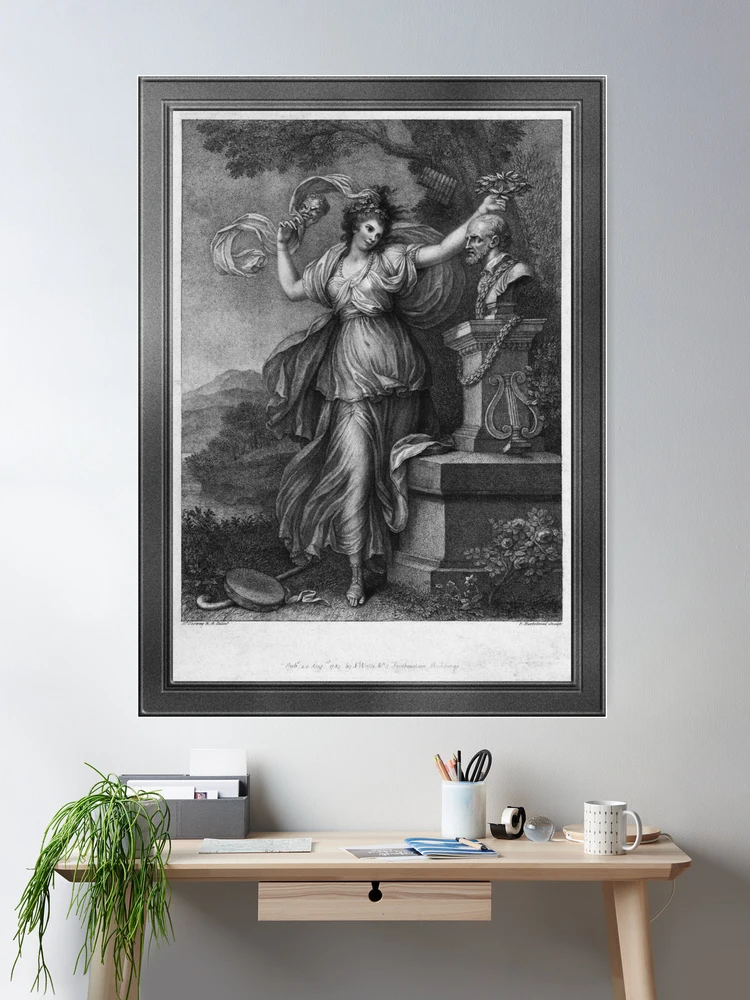
“Mrs Abington as Thalia,” luotu vuonna 1783 by Italian engraver Francesco Bartolozzi (1727 – 1815), showcases the legendary actress and comedienne, rouva. Abington, in a scene that evokes the classical mythological figure of Thalia, the Muse of Comedy. Bartolozzi’s etching is an exquisite example of 18th-century Neoclassical art, capturing the grace and elegance associated with the period while simultaneously honoring the theatrical tradition of the time.
The work is highly detailed and demonstrates Bartolozzi’s expertise in engraving, a medium that he mastered during his career. His skill in capturing texture and the natural flow of drapery, hiukset, and skin is evident, making this artwork a fine representation of his craftsmanship. The portrayal of Mrs. Abington as Thalia radiates an air of playful elegance, blending mythological themes with the real-world personality of the actress. This fusion reflects the period’s tendency to reimagine classical figures through contemporary lenses, a hallmark of the Neoclassical style.
Sisällysluettelo
Pääaihe: rouva. Abington hahmona Thalia
In this engraving, the central figure is Mrs. Abington herself, dressed as Thalia (yksi yhdeksästä kreikkalaisesta musasta), hän on musiikin museo, tanssi, komediaa ja idyllistä runoutta, standing with her body slightly turned to the left. Her facial expression exudes a sense of joy and vitality, reflecting the Muse’s role in inspiring comedy. Thalia is often depicted in the arts as a lively and playful character, and Mrs. Abington, with her renowned comedic talent, is an ideal representation of this figure.
rouva. Abington’s attire is in line with the classical tradition, a flowing draped gown, reminiscent of Greco-Roman fashions. The texture of the fabric is captured in great detail, giving it a sense of movement, as though it is gently flowing with an unseen breeze. The rich folds of her dress add to the depth of the engraving, creating a dynamic contrast with the delicate features of her face.
Her right hand holds a ribbon that spirals through the air, a gesture that both directs the viewer’s attention and connects her to the surrounding objects. Her left hand is extended toward the bust of Shakespeare, which is likely a symbolic reference to the intellectual and artistic influence that Thalia, and by extension Mrs. Abington, embodies. The bust is rendered in soft lines, enhancing the contrast with the vibrant movement of the figure of Mrs. Abington.
Esineet ja symboliikka
The ribbon held by Mrs. Abington is not just a decorative element but serves a symbolic purpose. It can be interpreted as representing the flow of creativity and the connection between the Muse of Comedy and the world of the living, signifying the movement of the theatrical arts into the broader cultural sphere. The ribbon swirls delicately in the air, drawing the viewer’s eye in a circular motion around the composition.
On the right side of the artwork stands a bust, likely representing a classical figure, possibly the Greek playwright Menander or another important figure in the history of theater. This symbolic gesture ties the engraving to the intellectual traditions of ancient Greece and Rome, reinforcing the theme of artistic inspiration.
Lisäksi, the objects scattered at the foot of the figure, including a lyre, hint at the importance of music and song in both comedy and theatrical performance. The lyre, an ancient instrument associated with the Muses, further connects the artwork to its classical roots, offering a visual connection to the arts of antiquity.
Maasto ja tausta
The background of the engraving is lush and soft, featuring an ethereal landscape. The soft contours of the trees and the distant mountains add a sense of tranquility, allowing the viewer to focus on the primary subject. The landscape serves to further frame the central figure, offering a backdrop that emphasizes the purity and timelessness of the scene. Bartolozzi uses fine cross-hatching and soft lines to create a sense of depth, with the trees seemingly receding into the distance.
The natural environment is peaceful, yet it complements the theme of creativity and performance, where nature itself can be seen as a muse. The gentle curves of the hills and the flowering plants offer a harmonious setting for the playful and vibrant figure of Mrs. Abington, highlighting the contrast between the human figure and the natural world, and reinforcing the connection between art and nature.
Materiaalit ja tekniikat
The artwork is an engraving, a technique that Francesco Bartolozzi was renowned for. Engraving involves carving into a metal plate to create an image, which is then inked and pressed onto paper. Bartolozzi’s mastery of this medium is evident in the fine details of the textures and the subtle tonal variations achieved through delicate lines and cross-hatching. His use of light and shadow is particularly noteworthy; the soft gradation of tone on Mrs. Abington’s skin and gown creates a lifelike quality, while the background retains a softer, more atmospheric presence.
The overall composition is meticulously arranged, with every element contributing to the balance of the scene. Bartolozzi employs a light touch with the engraving tools, allowing for the intricate details of the fabric and hair to shine through without overwhelming the central figure. The fluidity of the lines in the ribbon and the soft textures of the background enhance the sense of movement and grace, adding to the playful and celebratory mood of the scene.
Teema ja mieliala
The theme of the engraving is firmly rooted in the celebration of the arts and the role of comedy within cultural and intellectual life. rouva. Abington as Thalia embodies not only the figure of the Muse but also the lively spirit of the 18th-century theatrical world. The use of Thalia, the Muse of Comedy, aligns with the rising importance of entertainment and performance in the cultural life of the period. The mood is one of lightness, joy, and inspiration, as the figure of Mrs. Abington, with her radiant expression, seems to encourage the viewer to embrace the pleasures of the stage and the arts.
The juxtaposition of classical symbolism with contemporary subjects reflects the Neoclassical movement’s emphasis on reason, tilata, and the revival of classical ideals, as well as the ongoing dialogue between past and present. The engraving not only celebrates the figure of Thalia but also elevates the role of the artist, particularly the actress, in contributing to the cultural fabric of society.
Johtopäätös
“rouva. Abington hahmona Thalia” by Francesco Bartolozzi is a masterpiece of 18th-century engraving that seamlessly blends classical mythology with contemporary cultural figures. Through its delicate yet powerful portrayal of Mrs. Abington as the Muse of Comedy, the artwork encapsulates the spirit of the time, celebrating the arts, creativity, and the intellectual legacy of the past. The detailed craftsmanship and the skillful use of light, varjo, and texture elevate this piece as a quintessential example of Neoclassical art, making it a timeless reflection of the era’s aesthetic ideals and cultural values.
rouva. Abington hahmona Thalia c1783, italialainen kaivertaja Francesco Bartolozzi (1727 – 1815); sekä taidemaalari, kuninkaallisen akatemian perustajajäsen ja tunnettu värikynän kaiverrusmenetelmän popularisoinnista.
rouva. Abington as Thalia on retusoitu digitaalisen taiteen vanhojen mestarien kopio julkisesta kuvasta.
Alla olevat tiedot ovat peräisin Wikipedia.org
Francesco Bartolozzi
Francesco Bartolozzi syntyi Firenzessä, ja kuten tuolloin oli tapana, ajateltiin, että hän seuraa isänsä jalanjälkiä ja hänestä tulee kulta- ja hopeaseppä.
Tämä kuitenkin muuttuisi, koska nuori Bartolozzi osoitti suurta taitoa ja makua suunnittelussa; Tämän seurauksena hänet asetettiin kahden firenzeläisen taiteilijan valvontaan, mukaan lukien italialainen taidemaalari Ignazio Hugford (1703 – 1778) ja italialainen rokokoo -tyylinen maalari Giovanni Domenico Ferretti (1692 – 1768) joka opetti häntä maalaamaan.
Kolmen vuoden taidekoulutuksen jälkeen, hän meni Venetsiaan opiskelemaan kaiverrusta; ja työskenteli kuusi vuotta saksalaisen kaivertajan ja valmistelijan Joseph Wagnerin palveluksessa (1706 – 1780), kaivertaja ja printtimyyjä, ennen oman työpajan perustamista.
Ensimmäinen Venetsiassa tuotettu kaiverrus Francesco Bartolozzi oli italialaisen barokkimaalarin Marco Ricci -tyylinen levy. (1676 – 1730) ja Giacomo Francesco Zuccarelli (1702 – 1788) myöhään barokki- tai rokokoo -aikainen maisemamaalari.
Sitten sisään 1762 Bartolozzi muutti Roomaan lyhyeksi ajaksi, jossa hän valmisti kaiverrukset, jotka edustivat italialaisen barokkimaalari Domenichinon Grottaferratan freskoja (Domenico Zampieri 1581 – 1641) kuvaavat Pyhän Niluksen elämää.
Tuo kaiverrusjoukko ja hänen etsaukset vanhan mestarin teoksista, alkoi kiinnittää yleisön huomiota kaikkialla Euroopassa; ja sisään 1763 hän tapasi Richard Daltonin (1715 – 1791), valmistelija, kaivertaja ja Englannin kuninkaallinen kirjastonhoitaja, joka matkusti Italiassa etsimään hankintoja kuningas George III -taidekokoelmasta.
Dalton tarjosi hänelle nimityksen kaivertajaksi kuninkaalle; jonka Bartolozzi hyväksyi ja lähti Lontooseen vuonna 1764; missä hän asui 42 vuotta.
Lontoossa ollessaan hän tuotti suuren määrän kaiverruksia, johon kuului Clytie italialaisen maalarin Annibale Carraccin jälkeen (1560 – 1609), ja Neitsyt ja lapsi, italialaisen barokkimaalarin Carlo Dolcin jälkeen (1616/7 – 1686).
Suuri osa niistä on italialaisen maalarin Giovanni Battista Ciprianin teoksista (1727 – 1785) ja brittiläinen taidemaalari Angelica Kauffman (1741 – 1807). Bartolozzi antoi myös useita levyjä Boydellin Shakespearen galleriaan.