

Musidora
Musidora c1825 by American Painter Asher Brown Durand (1796 – 1886); who was part of the Romanticism Art Movement and was a graduate of the Hudson River School. Asher es va centrar principalment en les pintures de paisatges.
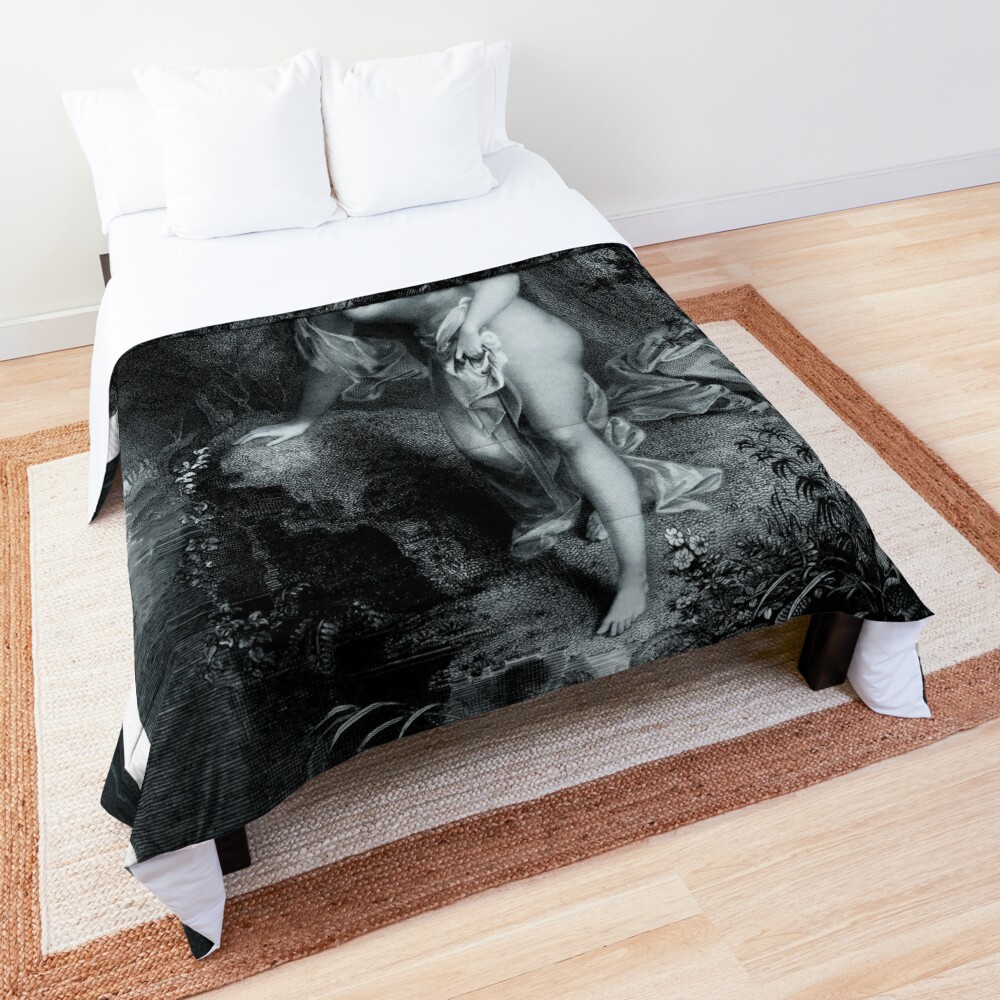
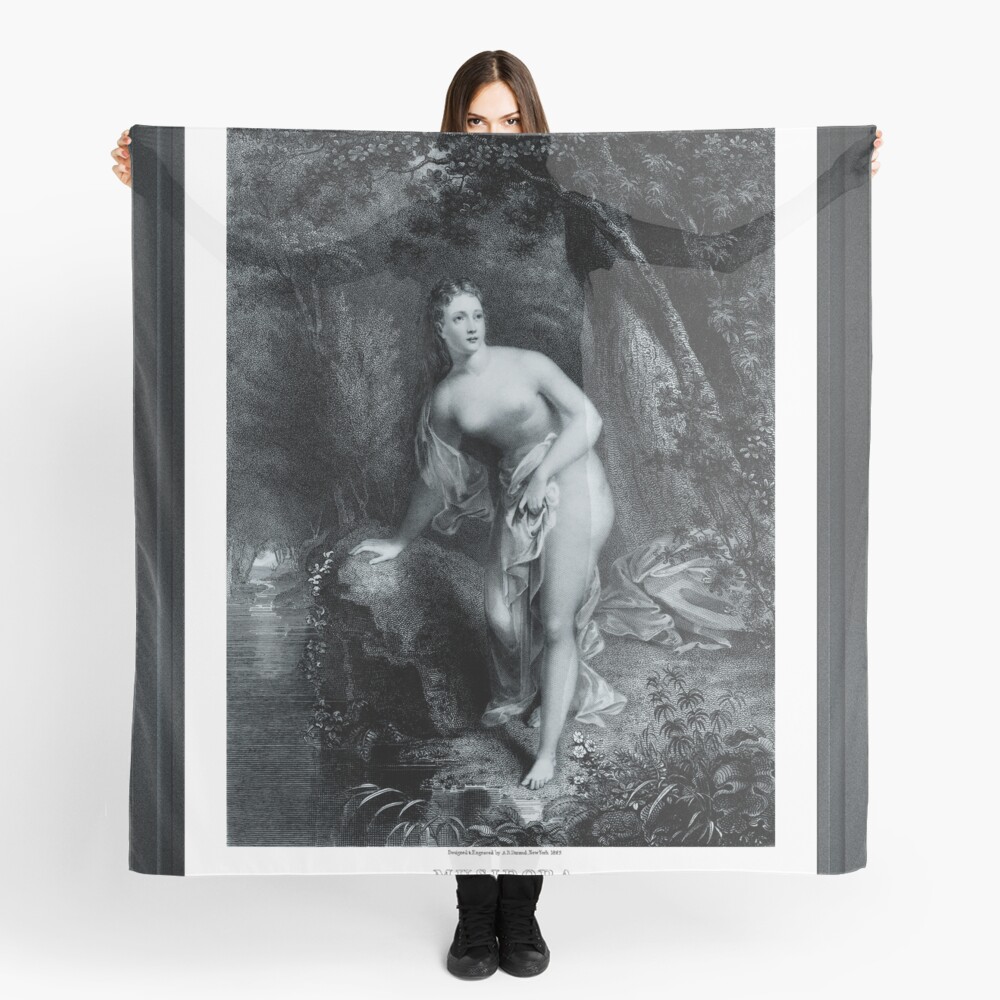
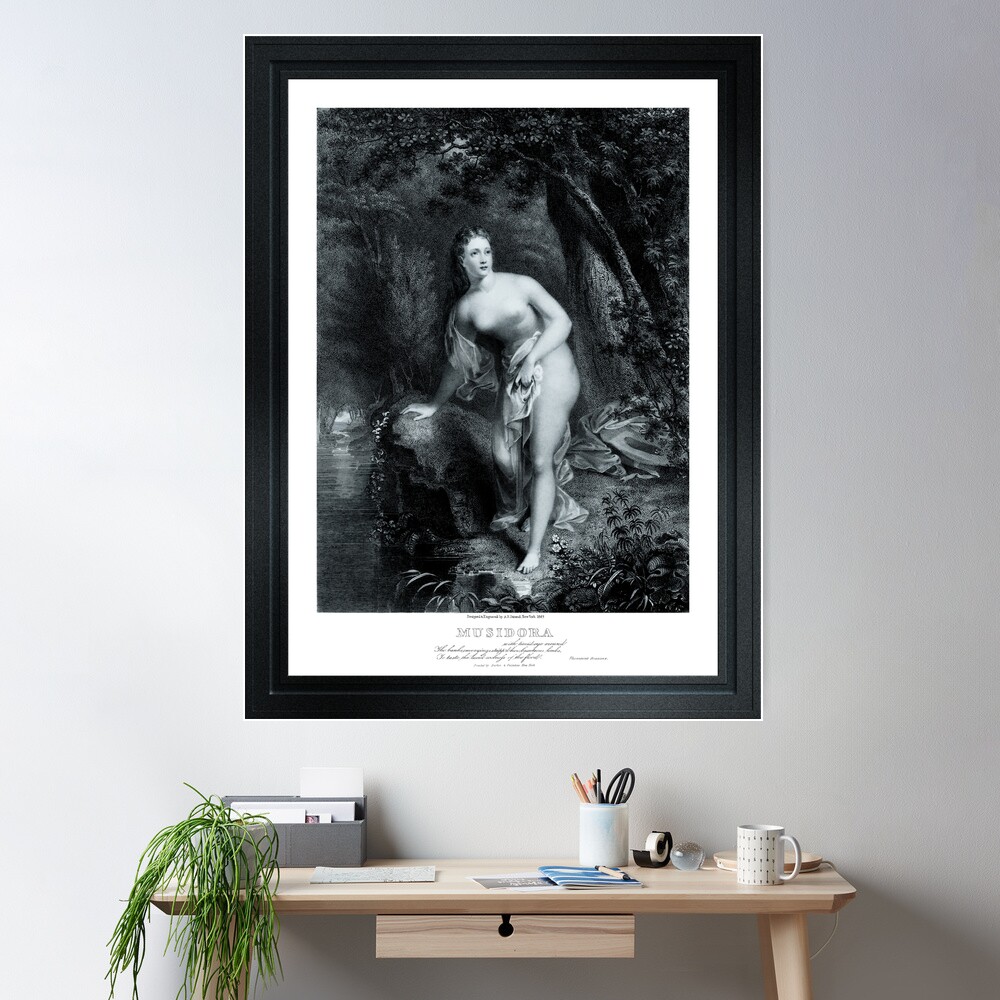
Això és un beautiful nude portrait engraving of a young woman in a lush forest that has removed all of her outer garments, which included her hat, scarf, and dress.
She is partially covered by sheer garment that is falling off her right shoulder and that is covering the front of her waist and right leg as it falls to the floor; and that she is holding in place on the front of her waist with her left hand.
She has laid her cloths at the base of a tree that is not to far behind her as she looks off into the distant sky that is illuminating her, as she is positioned slightly turned to her left; while she leans on a medium sized boulder with the palm of her right hand that is by an embankment of a large pond.
By the embankment are an assortment of flowers and plants, as well as smaller trees; and in the distance is a dense concentration of tress, and water flowing to an arched opening in the trees where we can see light illuminating the area.
Musidora d'Asher B. Durand is a remastered digital art old masters reproduction of a public domain image that is available for purchase online as a impressió artística de llenç enrotllat.
Informació a continuació de Wikipedia.org
Durand was born in and died in Maplewood, Nova Jersey (llavors anomenat Jefferson Village). Era el vuitè d’onze fills, i el seu pare era rellotger i argenter.
Durand va ser aprenent d'un gravador de 1812 a 1817 i més endavant va establir una associació amb el propietari de l'empresa, Charles Cushing Wright (1796 – 1854), que li va demanar que gestionés l’oficina de Nova York de l’empresa.
Va gravar la Declaració d'Independència de John Trumbull durant 1823, que va establir la reputació de Durand com un dels millors gravadors del país.
Durand va ajudar a organitzar la New York Drawing Association durant 1825, que es convertiria en l'Acadèmia Nacional de Disseny; exerciria l'organització com a president de 1845 a 1861.
Els gravats d’Asher en bitllets de banc es van utilitzar com a retrats dels primers segells postals d’Amèrica, el 1847 sèrie. Juntament amb el seu germà Cyrus també va gravar alguns dels successius 1851 problemes.
El seu principal interès va passar del gravat a la pintura a l'oli 1830 amb l’ànim del seu patró, Luman Reed. Durant 1837, he accompanied his friend Thomas Cole on a sketching expedition to Schroon Lake in the Adirondacks Mountains and soon after he began to concentrate on landscape painting.
He spent summers sketching in the Catskills, Adirondacks, and the White Mountains of New Hampshire, making hundreds of drawings and oil sketches that were later incorporated into finished academy pieces which helped to define the Hudson River School.
Durand is remembered particularly for his detailed portrayals of trees, rocks, and foliage. He was an advocate for drawing directly from nature with as much realism as possible. Durand wrote, “Let [the artist] scrupulously accept whatever [natura] presents him until he shall, in a degree, have become intimate with her infinity…never let him profane her sacredness by a willful departure from truth.”
Like other Hudson River School artists, Durand also believed that nature was an ineffable manifestation of God. He expressed this sentiment and his general opinions on art in his essay “Letters on Landscape Painting” in The Crayon, a mid-19th century New York art periodical. Wrote Durand, “[T]he true province of Landscape Art is the representation of the work of God in the visible creation…”
Durand is noted for his 1849 painting Kindred Spirits which shows fellow Hudson River School artist Thomas Cole and poet William Cullen Bryant in a Catskills Mountains landscape. This was painted as a tribute to Cole upon Cole’s death during 1848, i com a regal a Bryant.