

Musidora
Musidora c1825 by American Painter Asher Brown Durand (1796 – 1886); ロマン主義芸術運動の一員であり、ハドソンリバースクールの卒業生でした。. Asher’s main focus was on landscape paintings.
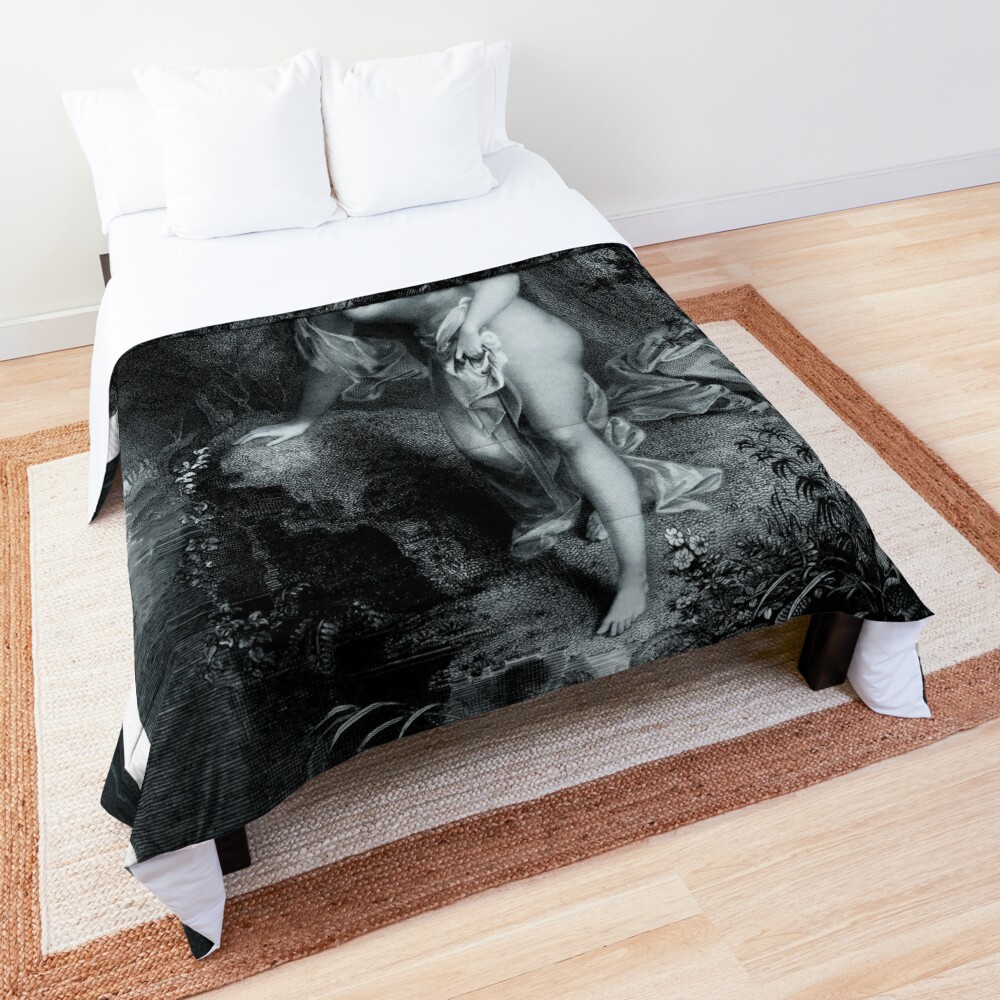
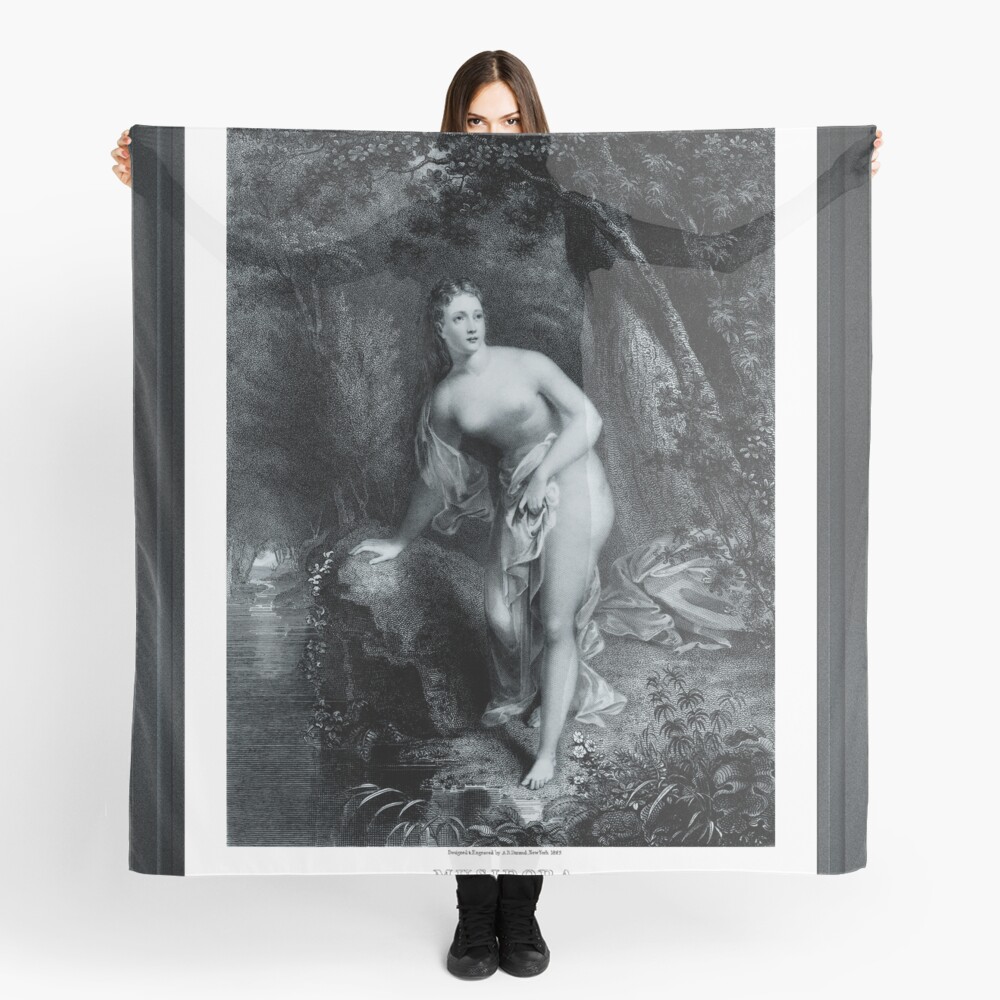
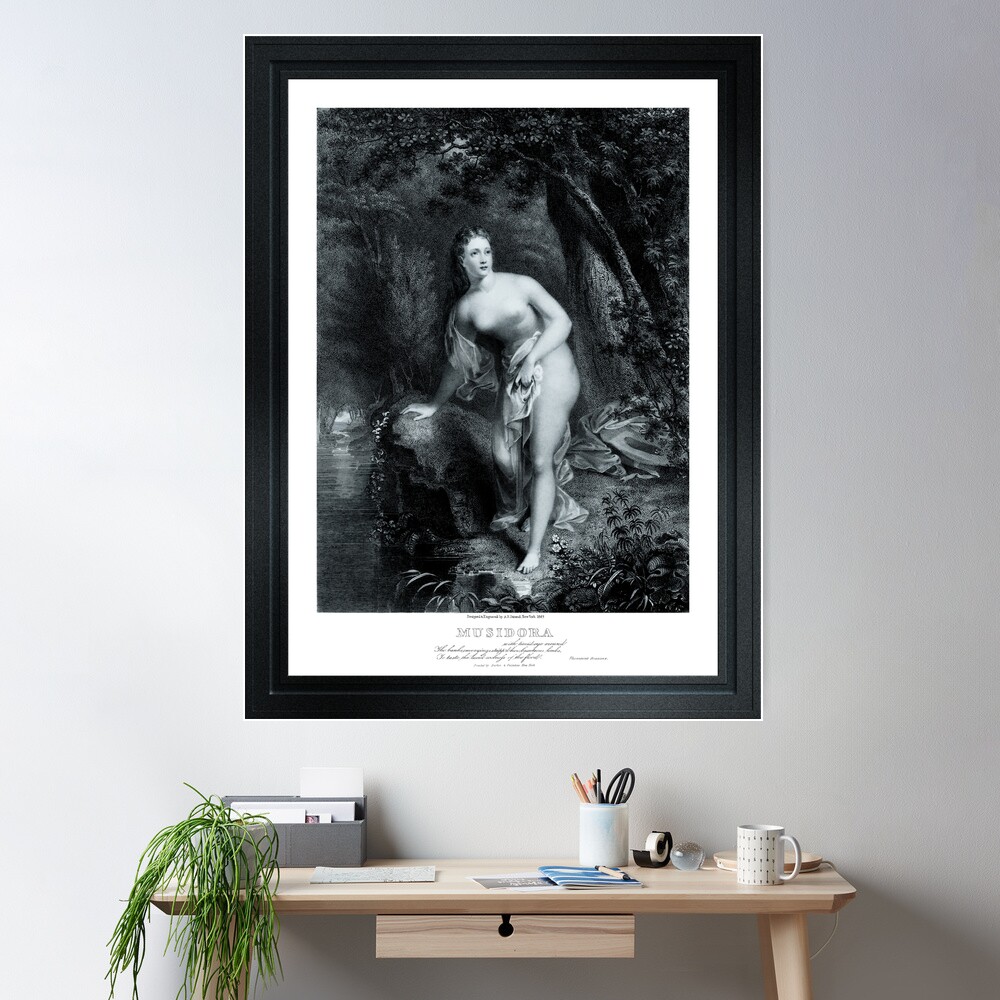
これは beautiful nude portrait engraving of a young woman in a lush forest that has removed all of her outer garments, which included her hat, scarf, and dress.
She is partially covered by sheer garment that is falling off her right shoulder and that is covering the front of her waist and right leg as it falls to the floor; and that she is holding in place on the front of her waist with her left hand.
She has laid her cloths at the base of a tree that is not to far behind her as she looks off into the distant sky that is illuminating her, as she is positioned slightly turned to her left; while she leans on a medium sized boulder with the palm of her right hand that is by an embankment of a large pond.
By the embankment are an assortment of flowers and plants, as well as smaller trees; and in the distance is a dense concentration of tress, and water flowing to an arched opening in the trees where we can see light illuminating the area.
Musidora by Asher B. Durand is a remastered digital art old masters reproduction of a public domain image that is available for purchase online as a ロール状のキャンバスアートプリント.
以下の情報から Wikipedia.org
Durand was born in and died in Maplewood, ニュージャージー州 (当時はジェファーソンビレッジと呼ばれていました). 彼は11人兄弟の8番目でした, and his father was a watchmaker and a silversmith.
Durand was apprenticed to an engraver from 1812 に 1817 and later entered into a partnership with the owner of the company, Charles Cushing Wright (1796 – 1854), who asked him to manage the company’s New York office.
He engraved the Declaration of Independence for John Trumbull during 1823, which established Durand’s reputation as one of the country’s finest engravers.
Durand helped organize the New York Drawing Association during 1825, which would become the National Academy of Design; he would serve the organization as president from 1845 に 1861.
Asher’s engravings on bank notes were used as the portraits for America’s first postage stamps, の 1847 series. Along with his brother Cyrus he also engraved some of the succeeding 1851 issues.
His main interest changed from engraving to oil painting about 1830 彼の常連客の励ましで, ルーマン・リード. その間 1837, 彼は友人のトーマス・コールと一緒にアディロンダック山地のシュローン湖へのスケッチ遠征に参加し、すぐに風景画に専念し始めました。.
彼は夏をキャッツキルでスケッチしました, アディロンダック, とニューハンプシャーのホワイトマウンテン, ハドソンリバー派を定義するのに役立った完成したアカデミー作品に後で組み込まれた何百もの図面と油絵を作成する.
Durand is remembered particularly for his detailed portrayals of trees, 岩, and foliage. He was an advocate for drawing directly from nature with as much realism as possible. Durand wrote, “Let [アーティスト] scrupulously accept whatever [自然] presents him until he shall, in a degree, have become intimate with her infinity…never let him profane her sacredness by a willful departure from truth.”
Like other Hudson River School artists, Durand also believed that nature was an ineffable manifestation of God. He expressed this sentiment and his general opinions on art in his essay “Letters on Landscape Painting” in The Crayon, a mid-19th century New York art periodical. Wrote Durand, “[NS]he true province of Landscape Art is the representation of the work of God in the visible creation…”
Durand is noted for his 1849 painting Kindred Spirits which shows fellow Hudson River School artist Thomas Cole and poet William Cullen Bryant in a Catskills Mountains landscape. This was painted as a tribute to Cole upon Cole’s death during 1848, and as a gift to Bryant.