

Ležící akt
“Ležící akt” (Ležící akt) is an exquisite painting created by the French artist Delphin Enjolras in the late 19th century, at a time when the French art scene was heavily influenced by the Symbolist and Academic traditions. Delphin Enjolras (1857 – 1945) was renowned for his delicate mastery in capturing the human form and the interplay of light and shadow.
In this work, Enjolras portrays a reclining female nude, a subject that had long been a cornerstone of classical academic art. nicméně, his treatment of the figure is imbued with a subtle sensuality and tranquility, combined with a deep appreciation for natural beauty and the human body. The painting is a testament to Enjolras’s technique and his deep understanding of classical art, particularly in his use of soft color palettes and finely tuned details that invite the viewer to contemplate the subject in its purest form.
Obsah
Hlavní předmět a kompozice
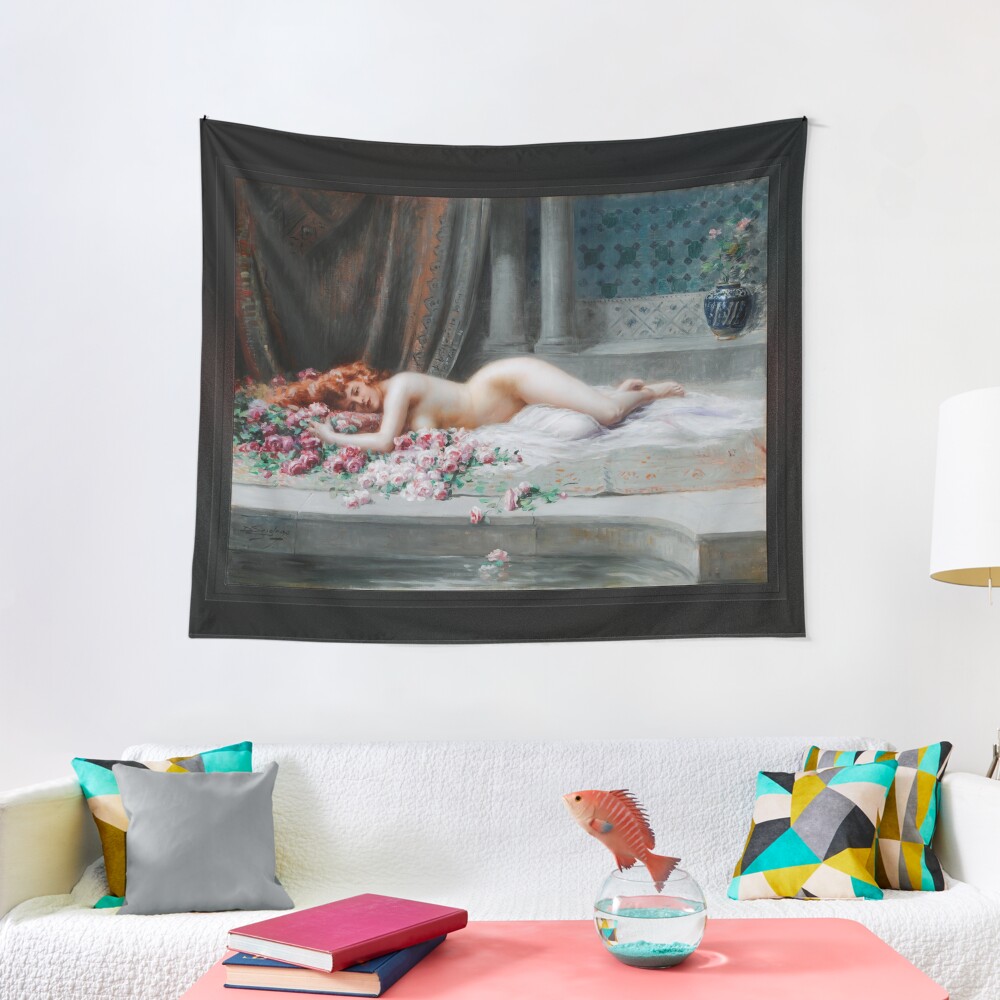
The main subject of “Ležící akt” is a reclining female figure, positioned gently across a luxurious bed or divan. Žena, with her pale, unblemished skin, is the epitome of classical beauty, with her lithe body stretching gracefully across the surface. Její vlasy, a soft auburn, tumbles around her in loose waves, contributing to the sense of relaxed repose. The woman’s gaze is not directed at the viewer, místo toho, she appears deep in contemplation or in a moment of private reflection, adding a sense of intimacy to the composition.
The soft curves of her body are highlighted by the careful modeling of light, which casts gentle shadows that emphasize her natural forms and delicate skin. The artist’s attention to the figure’s proportions and the softness of her anatomy reflects the academic training that Enjolras received, as well as his ability to convey both grace and naturalism.
Around her body are scattered an assortment of vibrant flowers, which add a layer of symbolism to the work. Roses, zejména, are visible among the petals, reinforcing ideas of beauty, fragility, and perhaps love. The flowers not only soften the sensuality of the nude figure but also serve to connect the subject to nature, suggesting a harmony between the human form and the natural world. The floral elements act as a contrast to the classical background, providing a burst of color that enlivens the otherwise serene and intimate scene.
Background and Setting
In the background of the painting, a tiled wall and ornate architectural elements provide a rich, almost exotic atmosphere. The cool blue and green tiles contrast with the warmth of the figure and the flowers, providing balance in the composition. The setting suggests a private, tranquil space, likely a Roman or Moorish-inspired interior, with its arched doorway and simple but elegant architectural lines. The choice of such a setting enhances the overall mood of calmness and solitude, encouraging the viewer to appreciate the moment of peaceful rest. The tiles, with their intricate patterns, serve as both a structural and decorative element, framing the reclining figure while also elevating the sense of luxury and refinement in the scene.
The water feature, possibly a small pool or fountain visible in the lower portion of the painting, contributes to the sense of serenity. The gentle ripples on the water’s surface suggest a stillness in the air, further enhancing the quiet, almost meditative atmosphere that surrounds the figure. This addition of water subtly emphasizes purity and tranquility, enhancing the overall theme of repose and beauty in the natural world.
Umělecký styl, Techniques, a nálada
Delphin Enjolras’s technique in “Ležící akt” reflects his command of the academic style, where an emphasis on form, anatomy, and the interplay of light is central. Měkký, almost ethereal quality of the light, as it caresses the figure’s skin, is particularly striking in the painting. Enjolras achieves this through smooth, layered brushstrokes that result in a texture that feels both fluid and delicate. The careful rendering of the woman’s body, combined with the soft blending of colors, results in a scene that feels both lifelike and dreamlike.
The use of color is also significant in setting the mood of the painting. The figure’s skin is depicted in soft, light tones of pink and cream, contrasting with the darker, richer tones of the flowers and the cool colors of the background. These color contrasts are important in maintaining a harmonious yet dynamic balance between the different elements of the painting. The warm tones of the figure add a sense of vitality and sensuality, while the cooler tones in the background and water feature provide a serene, grounding effect.
Celková nálada “Ležící akt” je ticho, intimní krása. The figure exudes a sense of calm and tranquility, as though she is lost in her thoughts or at rest. There is an undeniable sensuality in the portrayal of the female body, but it is not overtly provocative; místo toho, it is a celebration of the form and its connection to the natural world. The soft light, the flowers, and the serene setting all work together to convey a moment of peaceful reflection and rest.
Závěr
“Ležící akt” by Delphin Enjolras stands as an example of academic realism, capturing the elegance of the human body in a moment of peaceful repose. The artist’s skillful rendering of light, the delicate portrayal of the female figure, and the serene setting combine to create a painting that is both intimate and universally appealing. It speaks to the timeless tradition of the nude in art, while also offering a unique sense of tranquility and natural beauty.
This is a remastered digital art old masters reproduction of a public domain image that is available as a rolled canvas, akryl, online potisk kovu a dřeva.
Životopis umělce
Níže uvedené informace jsou odvozeny z Wikipedia.org
Delphin was born in Coucouron, se nachází v jižní Francii Casimir Enjolras a Delphine Laurens v 1857.
He studied watercolors under the French watercolorist Gaston Gérard at the “Škola kreslení města Paříže” nebo City of Paris Drawing School a studoval také u Jeana-Léona Gérôma (1824 – 1904) v Beaux-Arts (Škola výtvarných umění), a na Pascal Dagnan-Bouveret.
In the early part of Delphins painting career, he mainly painted landscapes; but would later transition in painting portraits of young women, which he excelled at.
Jeho portrét se zaměřoval na krásné a elegantní mladé ženy, obvykle světlem lampy vykonávající všední úkoly, jako je čtení nebo šití; oblečený nebo nahý; s mnoha z jeho pozdějších děl smyslné a erotické povahy.