

Dans Le Boudoir
“Dans Le Boudoir” is a captivating work of art by French painter Delphin Enjolras (1857 – 1945), renowned for his mastery of light, textura, and the intimate portrayal of feminine beauty. Painted in the late 19th to early 20th century, this piece epitomizes the artist’s skill in rendering delicate domestic scenes with a focus on elegance and sensuality. Enjolras, often celebrated for his depictions of women in private, tranquil moments, demonstrates his artistic acumen through the meticulous attention to detail, interplay of light, and a reverence for the natural grace of his subject.
Obsah
The Subject and Setting
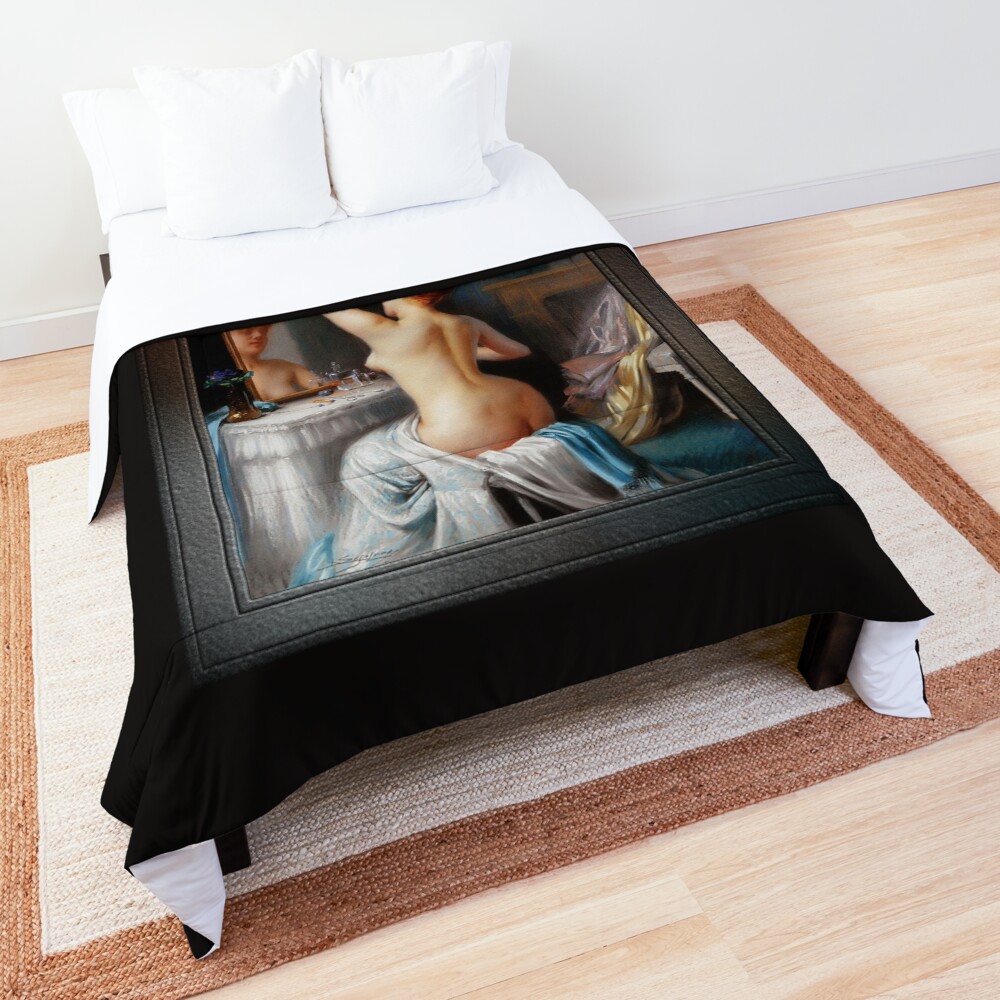
V srdci “Dans Le Boudoir” lies a tender depiction of a woman engaged in an intimate act of grooming. The subject is seated before an ornate gilded mirror, her back partially turned to the viewer, creating a composition that is both voyeuristic and reverent. Her auburn hair is styled meticulously, and her hand gently touches her head in a gesture of refinement, suggesting an unhurried moment of preparation. The viewer is drawn into the quiet serenity of her boudoir—a personal, private space filled with subtle opulence and delicate details.
The woman’s posture exudes poise and elegance, her bare skin illuminated by the soft, diffused light that Enjolras masterfully employs. The soft curves of her form are accentuated by the contrast between her pale complexion and the rich textures surrounding her. Draped fabric, rendered in hues of pristine white and muted turquoise, cascades over the edges of the vanity, emphasizing the luxurious setting. This balance between sensuality and grace is a hallmark of Enjolras’s oeuvre.
Objects and Their Symbolism
Enjolras fills the boudoir with objects that enhance the intimacy and refinement of the scene. The central focus beyond the subject is the gilded mirror, framed in an ornate Rococo-style design, which reflects the woman’s partially obscured face. The reflection creates a layered depth, inviting the viewer to ponder both the physical and psychological dimensions of the moment. This duality of perception—what is seen versus what is suggested—imbues the artwork with an air of mystery.
On the vanity, a delicate arrangement of objects adds further richness to the composition. Crystal perfume bottles glint in the light, hinting at the woman’s rituals of self-care and femininity. A soft blue vase, holding a sprig of vibrant violet flowers, adds a touch of natural beauty, complementing the warmth of the indoor setting. Tyto položky, though small, are rendered with exquisite precision, reflecting the artist’s keen observation of material culture during his time.
V pozadí, a floral arrangement in a blue ceramic vase graces the corner of the room, subtly anchoring the composition and extending the theme of grace and refinement. The setting is completed with a glimpse of draped golden fabric on a nearby chair, further emphasizing the luxurious yet understated atmosphere.
Styl a technika
Delphin Enjolras’s style in “Dans Le Boudoir” demonstrates his affiliation with late Academic painting, influenced by Impressionism’s emphasis on light and atmosphere. His brushwork is soft and blended, creating an ethereal quality that lends the scene a dreamlike intimacy. The careful gradation of light, from the softly illuminated skin of the subject to the muted shadows in the background, showcases Enjolras’s mastery of chiaroscuro.
The warm palette of golds, soft blues, and delicate skin tones evokes a sense of warmth and tranquility. Enjolras employs a delicate interplay of textures—the softness of fabric, the sheen of polished wood, and the smoothness of porcelain and glass—highlighting his ability to render tactile elements convincingly. This tactile realism, combined with the subtle glow of the interior lighting, immerses the viewer in the serene elegance of the boudoir.
Téma a nálada
The overarching theme of “Dans Le Boudoir” is one of introspection, ženskost, a tichou krásu každodenních rituálů. Tím, že se zaměříte na soukromý okamžik ženské péče, Enjolras povyšuje všednost na vznešené, nabízí pohled do osobní sféry často skryté před zraky veřejnosti. Toto téma je symbolem jeho širšího díla, který často oslavuje milost a důstojnost žen v domácím prostředí.
Nálada obrazu je klidná a kontemplativní, podtrženo měkkým, difuzní osvětlení a uvolněné držení těla ženy. Ve scéně je inherentní intimita, jako by divákovi byl poskytnut privilegovaný pohled do soukromého světa. Ještě, tato intimita je zmírněna elegancí kompozice, která zachovává smysl pro dekorum a respekt k předmětu.
Závěr
“Dans Le Boudoir” is a testament to Delphin Enjolras’s ability to capture the beauty and grace of the feminine form within a meticulously rendered domestic setting. Svým mistrovským využitím světla, textura, a složení, he transforms an intimate, everyday moment into a timeless work of art. The painting’s balance of sensuality and refinement, combined with its evocative atmosphere, ensures its enduring appeal as a celebration of feminine beauty and elegance.
Toto je remasterovaná reprodukce starých mistrů digitálního umění obrázku ve veřejné doméně, který je dostupný jako a rolované plátno, akryl, metal and wood prints online.
Umělec bio Wikipedia.org
Delphin was born in Coucouron, se nachází v jižní Francii Casimir Enjolras a Delphine Laurens v 1857.
He studied watercolors under the French watercolorist Gaston Gérard at the “Škola kreslení města Paříže” nebo City of Paris Drawing School a studoval také u Jeana-Léona Gérôma (1824 – 1904) v Beaux-Arts (Škola výtvarných umění), a na Pascal Dagnan-Bouveret.
In the early part of Delphins painting career, he mainly painted landscapes; but would later transition in painting portraits of young women, which he excelled at.
Jeho portrét se zaměřoval na krásné a elegantní mladé ženy, obvykle světlem lampy vykonávající všední úkoly, jako je čtení nebo šití; oblečený nebo nahý; s mnoha z jeho pozdějších děl smyslné a erotické povahy.