

La fée du coquelicot (La Femme Papillon): A Study in Symbolism and Aesthetic Delight
The Poppy Fairy by Luis Ricardo Faleroc'est La Femme Papillon, peint autour 1888, is a captivating example of late 19th-century Spanish art that blends allegorical themes with meticulous realism. This vertical canvas presents a scene steeped in fantasy, where the human form intertwines seamlessly with the natural world, creating an atmosphere of ethereal beauty and quiet contemplation. Falero, mais pas aussi largement célébré que certains de ses contemporains, demonstrates a remarkable technical skill and a keen eye for detail within this work, showcasing a unique vision that draws upon Symbolist aesthetics while retaining elements of academic training.
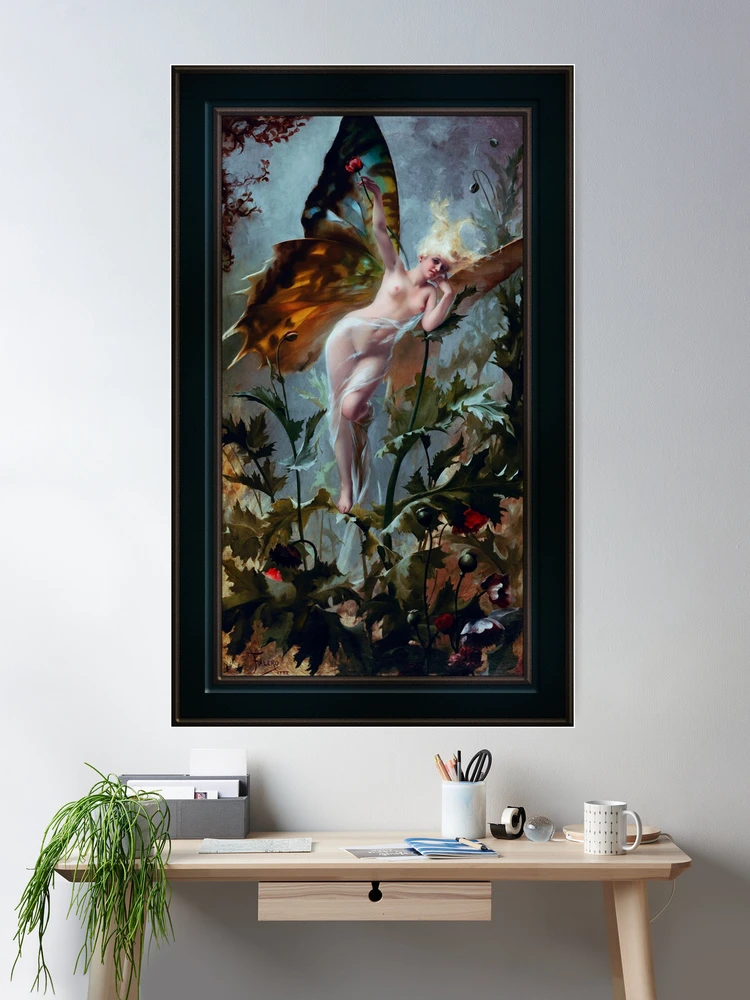
Table des matières
Harmonie compositionnelle & Natural Abundance
The composition is dominated by the central figure – a young woman embodying the spirit of a butterfly, or “papillon” in French—suspended amidst an opulent tangle of foliage and poppies. Falero’s arrangement isn’t haphazard; plutôt, it demonstrates a carefully considered balance between density and openness. The lower portion of the canvas is densely populated with dark green leaves, vibrant red poppy blossoms, and other unidentified plants, creating a rich textural foundation for the figure above.
This dense undergrowth serves to both ground the scene in reality and to visually isolate the fairy-like woman from the viewer, enhancing her otherworldly quality. The verticality of the composition is emphasized by the upward thrust of the central stem supporting the butterfly’s wing, drawing the eye upwards towards the figure’s face.
La figure: A Study in Delicate Form & Expression
The young woman herself is rendered with a remarkable degree of anatomical accuracy, characteristic of Falero’s academic training. Her pose is graceful and relaxed; she appears to float effortlessly within her verdant surroundings. She wears a sheer, flowing garment that clings loosely to her form, revealing the contours of her body while maintaining an air of modesty.
The fabric’s translucence further contributes to the ethereal quality of the scene, blurring the line between flesh and drapery. Her face is turned slightly towards the viewer, exhibiting a gentle expression—a subtle smile plays on her lips, suggesting a sense of quiet joy or contentment. Ses cheveux, rendered in loose, flowing curls, cascades around her head like a halo, further enhancing her otherworldly appearance. She holds a single poppy blossom aloft, as if offering it to an unseen presence.
The Butterfly Wing: A Symbol of Transformation & Flight
The most striking element of the painting is undoubtedly the enormous butterfly wing that dominates the upper portion of the canvas. This wing, rendered in rich hues of gold, marron, et noir, appears almost like a sculpted object rather than a natural form. Its size dwarfs the figure, emphasizing her fragility and vulnerability within the vastness of nature.
The intricate patterns on the wing’s surface are meticulously detailed, showcasing Falero’s technical prowess. The butterfly itself is a potent symbol of transformation, renaissance, and the fleeting beauty of life—themes that resonate throughout the painting. It suggests a connection between the human spirit and the natural world, hinting at a deeper understanding of existence beyond the purely material realm.
Palette de couleurs & Éclairage: Creating an Atmosphere of Enchantment

Falero’s use of color is masterful, creating a rich and evocative atmosphere. The dominant colors are earthy greens and browns, contrasted by the vibrant reds of the poppies and the shimmering gold of the butterfly wing. The lighting in the painting is soft and diffused, casting gentle shadows that accentuate the figure’s form and create a sense of depth.
There’s an overall muted quality to the palette, which contributes to the painting’s dreamlike atmosphere. La lumière semble émaner de la scène elle-même, rather than from any external source, further enhancing its otherworldly feel.
Influences artistiques & Contextual Significance
La Femme Papillon reflects several artistic trends prevalent in late 19th-century Europe. The Symbolist movement’s emphasis on allegory and subjective experience is evident in the painting’s use of symbolic imagery and its focus on evoking a particular mood or feeling rather than simply depicting reality. The influence of academic realism can be seen in Falero’s meticulous attention to detail and his skillful rendering of the human form. The work also shares affinities with the Aesthetic movement, which championed art for art’s sake and emphasized beauty as an end in itself. Falero’s painting stands as a testament to the enduring power of fantasy and imagination within the realm of fine art.
Biographie de l'artiste dérivée Wikipedia.org
Falero est né à Grenade et a d'abord poursuivi une carrière dans la marine espagnole, mais a abandonné à la déception de ses parents; comme il a décidé de voyager à Paris, où il a étudié l'art, chimie et génie mécanique.
Pendant ses études en chimie et génie mécanique; il considérait les expériences qu'il devait mener trop dangereuses, l'amenant ainsi à concentrer son attention sur la peinture seule.
En conséquence, il est devenu un élève du portraitiste et orientaliste français Gabriel-Joseph-Marie-Augustin Ferrier (1847 – 1914). Après Paris, il a déménagé à Londres, où il a poursuivi ses études, et finalement réglé.
Falero avait un intérêt particulier pour l'astronomie et a incorporé des constellations célestes dans plusieurs de ses œuvres, tel que “Le mariage d'une comète” et “Étoiles jumelles”. Son intérêt et sa connaissance de l'astronomie l'ont également amené à illustrer les œuvres de Camille Flammarion.
Dans 1896, l'année de sa mort, Maud Harvey a poursuivi Falero pour paternité. La poursuite alléguait que Falero avait séduit Harvey alors qu'elle était 17, servant d'abord de femme de chambre, puis son modèle. Quand il a découvert qu'elle était enceinte, il l'a renvoyée.
Elle a gagné l'affaire et a reçu cinq shillings par semaine pour soutenir leur enfant. Falero est décédé au University College Hospital, Londres, à l'âge de 45.
Il s'agit d'une reproduction de maîtres anciens d'art numérique retouchée d'une image du domaine public qui est disponible en tant que impression sur toile roulée en ligne.