

Nimfen en Satyr
Nimfen en Satyr: A Study in Classical Fantasy
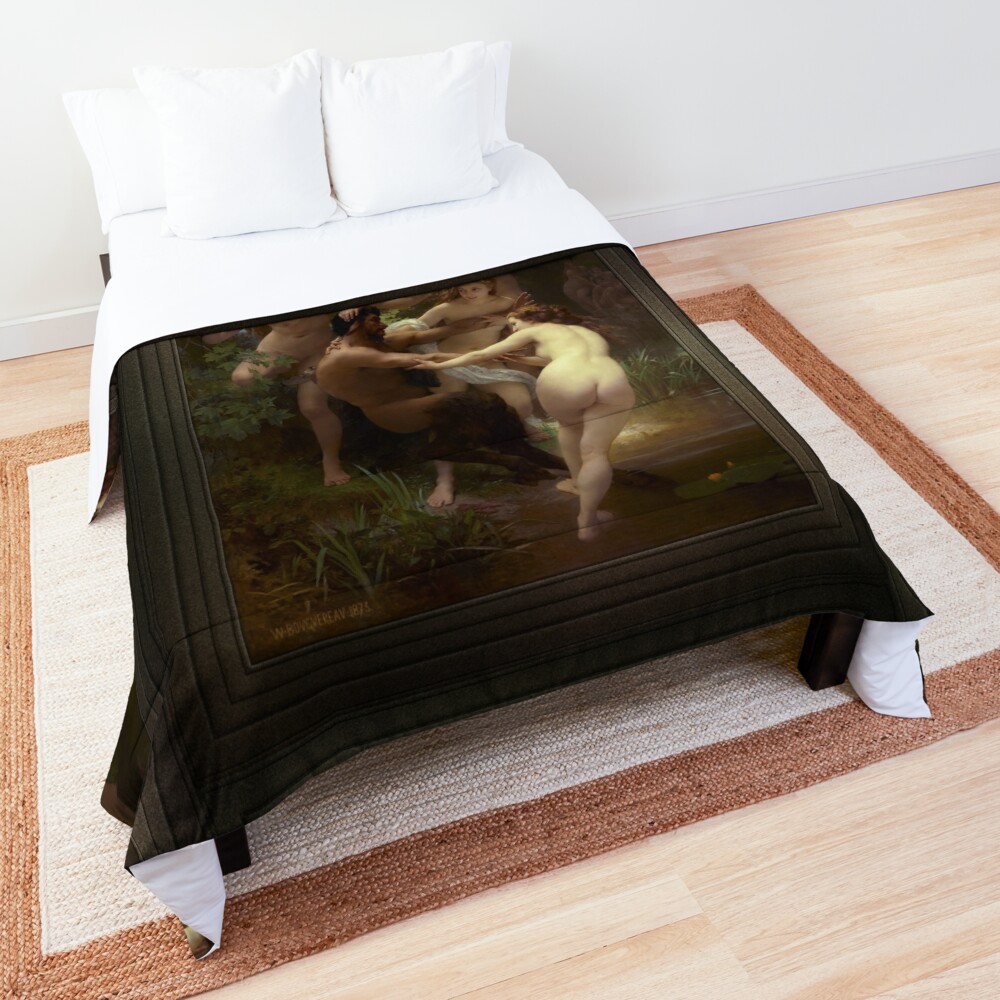
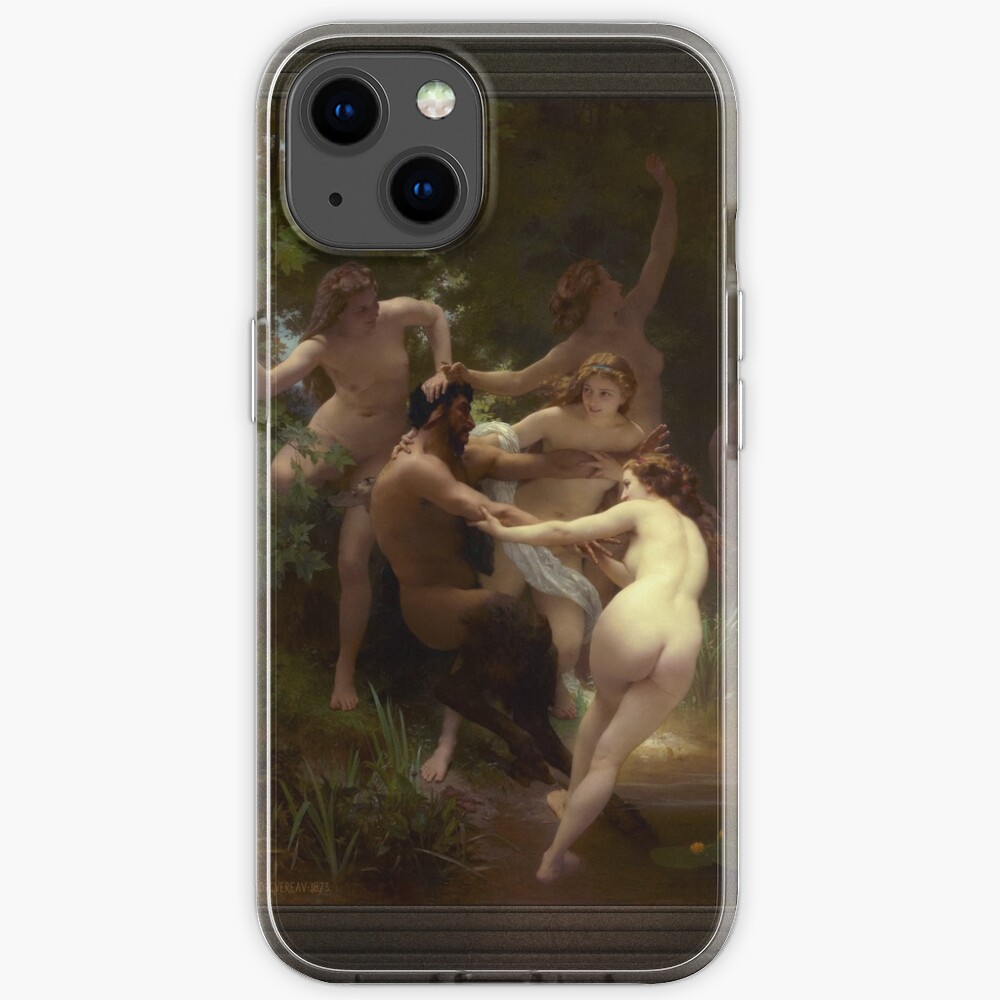
William-Adolphe Bouguereau’s “Nymphs and Satyr,” painted around 1873, exemplifies the artist’s celebrated academic style and his fascination with mythologisch subjects. The painting depicts a playful scene of nymphs playfully encircling a satyr within a lush woodland setting. It is a work that showcases Bouguereau’s technical mastery – particularly his ability to render flesh tones and create an atmosphere of idyllic beauty, while also reflecting the broader artistic trends of 19th-century France, specifically the revival of classical themes and allegorical narratives.
Inhoudsopgave
Compositorische structuur & Narrative
The composition is carefully structured around a central figure: the satyr. He occupies the lower center of the canvas, his dark skin contrasting with the lighter complexions of the surrounding nymphs. The arrangement isn’t one of aggression or threat; liever, it conveys a sense of lighthearted pursuit and playful entanglement.
The nymphs are positioned in a dynamic circular formation around him, their bodies intertwined and their expressions ranging from amusement to gentle teasing. This creates a visual rhythm that draws the viewer’s eye across the canvas, emphasizing the interaction between the figures. The background is deliberately blurred, receding into a dense forest of verdant foliage, which serves to isolate the group and focus attention on the central action.
De figuren: Nimfen & Satyr
Each nymph possesses distinct features and postures, contributing to the overall sense of movement and vitality. Their bodies are rendered with meticulous detail, showcasing Bouguereau’s skill in depicting the human form. They wear minimal attire – flowing drapery that clings to their forms while revealing the contours of their bodies, a common characteristic of academic nudes during this period.
Their hair is loosely arranged, cascading around their shoulders and adding to the overall sense of naturalness. The satyr, a creature from Greek mythology representing wild nature and revelry, stands out due to his darker skin tone and more rugged features. His posture suggests surprise and perhaps mild discomfort as he finds himself surrounded by the playful nymphs. He is depicted with horns and pointed ears, characteristic attributes of his mythological identity.
Kleurenpalet & Verlichting
Bouguereau’s use of color contributes significantly to the painting’s atmosphere. The palette is dominated by warm earth tones – greens, bruin, and ochres – which evoke a sense of natural harmony. The nymphs’ skin tones are rendered with remarkable subtlety, capturing the play of light on their bodies. Een zachte, diffused light filters through the foliage, illuminating the figures from above and creating gentle shadows that enhance their three-dimensionality. The lighting is not harsh or dramatic; in plaats van, it contributes to the overall sense of tranquility and idyllic beauty. The contrast between the satyr’s darker skin and the nymphs’ lighter complexions further emphasizes the visual dynamic within the composition.
Artistieke invloeden & Stijl
“Nymphs and Satyr” reflects Bouguereau’s training in the academic tradition, which emphasized technical skill, anatomical accuracy, and idealized beauty. His work draws inspiration from classical sculpture and Renaissance painting, evident in the graceful poses of the figures and the harmonious composition.
Bouguereau was a proponent of realism, but his paintings are not simply representational; they possess an element of idealization that elevates them beyond mere depictions of reality. The painting’s subject matter, a mythological scene, was also popular among artists during this period, reflecting a broader interest in classical themes and allegorical narratives. Bouguereau’s style is often associated with the academic tradition, characterized by its emphasis on technical proficiency and idealized beauty.
Technical Execution & Detail
The painting’s surface reveals meticulous brushwork, particularly evident in the rendering of flesh tones and foliage. Bouguereau employed a layering technique to build up color gradually, creating subtle gradations and enhancing the sense of realism.
The details are rendered with precision – from the delicate folds of drapery to the individual strands of hair, demonstrating Bouguereau’s mastery of his craft. The artist’s attention to detail extends to the background elements as well; the foliage is depicted with a remarkable degree of naturalism, creating a convincing sense of depth and atmosphere.
Nalatenschap & Betekenis
“Nymphs and Satyr” remains one of Bouguereau’s most celebrated works, admired for its technical brilliance and its depiction of idyllic beauty. The painting exemplifies the artist’s ability to synthesize classical themes with contemporary artistic trends, creating a work that is both timeless and representative of its era. It stands as a testament to Bouguereau’s enduring legacy as one of the leading academic painters of his time.
Artist Bio Courtesy Wikipedia.org
William-Adolphe Bouguereau werd geboren in La Rochelle, Frankrijk, Aan 30 november 1825, tot een familie van wijn- en olijfoliehandelaren.[4] De zoon van Théodore Bouguereau (geboren 1800) en Marie Bonnin (1804), bekend als Adeline, William is katholiek opgevoed. Hij had een oudere broer, Alfred, en een jongere zus, Marie (bekend als Hanna), die stierf toen ze zeven was?.
Het gezin verhuisde naar Saint-Martin-de-Ré in 1832. Een andere broer of zus werd geboren in 1834, Pot. Op de leeftijd van 12, Bouguereau ging naar Mortagne om bij zijn oom Eugène . te blijven, een priester en ontwikkelde een liefde voor de natuur, religie en literatuur.
In 1839, hij werd gestuurd om te studeren voor het priesterschap aan een katholiek college in Pons. Hier leerde hij tekenen en schilderen door Louis Sage, die had gestudeerd onder Ingres. Bouguereau verliet met tegenzin zijn studie om terug te keren naar zijn familie, nu woonachtig in Bordeaux.
Daar ontmoette hij een lokale kunstenaar, Charles Marionneau, en begon in november aan de Gemeentelijke School voor Tekenen en Schilderen 1841. Bouguereau werkte ook als winkelbediende, het met de hand inkleuren van litho's en het maken van kleine schilderijtjes die zijn gereproduceerd met chromolithografie.
Hij was al snel de beste leerling van zijn klas, en besloot kunstenaar te worden in Parijs. Om de verhuizing te financieren, hij verkocht portretten - 33 oliën in drie maanden. Allen waren niet ondertekend en slechts één is getraceerd. Hij kwam oud in Parijs aan 20 in maart 1846.
Gelijkheid voor de dood (Gelijkheid voor de dood), 1848, olieverf op canvas, 141 × 269 cm (55.5 × 105.9 in), Musée d'Orsay, Parijs. Gelijkheid is het eerste grote schilderij van Bouguereau, geproduceerd na twee jaar aan de École des Beaux-Arts de Paris op de leeftijd van 23.
Bouguereau werd student aan de École des Beaux-Arts.[4] Als aanvulling op zijn formele opleiding in tekenen, hij woonde anatomische dissecties bij en studeerde historische kostuums en archeologie.
Hij werd toegelaten tot het atelier van François-Édouard Picot, waar hij schilderkunst studeerde in de academische stijl. Dante en Virgil in de hel (1850) was een vroeg voorbeeld van zijn neoklassieke werken.
Academische schilderkunst had de hoogste status op historische en mythologische onderwerpen, en Bouguereau vastbesloten om de Prix de Rome te winnen, waarmee hij een verblijf van drie jaar zou krijgen in de Villa Medici in Rome, Italië, waar hij naast formele lessen de renaissancekunstenaars en hun meesterwerken uit de eerste hand kon bestuderen, evenals Grieks, Etruskisch, en Romeinse oudheden.
Nymphs and Satyr is a retouched digital art reproduction of a public domain image which is available for purchase as a opgerolde canvas print online.