

Het toilet van Venus: The Allure of Leisure
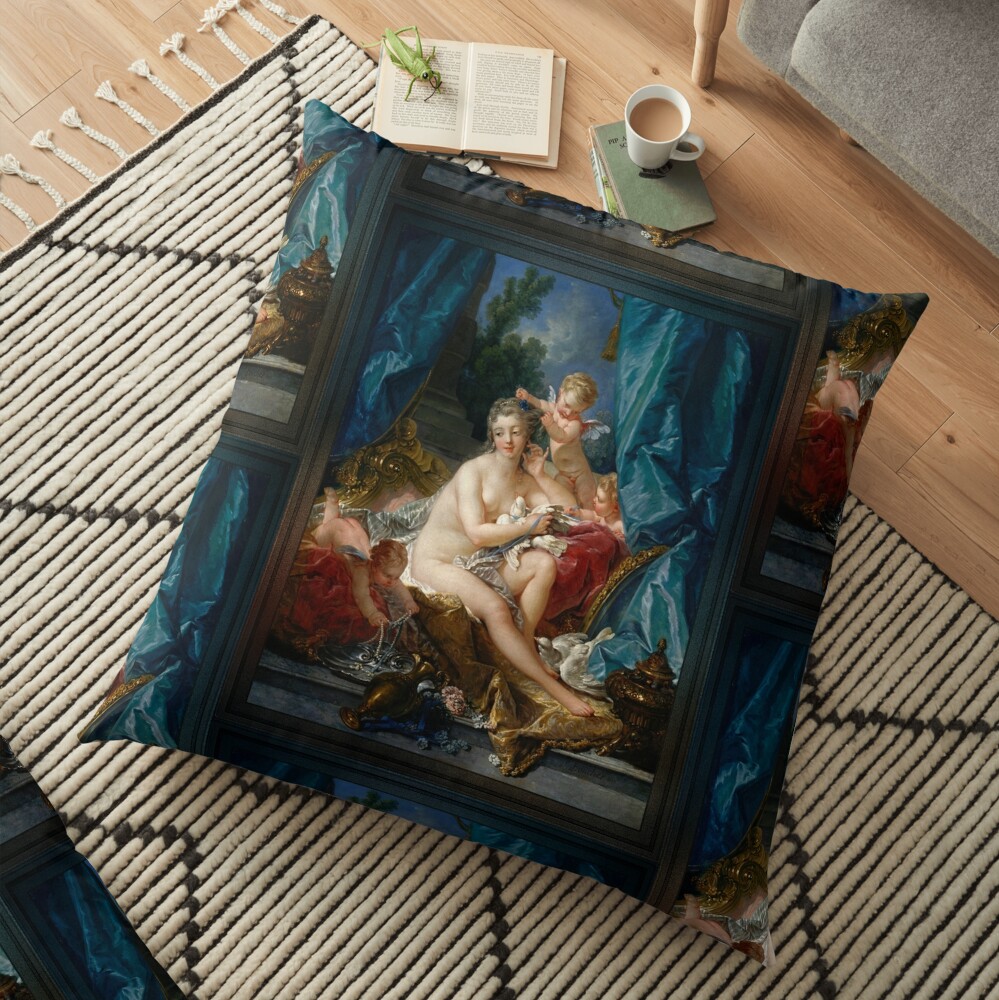
Het toilet van Venus, this version was painted by François Boucher (1703 – 1770) rondom 1751; and stands as a quintessential example of Rococo art, embodying its characteristic sensuality, elegantie, and playful depiction of mythological themes. Dit grootschalige canvas, currently residing in the Louvre Museum, transports viewers to a realm of idyllic beauty and leisurely indulgence, showcasing Boucher’s mastery of color, licht, en compositie. The painting is not merely a representation of the goddess Venus; it’s an exploration of feminine grace within a carefully constructed fantasy landscape.
Inhoudsopgave
A Scene of Delicate Rituals
De centrale figuur, undeniably Venus (Aphrodite in Greek mythology), reclines upon a lavishly adorned chaise lounge. She is depicted mid-action, engaged in the intimate act of dressing her hair. Her posture is relaxed and graceful, conveying an air of serene contentment rather than any sense of formality or grandeur. The artist’s focus isn’t on portraying Venus as a powerful deity but rather as a beautiful woman enjoying a moment of personal care.
She holds a small mirror to one side, seemingly admiring her reflection while a handmaid gently arranges ribbons in her hair. This intimate scene is far removed from the heroic narratives often associated with classical mythology; in plaats van, it emphasizes domesticity and private pleasure.
Cherubic Companions & Decorative Details
Surrounding Venus are several cherubs, characteristic figures within Rococo art. These playful spirits flit about, attending to the goddess’s needs. One cherub playfully blows bubbles, while another offers a bouquet of flowers. Their presence adds an element of lightness and whimsy to the scene, reinforcing the overall atmosphere of carefree enjoyment.
The chaise lounge itself is a masterpiece of decorative detail, featuring intricate carvings and luxurious fabrics in rich reds and golds. Scattered around Venus are various objects associated with beauty and adornment: perfume bottles, scattered roses, sieraden, and a small white rabbit – all contributing to the painting’s opulent aesthetic.
A Stage Setting of Opulence & Natuur
The setting for this idyllic scene is equally important. Heavy blue draperies frame the composition on either side, creating a sense of theatricality and enclosure. Beyond these curtains lies a glimpse of a lush garden with verdant trees and classical architecture in the distance. This carefully constructed backdrop suggests a secluded paradise, further enhancing the feeling of privacy and indulgence. The use of light is particularly noteworthy; Boucher masterfully employs soft, diffused lighting to illuminate Venus’s figure, highlighting her skin’s luminosity and creating a sense of warmth and intimacy.
Kleurenpalet & Artistieke techniek
Boucher’s color palette in “The Toilet of Venus” is dominated by pastel hues – pinks, blues, Groenen, and golds – which are hallmarks of the Rococo style. These soft colors contribute to the painting’s overall feeling of lightness and delicacy. His brushwork is loose and fluid, creating a sense of movement and spontaneity. The artist’s technique prioritizes capturing the essence of beauty and pleasure over strict realism. He uses subtle gradations of color to model Venus’s form, emphasizing her curves and contours while maintaining an ethereal quality.

Context & Nalatenschap
“The Toilet of Venus” was created during a period when Rococo art flourished in France, particularly under the patronage of Madame de Pompadour, Louis XV’s influential mistress. Boucher became the leading artist of this style, known for his decorative paintings that catered to the tastes of the aristocracy. The painting reflects the prevailing cultural values of the time – an emphasis on pleasure, schoonheid, and refined leisure.
It’s a testament to Boucher’s ability to create visually stunning works that captured the spirit of the Rococo era and continues to captivate audiences with its charm and elegance. The work’s influence can be seen in subsequent artistic trends, particularly in depictions of idealized feminine figures and the use of decorative elements to enhance visual appeal.
Kunstenaar bio van Wikipedia.org
Een inwoner van Parijs, Boucher was de zoon van een minder bekende schilder Nicolas Boucher, die hem zijn eerste artistieke opleiding gaf. Op de leeftijd van zeventien, een schilderij van Boucher werd bewonderd door de schilder François Lemoyne. Lemoyne benoemde later Boucher als zijn leerling, maar na slechts drie maanden, hij ging werken voor de graveur Jean-François Cars.
In 1720, hij won de elite Grand Prix de Rome voor schilderen, maar maakte pas vijf jaar later gebruik van de daaruit voortvloeiende kans om in Italië te studeren, vanwege financiële problemen bij de Koninklijke Academie voor Schilderkunst en Beeldhouwkunst.[1] Bij zijn terugkeer van zijn studie in Italië werd hij toegelaten tot de opnieuw opgerichte Académie de peinture et de sculpture on 24 november 1731. Zijn receptie stuk (receptie stuk) was zijn Rinaldo en Armida van 1734.
Boucher huwde Marie-Jeanne Buzeau in 1733. Het echtpaar kreeg samen drie kinderen. Boucher werd een faculteitslid in 1734 en zijn carrière versnelde vanaf dit punt toen hij werd gepromoveerd tot hoogleraar en vervolgens tot rector van de Academie, inspecteur worden bij de Royal Gobelins Manufactory en uiteindelijk Premier Peintre du Roi (Eerste schilder van de koning) in 1765. Portret van Marie-Louise O'Murphy c. 1752
Boucher stierf op 30 Kunnen 1770 in zijn geboorteland Parijs. Zijn naam, samen met die van zijn beschermheer Madame de Pompadour, synoniem was geworden met de Franse Rococo-stijl, de gebroeders Goncourt ertoe brengen te schrijven: “Boucher is een van die mannen die de smaak van een eeuw vertegenwoordigen, wie uiten, personifiëren en belichamen.”
Boucher staat erom bekend dat de natuur dat is “te groen en slecht verlicht” (te groen en slecht verlicht).
Boucher werd geassocieerd met de edelsteengraveur Jacques Guay, wie hij leerde tekenen. Hij begeleidde ook de Moravisch-Oostenrijkse schilder Martin Ferdinand Quadal en de neoklassieke schilder Jacques-Louis David in 1767.[4] Later, Boucher maakte een reeks tekeningen van werken van Guay, die Madame de Pompadour vervolgens graveerde en als een mooi gebonden boekdeel verspreidde onder bevoorrechte hovelingen
Het toilet van Venus is een geretoucheerde digitale kunstreproductie van een afbeelding uit het publieke domein, die kan worden gekocht als een canvas print online.