

Odalisque c1858
“Odalisque c1858” is a masterpiece by the French artist Henri Pierre Pico, who lived from 1824 per 1895. Painted in 1858, this artwork represents a fine example of Romanticism, a movement that sought to convey deep emotion, sensualità, and vivid imagery. The subject matter and composition reflect the opulence and sensuality typical of the 19th-century French salons. Picou’s work, filled with vivid color and graceful detail, encapsulates the atmosphere of the Orient and the allure of the harem, an artistic theme that gained popularity in European art during the 19th century.
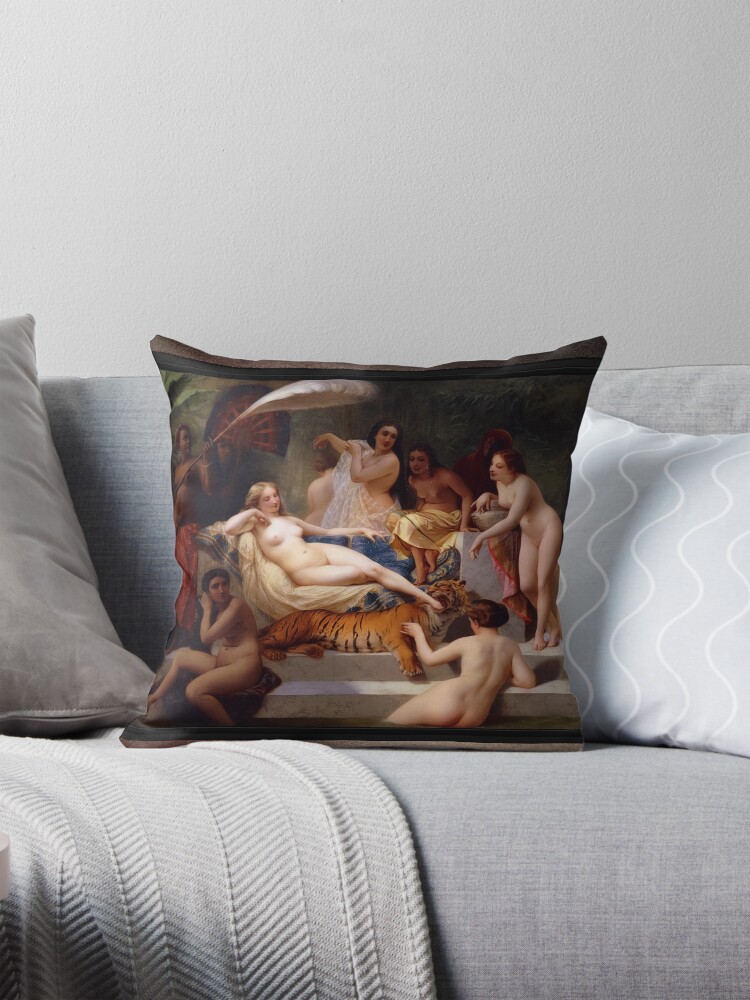
The painting depicts an exotic and opulent scene set within a lush, green garden. In primo piano, a reclining nude woman lies draped over a luxurious tiger skin rug, her body elegantly posed to convey both relaxation and sensuality.
Il soggetto del dipinto, often referred to as an “odalisque” in the art world, refers to a woman in a harem, typically a concubine or servant, though in this case, the figure embodies a sense of power and beauty rather than mere submission. The subject’s position, partially turned to the side, suggests a moment of repose, and her expression, while not overly emotive, evokes a serene yet slightly aloof mood. The figure is meticulously detailed, con morbido, porcelain-like skin that contrasts with the vivid richness of her surroundings.
Sommario
The Setting and Composition
The background of the painting is a lush, impostazione naturale, with the surrounding foliage creating a sense of depth and enclosure. The warm tones of the earth and the deep greens of the trees contrast against the vibrant golds and turquoises of the woman’s attire, which consists of flowing, sheer fabrics. These colors and textures evoke a sense of Eastern luxury, in line with the Romanticized view of the Orient that was prevalent in European art of the time.
The setting itself, comprising not just a garden but also figures of other women and servants—adds a sense of social hierarchy to the piece. Sullo sfondo, several other figures are partially visible. Some women are depicted in various stages of undress, attending to the main figure in a way that suggests both intimacy and exotic allure. The way they are positioned around the central figure highlights the harem setting and the role of women within it. The inclusion of a tiger further adds to the exoticism, as it symbolizes power and mystery, reflecting the theme of untamed nature and luxury.
The Figures and Their Role
In addition to the reclining odalisque, the painting features a number of secondary figures, including female attendants and an exotic servant. One such figure stands at the back, holding a fan and facing the central figure, adding to the dynamic of the scene. The presence of these figures serves to reinforce the sense of the harem environment, where women are not only objects of desire but also part of a larger, intricate social structure.
The figures in the painting are rendered with remarkable attention to detail, especially in terms of their anatomy and expressions. The artist pays great care to the human form, emphasizing the smoothness and softness of the flesh in stark contrast to the more tactile textures of the tiger skin rug and the surrounding environment. The female figures, each with their unique postures and roles, form a visual harmony that draws the viewer’s eye back to the central reclining figure.
Symbolism and Theme
The central theme of the painting is the depiction of female sensuality, and by extension, the romanticized concept of the Orient. In the 19th century, the harem became a popular subject in European art, often seen as a symbol of luxury, forbidden beauty, and exotic allure. tuttavia, Picou’s portrayal moves beyond a simple depiction of sensuality, suggesting a more complex narrative about power, desire, and the roles of women in different cultures.
The use of the tiger skin rug as a central motif is highly symbolic. Tigers, in European art, were often associated with untamed forces, forza, and sometimes danger. La donna, by lying atop the tiger, suggests her control over the ferocity and wildness of the animal, a metaphor for both her own power and the heightened sense of mystery associated with the East. The female form, smooth and vulnerable, is in contrast with the wildness of the tiger, yet it is not subdued or submissive, it is regal, calma, and in control of her surroundings.
The harem, as depicted in this piece, is less a place of confinement than a space of empowerment and mystery, where women exist outside the usual rules of society and are able to express a more sensual and liberated existence. This is reflected in the calm demeanor of the central figure and the luxuriousness of the scene itself. By presenting the odalisque in a state of repose, Picou adds a layer of depth to the piece, suggesting that the woman’s power lies not in overt action, but in her allure, her mystery, and her presence.
The Mood and Emotional Tone
The mood of the painting is one of quiet luxury and latent power. The serene expression of the central figure contrasts with the more active, yet passive, roles of the other women and the exotic environment around her. The sensuality in the painting is not overtly provocative but is instead conveyed through the soft lines of the female form, the opulence of the setting, and the harmonious interaction between the figures and their surroundings. There is an almost dreamlike quality to the scene, enhanced by the naturalistic details and the rich color palette.
The interaction between the various figures in the painting, some passive, others active, creates a subtle tension within the composition. This interplay of emotions and roles adds a layer of narrative complexity to the piece, allowing the viewer to interpret the scene in a variety of ways, depending on their own perspective.
Conclusione
Henri-Pierre Picou’s “Odalisque c1858” is an exquisite representation of 19th-century French Romanticism. Through the lush, sensual portrayal of the reclining figure and the exotic environment, Picou creates a mood that combines luxury with mystery. The painting encapsulates the fascination with the Orient that was prevalent during the era, while also exploring themes of power, sensualità, e femminilità. Its careful composition, attenzione ai dettagli, and use of symbolism make it a work of enduring beauty, capturing a moment in time when the allure of the harem was woven into the fabric of European artistic imagination.
Odalisque c1858 by French Painter Henri Pierre Pico (1824 – 1895); noto per i suoi primi ritratti e soggetti storici e nei suoi ultimi anni per i suoi temi allegorici e mitologici
An Odalisque was a female attendant or chambermaid in a Turkish Seraglio (un alloggio sequestrato usato da mogli e concubine in una famiglia ottomana.).
This Odalisque painting shows a nude central female figure who may be the main wife or Concubine, is resting on a marble couch that is padded with decorative pillows and sheets; that is part of a double stacked marble base that leads to a pool; and in the background there are green plants.
She is surrounded by eight other nude women; two that are partially in the pool of water. with one petting a young tiger that is putting the foot of the main female into its mouth.
There are also three more females (which are most like the Odalisque), that one can assume are slaves that are providing for the needs of the other women that are relaxing on the marble pedestal.
Odalisque is a retouched digital art old masters reproduction of a public domain image that you can purchase as home decor wall art prints.
Questa creazione di arte digitale, come tutte le opere d'arte che si possono trovare sul sito Web di Xzendor7 è disponibile per l'acquisto online in una varietà di formati di materiali, comprese le stampe su tela, stampe acriliche, stampe in metallo, stampe su legno, stampe incorniciate, manifesti, e come stampe su tela arrotolata in una varietà di formati da 12 pollici a 72 pollici a seconda delle dimensioni dell'opera d'arte effettiva e del negozio di stampa su richiesta da cui scegli di acquistare l'arte.
L'opera d'arte è disponibile anche su un'ampia gamma di abbigliamento da uomo e da donna, tazze, borse, sciarpe, quaderni e diari e tanti prodotti per l'arredamento della casa.
Biografia dell'artista
Informazioni di seguito derivate da Wikipedia.org
Henri-Pierre è stato un pittore accademico e uno dei fondatori della scuola neogreca, insieme ai suoi amici più cari Gustave Boulanger, Jean-Léon Gérôme, e Jean Louis Hamon, anche pittori accademici.
All of the men studied in the workshops of both Paul Delaroche and later Charles Gleyre. Picou’s style was noticeably influenced by Gleyre; while the rest of the group generally painted classical and mythological subjects.
Picou first debuted is artistic style at the Salon in 1847; and the following year was awarded a second-class medal for his painting, Cléopâtre et Antoine sur le Cydnus. Also known as Cleopatra on the Cydnus, it is commonly regarded as Picou’s masterpiece.
The showing at the Salon in 1848 di Cléopâtre et Antoine sur le Cydnus è stato scritto dal critico Théophile Gautier, che pensavano che l'argomento fosse troppo ambizioso, ma ha anche detto che “Così com'è, dà la migliore speranza per il futuro del giovane artista, e si colloca tra i sette o otto dipinti più importanti del Salon.”
Nel 1875, il dipinto è stato esposto a New York, e poi ha trovato posto sui muri di una galleria d'arte privata a San Francisco.
Picou ha mantenuto un grande laboratorio a Parigi sul Boulevard de Magenta, which provided him room to work on his expansive frescoes. His popularity continued to rise and he went on to win the Second Prix de Rome in 1853 per la sua pittura, Jésus chassant les vendeurs du Temple (The Moneylenders Chased from the Temple), and another second-class medal for his Salon painting in 1857.
Dal momento del suo debutto in 1847, divenne un assiduo frequentatore del Salon, mostrando quasi ogni anno fino alla sua mostra finale in 1893. È stato definito il pittore più alla moda verso la fine del Secondo Impero francese; e ha ricevuto molte commissioni, comprese commissioni per grandi affreschi religiosi di molte chiese, che includeva l'Église Saint-Roch.