

Odalisque c1858
“Odalisque c1858” is a masterpiece by the French artist Henri Pierre Picou, who lived from 1824 do 1895. Painted in 1858, this artwork represents a fine example of Romanticism, a movement that sought to convey deep emotion, zmysłowość, and vivid imagery. The subject matter and composition reflect the opulence and sensuality typical of the 19th-century French salons. Picou’s work, filled with vivid color and graceful detail, encapsulates the atmosphere of the Orient and the allure of the harem, an artistic theme that gained popularity in European art during the 19th century.
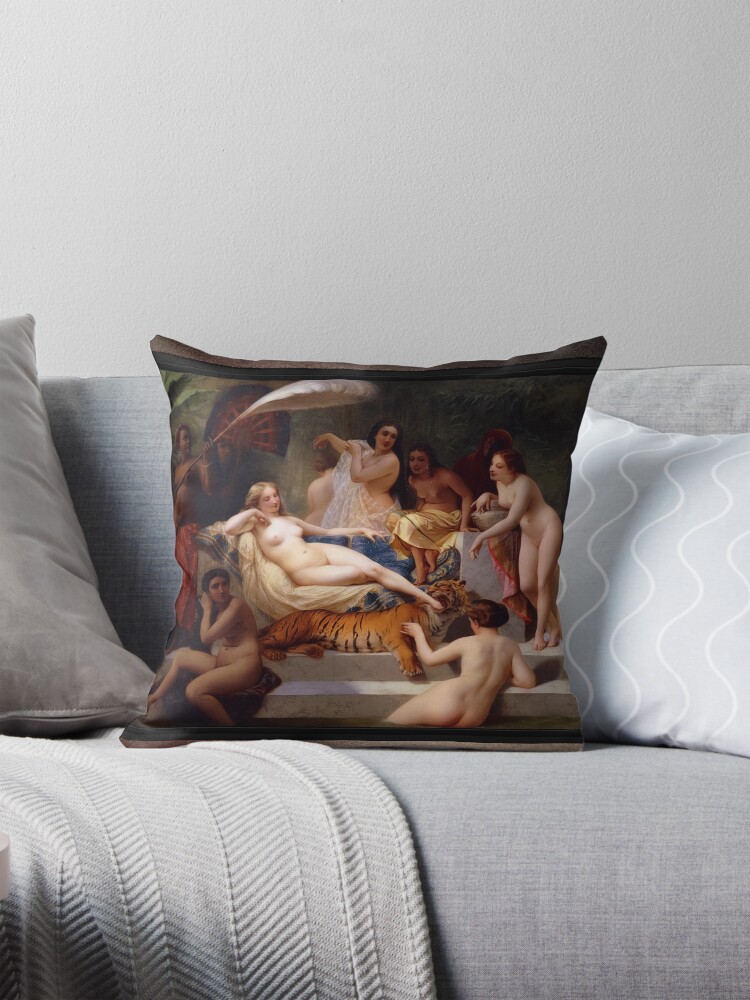
The painting depicts an exotic and opulent scene set within a lush, green garden. Na pierwszym planie, a reclining nude woman lies draped over a luxurious tiger skin rug, her body elegantly posed to convey both relaxation and sensuality.
Temat obrazu, often referred to as an “odalisque” in the art world, refers to a woman in a harem, typically a concubine or servant, though in this case, the figure embodies a sense of power and beauty rather than mere submission. The subject’s position, partially turned to the side, suggests a moment of repose, and her expression, while not overly emotive, evokes a serene yet slightly aloof mood. The figure is meticulously detailed, z miękkim, porcelain-like skin that contrasts with the vivid richness of her surroundings.
Spis treści
Ustawienie i kompozycja
The background of the painting is a lush, naturalne otoczenie, with the surrounding foliage creating a sense of depth and enclosure. The warm tones of the earth and the deep greens of the trees contrast against the vibrant golds and turquoises of the woman’s attire, which consists of flowing, sheer fabrics. These colors and textures evoke a sense of Eastern luxury, in line with the Romanticized view of the Orient that was prevalent in European art of the time.
The setting itself, comprising not just a garden but also figures of other women and servants—adds a sense of social hierarchy to the piece. W tle, several other figures are partially visible. Some women are depicted in various stages of undress, attending to the main figure in a way that suggests both intimacy and exotic allure. The way they are positioned around the central figure highlights the harem setting and the role of women within it. The inclusion of a tiger further adds to the exoticism, as it symbolizes power and mystery, reflecting the theme of untamed nature and luxury.
The Figures and Their Role
In addition to the reclining odalisque, the painting features a number of secondary figures, including female attendants and an exotic servant. One such figure stands at the back, holding a fan and facing the central figure, adding to the dynamic of the scene. The presence of these figures serves to reinforce the sense of the harem environment, where women are not only objects of desire but also part of a larger, intricate social structure.
The figures in the painting are rendered with remarkable attention to detail, especially in terms of their anatomy and expressions. The artist pays great care to the human form, emphasizing the smoothness and softness of the flesh in stark contrast to the more tactile textures of the tiger skin rug and the surrounding environment. The female figures, each with their unique postures and roles, form a visual harmony that draws the viewer’s eye back to the central reclining figure.
Symbolism and Theme
The central theme of the painting is the depiction of female sensuality, and by extension, the romanticized concept of the Orient. In the 19th century, the harem became a popular subject in European art, often seen as a symbol of luxury, forbidden beauty, and exotic allure. jednak, Picou’s portrayal moves beyond a simple depiction of sensuality, suggesting a more complex narrative about power, pragnienie, and the roles of women in different cultures.
The use of the tiger skin rug as a central motif is highly symbolic. Tigers, in European art, were often associated with untamed forces, wytrzymałość, and sometimes danger. Kobieta, by lying atop the tiger, suggests her control over the ferocity and wildness of the animal, a metaphor for both her own power and the heightened sense of mystery associated with the East. The female form, smooth and vulnerable, is in contrast with the wildness of the tiger, yet it is not subdued or submissive, it is regal, spokój, and in control of her surroundings.
The harem, as depicted in this piece, is less a place of confinement than a space of empowerment and mystery, where women exist outside the usual rules of society and are able to express a more sensual and liberated existence. This is reflected in the calm demeanor of the central figure and the luxuriousness of the scene itself. By presenting the odalisque in a state of repose, Picou adds a layer of depth to the piece, suggesting that the woman’s power lies not in overt action, but in her allure, her mystery, and her presence.
The Mood and Emotional Tone
The mood of the painting is one of quiet luxury and latent power. The serene expression of the central figure contrasts with the more active, yet passive, roles of the other women and the exotic environment around her. The sensuality in the painting is not overtly provocative but is instead conveyed through the soft lines of the female form, the opulence of the setting, and the harmonious interaction between the figures and their surroundings. There is an almost dreamlike quality to the scene, enhanced by the naturalistic details and the rich color palette.
The interaction between the various figures in the painting, some passive, others active, creates a subtle tension within the composition. This interplay of emotions and roles adds a layer of narrative complexity to the piece, allowing the viewer to interpret the scene in a variety of ways, depending on their own perspective.
Wniosek
Henri-Pierre Picou’s “Odalisque c1858” is an exquisite representation of 19th-century French Romanticism. Through the lush, sensual portrayal of the reclining figure and the exotic environment, Picou creates a mood that combines luxury with mystery. The painting encapsulates the fascination with the Orient that was prevalent during the era, while also exploring themes of power, zmysłowość, and femininity. Its careful composition, dbałość o szczegóły, and use of symbolism make it a work of enduring beauty, capturing a moment in time when the allure of the harem was woven into the fabric of European artistic imagination.
Odalisque c1858 by French Painter Henri Pierre Picou (1824 – 1895); znany ze swoich wczesnych prac portretowych i tematyki historycznej, a w późniejszych latach z tematów alegorycznych i mitologicznych
An Odalisque was a female attendant or chambermaid in a Turkish Seraglio (a sequestered living quarter used by wives and concubines in an Ottoman household.).
This Odalisque painting shows a nude central female figure who may be the main wife or Concubine, is resting on a marble couch that is padded with decorative pillows and sheets; that is part of a double stacked marble base that leads to a pool; and in the background there are green plants.
She is surrounded by eight other nude women; two that are partially in the pool of water. with one petting a young tiger that is putting the foot of the main female into its mouth.
There are also three more females (which are most like the Odalisque), that one can assume are slaves that are providing for the needs of the other women that are relaxing on the marble pedestal.
Odalisque is a retouched digital art old masters reproduction of a public domain image that you can purchase as home decor wall art prints.
To dzieło sztuki cyfrowej, podobnie jak wszystkie dzieła sztuki, które można znaleźć na stronie internetowej Xzendor7, można kupić online w różnych formatach materiałów, w tym odbitki na płótnie, wydruki akrylowe, metalowe nadruki, druki na drewnie, wydruki w ramkach, plakaty, oraz jako zwinięte wydruki na płótnie w różnych rozmiarach od 12 cale do 72 cale w zależności od rozmiaru rzeczywistej grafiki i sklepu z drukiem na żądanie, w którym zdecydujesz się kupić sztukę.
Grafika jest również dostępna na szerokiej gamie odzieży męskiej i damskiej, kubki, torby, szaliki, notesy i czasopisma oraz wiele produktów do dekoracji wnętrz.
Biografia artysty
Informacje poniżej pochodzą z Wikipedia.org
Henri-Pierre był malarzem akademickim i jednym z założycieli szkoły neogreckiej, wraz ze swoimi bliskimi przyjaciółmi Gustavem Boulanger, Jean-Leon Gerome, i Jean-Louis Hamon, także malarze akademiccy.
Wszyscy mężczyźni studiowali w warsztatach zarówno Paula Delaroche’a, jak i późniejszego Charlesa Gleyre’a. Na styl Picou zauważalny wpływ miał Gleyre; podczas gdy reszta grupy malowała głównie tematy klasyczne i mitologiczne.
Picou po raz pierwszy zadebiutowała swoim stylem artystycznym na Salonie w 1847; a rok później za swoje malarstwo otrzymał medal II stopnia, Kleopatra i Antoniusz nad Cydnus. Znana również jako Kleopatra nad Cydnus, jest powszechnie uważany za arcydzieło Picou.
Pokaz w Salonie w 1848 o Kleopatrze i Antoniuszu nad Cydnus pisał krytyk Théophile Gautier, którzy uznali, że temat jest zbyt ambitny, ale też to powiedział “Tak jak jest, daje największe nadzieje na przyszłość młodego artysty, i plasuje się wśród siedmiu lub ośmiu najważniejszych obrazów Salonu.”
W 1875, obraz był wystawiany w Nowym Jorku, a potem znalazł miejsce na ścianach prywatnej galerii sztuki w San Francisco.
Picou prowadził duży warsztat w Paryżu przy Boulevard de Magenta, co zapewniło mu miejsce do pracy nad rozległymi freskami. Jego popularność stale rosła, a on zdobył drugą nagrodę Prix de Rome w 1853 za swoje malarstwo, Jezus wypędza sprzedawców ze świątyni (Lichwiarze wypędzeni ze świątyni), i kolejny medal drugiej klasy za malarstwo w Salonie 1857.
Od czasu swojego debiutu w 1847, stał się stałym bywalcem Salonu, pokazywany prawie co roku, aż do swojej ostatniej wystawy w 1893. Nazywany najmodniejszym malarzem schyłku II Cesarstwa Francuskiego; i otrzymał wiele prowizji, w tym komisje na duże freski religijne z wielu kościołów, który obejmował Église Saint-Roch.