

Sur la Pintkunveno c1903
“Sur la Pintkunveno (Sur la Pintoj),” kreita en 1903 de la fama franca pentristo Pascal-Adolphe-Jean Dagnan-Bouveret (1852 – 1929), estas konvinka portreto, kiu kaptas la serenecon kaj gracon de virino inter la mirinda pejzaĝo de la Alpoj.. Ĉi tiu arto montras la esceptan kapablon de Dagnan-Bouveret en miksi naturan belecon kun homa emocio., portretante kaj la grandiozecon de naturo kaj la introspekton de la homa spirito.
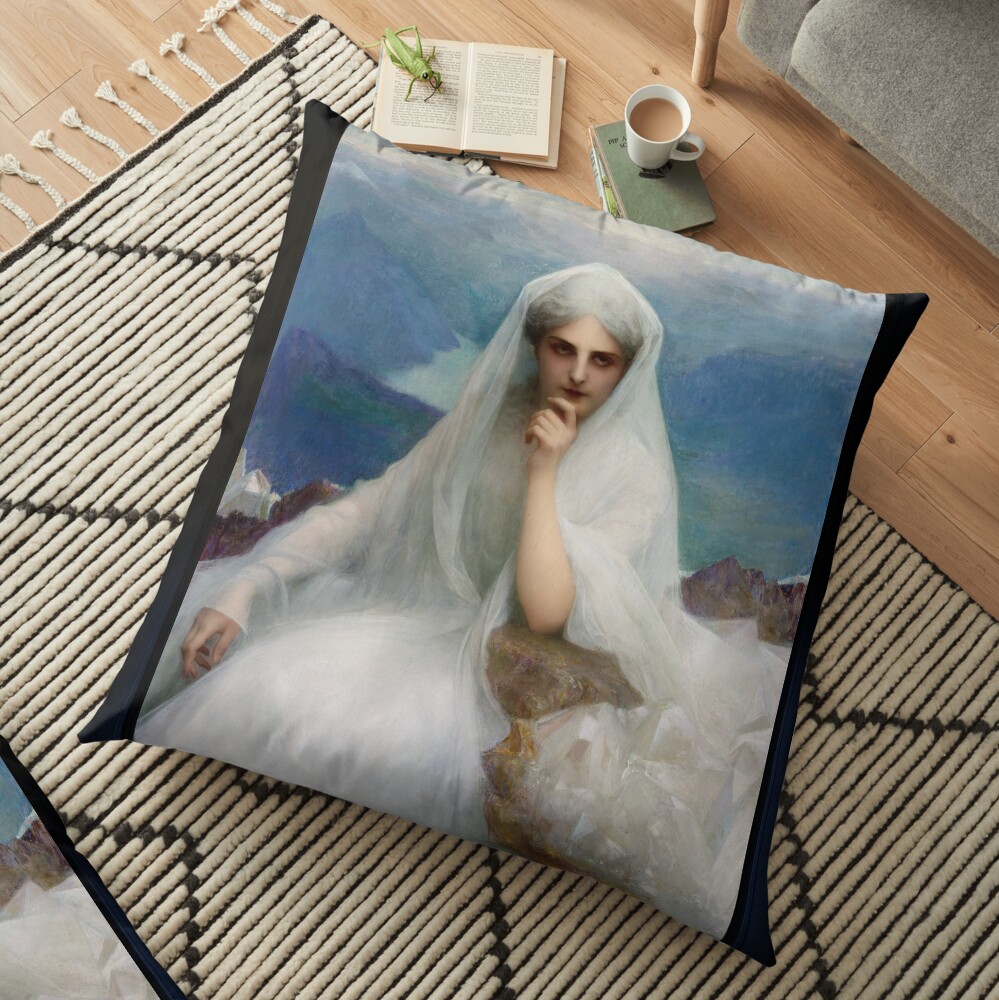
La sceno estas elvokiva bildigo de izola figuro, virino drapirita en fluanta blanka vualo, sidante sur roka krutaĵo, rigardante mediteme en la malproksimon. La verko estas perfekta ekzemplo de la Simbolisma movado, kiu estis elstara dum la malfruaj 19-a kaj fruaj 20-a jarcentoj, kaj ankaŭ estas influita per la realismo kaj atento al detaloj por kiuj Dagnan-Bouveret estas konata.
Enhavtabelo
La Centra Figuro
Ĉe la koro de la komponado estas la virino, kies ĉeesto regas la scenon. Ŝi estas prezentita kiel etera, preskaŭ spektra figuro, ŝia vizaĝo parte obskurita de vualo, kiu ondas ĉirkaŭ ŝi, rememoriga pri dia aŭ mita ento. La vualo, blanka kaj diafana, subtile kontrastas kun la ĉirkaŭa roka tereno, emfazante ŝian alimondan naturon.
Ŝia mieno estas pensema, her eyes gazing into the distance with a contemplative and almost melancholic expression, as though she is caught in a moment of deep reflection. One of her hands rests gently on a rock beside her, while the other is poised to touch her chin, suggesting a moment of introspection or quiet meditation.
Her attire is simple yet elegant, dominated by the white fabric of her veil and gown. The whiteness of her garments symbolizes purity, Senkulpeco, and perhaps a spiritual connection to the natural world around her.
The softness of the fabric contrasts with the ruggedness of the mountains and rocks, reinforcing the juxtaposition between human fragility and the vast, enduring force of nature. The figure is both delicate and resilient, a representation of human vulnerability in the face of the infinite.
La Pejzaĝo
The backdrop of the painting features a breathtaking alpine landscape, with distant mountains that are hazy and almost dreamlike in their appearance. The colors of the mountains are soft, muted blues and purples, suggesting the distance and grandeur of the landscape. The peaks are shrouded in mist, which lends a mystical quality to the scene. The vastness of the terrain further enhances the solitude of the woman, emphasizing her isolation and the introspective nature of the moment.
En la malfono, the rocky outcrop on which the woman sits is painted with meticulous detail, the sharp edges and rough textures of the rocks providing a stark contrast to the smooth, flowing lines of her gown and veil. The rocks themselves are an integral part of the composition, anchoring the figure to the earth while simultaneously highlighting her detachment from the physical world around her. These elements of the landscape are bathed in soft, difuzita lumo, adding to the dreamlike atmosphere of the painting.
Simboleco kaj Temoj
Dagnan-Bouveret’s use of symbolism in “Sur la Pintkunveno” invites viewers to interpret the painting on multiple levels. The woman’s white attire and veil suggest purity, but they also evoke themes of spiritual transcendence, as though she is part of an eternal, ethereal world. Her introspective gaze might symbolize a quest for understanding or a search for meaning in the face of nature’s immensity. La vualo, an often-used symbol in art, may suggest a barrier between the material and spiritual realms, hinting at the idea of veiled truths or the mysteries of the universe.
The woman’s isolation on the summit of the mountain evokes themes of solitude, contemplation, and perhaps even existential reflection. In the face of the infinite landscape, she is small and insignificant, yet her calm demeanor suggests a harmonious relationship with her surroundings. Her quiet presence contrasts with the powerful forces of nature that dominate the painting, perhaps symbolizing the resilience of the human spirit in the face of the vast unknown.
The symbolism of the mountain itself is significant. Mountains have long been associated with strength, endurance, kaj transcendeco, and in many cultures, they represent a place where the divine meets the earth. In this context, the summit where the woman sits could be interpreted as a spiritual or meditative place, a threshold between the earthly and the celestial.
Arta stilo kaj tekniko
La pentraĵo de Dagnan-Bouveret montras majstradon de kaj naturalismo kaj idealigo, karakterizaĵo de la simbolisma movado. Lia kapablo kapti la nuancojn de lumo kaj teksturo en la pejzaĝo estas evidenta en la delikata uzado de la foraj montoj., kiuj aperas preskaŭ molaj kaj vaporaj kontraste al la akraj, klaraj linioj de la figuro en la malfono. La atento al detaloj en la vesto de la virino kaj la ŝtona tereno estas indika de la engaĝiĝo de la artisto al realismo., dum la ĝenerala komponado, kun ĝia mola kolora paletro kaj sonĝeca kvalito, levas la pentraĵon al la sfero de la simbola kaj la sublima.
La uzo de lumo en la pentraĵo estas subtila sed efika. La milda lumigado sur la vizaĝo de la figuro kaj la brila blankeco de ŝia vualo kontrastas kun la malvarmigilo, pli malgajaj tonoj de la ĉirkaŭa pejzaĝo. Ĉi tiu interagado de lumo kaj ombro kreas senton de profundo kaj volumeno, plibonigante la tridimensiecon de la figuroj kaj la naturaj elementoj. La peniko estas delikata kaj fluida, kun glataj transiroj inter lumo kaj mallumo, pruntedonante al la pentraĵo senton de atmosfero kiu estas kaj trankvila kaj introspektiva.
Konkludo
“Sur la Pintkunveno (Sur la Pintoj)” c1903 estas profunda artverko kiu kombinas realismon, Simbolismo, kaj esplorado de la rilato inter homaro kaj naturo. La soleca figuro de la virino, ŝia kontemplado inter la majesta alpa pejzaĝo, invitas spektantojn pripensi sian propran ligon al la mondo ĉirkaŭ ili. La delikata uzado de lumo de Dagnan-Bouveret, koloro, and texture creates an otherworldly atmosphere, one in which the boundaries between the physical and spiritual realms seem to blur. The painting is both a visual feast and a thought-provoking meditation on solitude, transcendeco, and the eternal mysteries of the natural world.
Sur la Pintkunveno (Sur la Pintoj) c1903 by French Painter Pascal-Adolphe-Jean Dagnan-Bouveret (1852 – 1929); a leading artists of the Naturalist School.
This painting depicts a maiden sitting on a mountain top that is dressed in a white robe and covered in a white veil which flows around her body and covers part of her head that is lightly covered with white frost.
By her left side is a stone cistern (a tank for storing water), filled with ice crystals and in the distance on her right is a valley that is surrounded by blue mountains and a glacial lake.
She has dark piercing eyes that are looking upward as if looking at something of great concern in the far distance has she rest her chin on her left hand with her elbow resting on the edge of the cistern; while her right hand rest on her right thigh.
Ĉi tio estas readaptita cifereca arta reproduktaĵo de malnovaj majstroj de publika domajna bildo disponebla kiel a tolo presaĵo rete.
Artisto Bio derivita de Vikipedio.org
Pascal was born in Paris France on January 7, 1852 and was raised by his grandfather, from which he took the name Bouveret after his father emigrated to Brazil.
He started his education in 1869, studying at the École des Beaux-Arts under French Painters Alexandre Cabanel (1823 – 1889) and Jean-Léon Gérôme (1824 – 1904) from 1869 al 1875.
De 1875 tra 1896 he exhibited at the Paris Salon, first exhibiting there in 1875, where in 1880 he won the first place for the painting “An Accident”; tiam en 1885 he received the medal of honor for his piece “Horses At The Watering Trough”.
During the 1880s Pascal along with French Painter Gustave Courtois (1852 – 1923), maintained a studio in a fashionable part of Paris called Neuilly-sur-Seine; and by this time was a well known and established leading artist known for his peasant scenes, mystical creations and religious compositions.
En 1891 Pascal was made an Officer of the Legion of Honour, and nine years later became a member of the Institut de France.