

On the Summit c1903
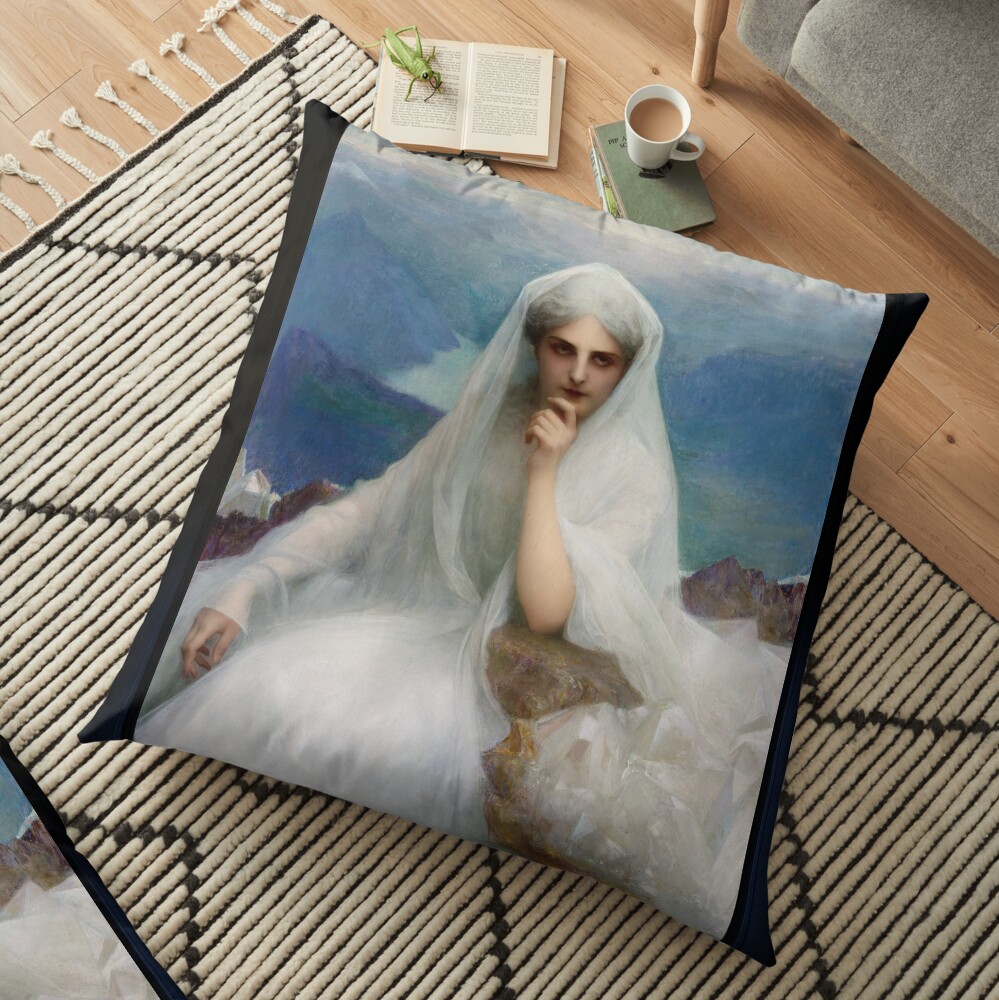
“On the Summit (על הפסגות),” נוצר ב 1903 by the renowned French painter Pascal-Adolphe-Jean Dagnan-Bouveret (1852 – 1929), is a compelling portrait that captures the serenity and grace of a woman amidst the stunning landscape of the Alps. This artwork demonstrates Dagnan-Bouveret’s exceptional skill in blending natural beauty with human emotion, portraying both the grandeur of nature and the introspection of the human spirit.
The scene is an evocative depiction of a solitary figure, a woman draped in a flowing white veil, sitting atop a rocky precipice, gazing contemplatively into the distance. The work is a perfect example of the Symbolist movement, which was prominent during the late 19th and early 20th centuries, and is also influenced by the realism and attention to detail for which Dagnan-Bouveret is known.
תוכן העניינים
הדמות המרכזית
At the heart of the composition is the woman, whose presence dominates the scene. She is depicted as an ethereal, almost spectral figure, her face partially obscured by a veil that billows around her, reminiscent of a divine or mythical entity. The veil, white and translucent, subtly contrasts with the surrounding rocky terrain, emphasizing her otherworldly nature.
Her expression is pensive, her eyes gazing into the distance with a contemplative and almost melancholic expression, as though she is caught in a moment of deep reflection. One of her hands rests gently on a rock beside her, while the other is poised to touch her chin, suggesting a moment of introspection or quiet meditation.
Her attire is simple yet elegant, dominated by the white fabric of her veil and gown. The whiteness of her garments symbolizes purity, תְמִימוּת, and perhaps a spiritual connection to the natural world around her.
The softness of the fabric contrasts with the ruggedness of the mountains and rocks, reinforcing the juxtaposition between human fragility and the vast, enduring force of nature. The figure is both delicate and resilient, a representation of human vulnerability in the face of the infinite.
The Landscape
The backdrop of the painting features a breathtaking alpine landscape, with distant mountains that are hazy and almost dreamlike in their appearance. The colors of the mountains are soft, muted blues and purples, suggesting the distance and grandeur of the landscape. The peaks are shrouded in mist, which lends a mystical quality to the scene. The vastness of the terrain further enhances the solitude of the woman, emphasizing her isolation and the introspective nature of the moment.
בחזית, the rocky outcrop on which the woman sits is painted with meticulous detail, the sharp edges and rough textures of the rocks providing a stark contrast to the smooth, flowing lines of her gown and veil. The rocks themselves are an integral part of the composition, anchoring the figure to the earth while simultaneously highlighting her detachment from the physical world around her. These elements of the landscape are bathed in soft, אור מפוזר, adding to the dreamlike atmosphere of the painting.
סמליות ונושאים
Dagnan-Bouveret’s use of symbolism in “On the Summit” invites viewers to interpret the painting on multiple levels. The woman’s white attire and veil suggest purity, but they also evoke themes of spiritual transcendence, as though she is part of an eternal, ethereal world. Her introspective gaze might symbolize a quest for understanding or a search for meaning in the face of nature’s immensity. The veil, an often-used symbol in art, may suggest a barrier between the material and spiritual realms, hinting at the idea of veiled truths or the mysteries of the universe.
The woman’s isolation on the summit of the mountain evokes themes of solitude, הִתבּוֹנְנוּת, and perhaps even existential reflection. In the face of the infinite landscape, she is small and insignificant, yet her calm demeanor suggests a harmonious relationship with her surroundings. Her quiet presence contrasts with the powerful forces of nature that dominate the painting, perhaps symbolizing the resilience of the human spirit in the face of the vast unknown.
The symbolism of the mountain itself is significant. Mountains have long been associated with strength, endurance, והתעלות, and in many cultures, they represent a place where the divine meets the earth. בהקשר זה, the summit where the woman sits could be interpreted as a spiritual or meditative place, a threshold between the earthly and the celestial.
סגנון וטכניקה אומנותית
Dagnan-Bouveret’s painting demonstrates a mastery of both naturalism and idealization, characteristic of the Symbolist movement. His ability to capture the nuances of light and texture in the landscape is evident in the delicate handling of the distant mountains, which appear almost soft and vaporous in contrast to the sharp, clear lines of the figure in the foreground. The attention to detail in the woman’s clothing and the rocky terrain is indicative of the artist’s commitment to realism, while the overall composition, with its soft color palette and dreamlike quality, elevates the painting to the realm of the symbolic and the sublime.
The use of light in the painting is subtle but effective. The soft illumination on the figure’s face and the glowing whiteness of her veil contrast with the cooler, more somber tones of the surrounding landscape. This interplay of light and shadow creates a sense of depth and volume, enhancing the three-dimensionality of the figures and the natural elements. The brushwork is delicate and fluid, with smooth transitions between light and dark, lending the painting a sense of atmosphere that is both tranquil and introspective.
מַסְקָנָה
“On the Summit (על הפסגות)” c1903 is a profound work of art that combines realism, symbolism, and an exploration of the relationship between humanity and nature. The solitary figure of the woman, her contemplation amidst the majestic alpine landscape, invites viewers to reflect on their own connection to the world around them. Dagnan-Bouveret’s delicate handling of light, צֶבַע, and texture creates an otherworldly atmosphere, one in which the boundaries between the physical and spiritual realms seem to blur. The painting is both a visual feast and a thought-provoking meditation on solitude, transcendence, and the eternal mysteries of the natural world.
On the Summit (על הפסגות) c1903 by French Painter Pascal-Adolphe-Jean Dagnan-Bouveret (1852 – 1929); אמנים מובילים של בית הספר לטבע.
This painting depicts a maiden sitting on a mountain top that is dressed in a white robe and covered in a white veil which flows around her body and covers part of her head that is lightly covered with white frost.
By her left side is a stone cistern (a tank for storing water), filled with ice crystals and in the distance on her right is a valley that is surrounded by blue mountains and a glacial lake.
She has dark piercing eyes that are looking upward as if looking at something of great concern in the far distance has she rest her chin on her left hand with her elbow resting on the edge of the cistern; while her right hand rest on her right thigh.
זהו רפרודוקציה של אמנות דיגיטלית מחודשת של אמן ישן של תמונה ברשות הרבים הזמינה בתור א הדפס קנבס באינטרנט.
אמן ביו שמקורו Wikipedia.org
פסקל נולד בפריז צרפת בינואר 7, 1852 וגדל אצל סבו, ממנו לקח את השם Bouveret לאחר שאביו היגר לברזיל.
הוא התחיל את לימודיו ב 1869, לומד ב-Ecole des Beaux-Arts אצל הציירים הצרפתים אלכסנדר קבנל (1823 – 1889) וז'אן לאון ג'רום (1824 – 1904) מ 1869 ל 1875.
מ 1875 דרך 1896 הוא הציג בסלון פריז, התערוכה הראשונה שם ב 1875, איפה ב 1880 הוא זכה במקום הראשון על הציור “תאונה”; ואז פנימה 1885 הוא קיבל את מדליית הכבוד על היצירה שלו “סוסים בצקת השקיה”.
במהלך שנות ה-80 פסקל יחד עם הצייר הצרפתי גוסטב קורטואה (1852 – 1923), החזיק סטודיו בחלק אופנתי של פריז בשם Neuilly-sur-Seine; ובזמן זה היה אמן מוביל ידוע ומבוסס הידוע בסצנות האיכרים שלו, יצירות מיסטיות ויצירות דתיות.
ב 1891 פסקל מונה לקצין לגיון הכבוד, ותשע שנים מאוחר יותר הפך לחבר במכון דה פראנס.