

On the Summit c1903
“サミットについて (オン・ザ・ピークス),” に作成されました 1903 有名なフランスの画家による パスカル・アドルフ・ジャン・ダグナン・ブヴレ (1852 – 1929), is a compelling portrait that captures the serenity and grace of a woman amidst the stunning landscape of the Alps. This artwork demonstrates Dagnan-Bouveret’s exceptional skill in blending natural beauty with human emotion, portraying both the grandeur of nature and the introspection of the human spirit.
The scene is an evocative depiction of a solitary figure, a woman draped in a flowing white veil, sitting atop a rocky precipice, gazing contemplatively into the distance. The work is a perfect example of the Symbolist movement, which was prominent during the late 19th and early 20th centuries, and is also influenced by the realism and attention to detail for which Dagnan-Bouveret is known.
目次
中央の人物
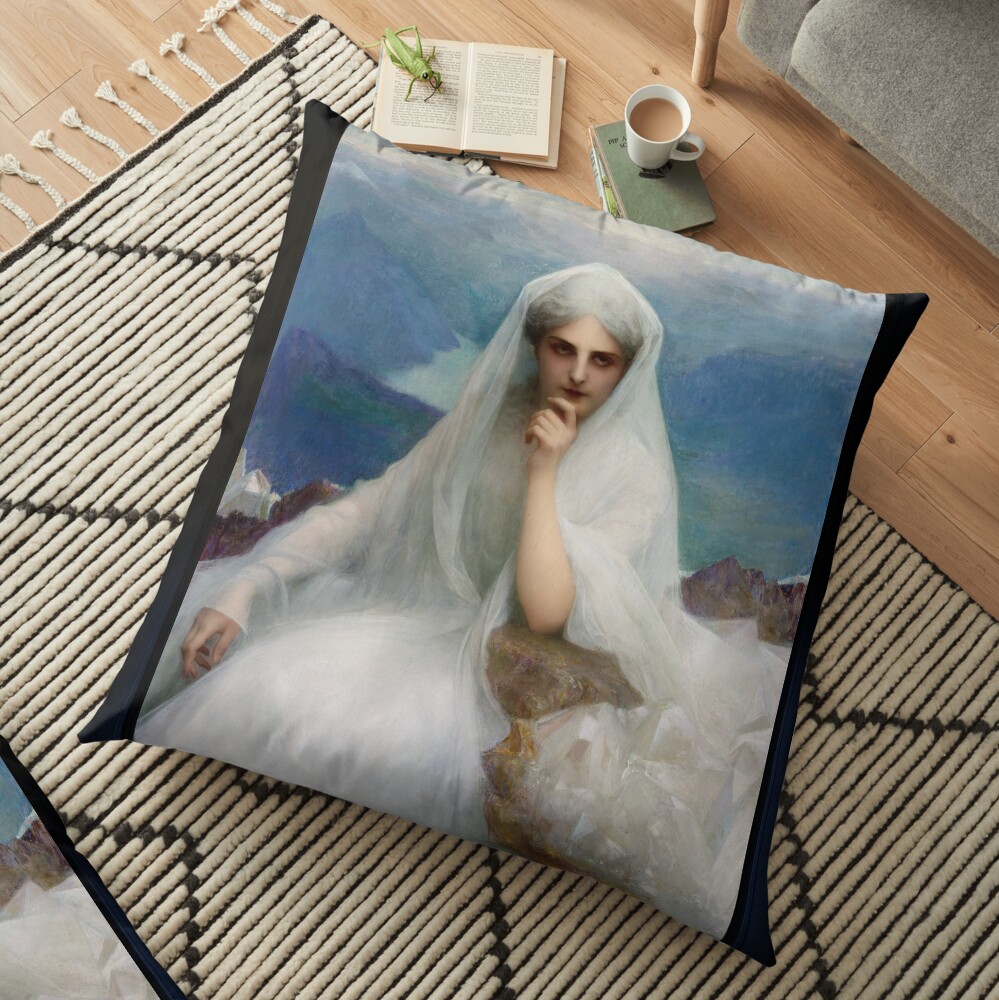
At the heart of the composition is the woman, whose presence dominates the scene. She is depicted as an ethereal, almost spectral figure, her face partially obscured by a veil that billows around her, reminiscent of a divine or mythical entity. ベール, white and translucent, subtly contrasts with the surrounding rocky terrain, emphasizing her otherworldly nature.
Her expression is pensive, her eyes gazing into the distance with a contemplative and almost melancholic expression, as though she is caught in a moment of deep reflection. One of her hands rests gently on a rock beside her, while the other is poised to touch her chin, suggesting a moment of introspection or quiet meditation.
Her attire is simple yet elegant, dominated by the white fabric of her veil and gown. The whiteness of her garments symbolizes purity, イノセンス, and perhaps a spiritual connection to the natural world around her.
The softness of the fabric contrasts with the ruggedness of the mountains and rocks, reinforcing the juxtaposition between human fragility and the vast, enduring force of nature. The figure is both delicate and resilient, a representation of human vulnerability in the face of the infinite.
The Landscape
The backdrop of the painting features a breathtaking alpine landscape, with distant mountains that are hazy and almost dreamlike in their appearance. The colors of the mountains are soft, muted blues and purples, suggesting the distance and grandeur of the landscape. The peaks are shrouded in mist, which lends a mystical quality to the scene. The vastness of the terrain further enhances the solitude of the woman, emphasizing her isolation and the introspective nature of the moment.
手前で, the rocky outcrop on which the woman sits is painted with meticulous detail, the sharp edges and rough textures of the rocks providing a stark contrast to the smooth, flowing lines of her gown and veil. The rocks themselves are an integral part of the composition, anchoring the figure to the earth while simultaneously highlighting her detachment from the physical world around her. These elements of the landscape are bathed in soft, 拡散光, adding to the dreamlike atmosphere of the painting.
象徴性とテーマ
Dagnan-Bouveret’s use of symbolism in “サミットについて” invites viewers to interpret the painting on multiple levels. The woman’s white attire and veil suggest purity, but they also evoke themes of spiritual transcendence, as though she is part of an eternal, ethereal world. Her introspective gaze might symbolize a quest for understanding or a search for meaning in the face of nature’s immensity. ベール, an often-used symbol in art, may suggest a barrier between the material and spiritual realms, hinting at the idea of veiled truths or the mysteries of the universe.
The woman’s isolation on the summit of the mountain evokes themes of solitude, 熟考, and perhaps even existential reflection. In the face of the infinite landscape, she is small and insignificant, yet her calm demeanor suggests a harmonious relationship with her surroundings. Her quiet presence contrasts with the powerful forces of nature that dominate the painting, perhaps symbolizing the resilience of the human spirit in the face of the vast unknown.
The symbolism of the mountain itself is significant. Mountains have long been associated with strength, 持久力, そして超越性, and in many cultures, they represent a place where the divine meets the earth. この文脈で, the summit where the woman sits could be interpreted as a spiritual or meditative place, a threshold between the earthly and the celestial.
芸術的なスタイルとテクニック
Dagnan-Bouveret’s painting demonstrates a mastery of both naturalism and idealization, characteristic of the Symbolist movement. His ability to capture the nuances of light and texture in the landscape is evident in the delicate handling of the distant mountains, which appear almost soft and vaporous in contrast to the sharp, clear lines of the figure in the foreground. The attention to detail in the woman’s clothing and the rocky terrain is indicative of the artist’s commitment to realism, while the overall composition, with its soft color palette and dreamlike quality, elevates the painting to the realm of the symbolic and the sublime.
The use of light in the painting is subtle but effective. The soft illumination on the figure’s face and the glowing whiteness of her veil contrast with the cooler, more somber tones of the surrounding landscape. This interplay of light and shadow creates a sense of depth and volume, enhancing the three-dimensionality of the figures and the natural elements. The brushwork is delicate and fluid, 明るいと暗い間の滑らかな遷移で, lending the painting a sense of atmosphere that is both tranquil and introspective.
結論
“サミットについて (オン・ザ・ピークス)” c1903 is a profound work of art that combines realism, 象徴主義, and an exploration of the relationship between humanity and nature. The solitary figure of the woman, her contemplation amidst the majestic alpine landscape, invites viewers to reflect on their own connection to the world around them. Dagnan-Bouveret’s delicate handling of light, 色, and texture creates an otherworldly atmosphere, one in which the boundaries between the physical and spiritual realms seem to blur. The painting is both a visual feast and a thought-provoking meditation on solitude, 超越性, and the eternal mysteries of the natural world.
サミットについて (オン・ザ・ピークス) c1903 フランスの画家による パスカル・アドルフ・ジャン・ダグナン・ブヴレ (1852 – 1929); 自然主義者学校の主要な芸術家.
この絵は、山の頂上に座っている乙女を描いています。乙女は白いローブを着て、白いベールで覆われ、体の周りを流れ、白い霜で軽く覆われた頭の一部を覆っています。.
彼女の左側には石の水槽があります (水を貯めるためのタンク), 氷の結晶で満たされており、右側の遠くには青い山々と氷河湖に囲まれた谷があります.
彼女は、あごを左手に置いて、肘を槽の端に置いて、遠くにある大きな関心事を見ているかのように、上を向いている暗い鋭い目をしています。; 彼女の右手は彼女の右太ももの上に置いている.
これは、リマスターされたデジタルアートのオールドマスターであり、パブリックドメインの画像を複製したものです。 キャンバスプリント オンライン.
アーティスト略歴の由来 Wikipedia.org
パスカルは1月にフランスのパリで生まれました 7, 1852 そして祖父に育てられた, 彼の父がブラジルに移住した後、彼はそこからブーベレという名前を取りました.
彼はで教育を始めました 1869, エコール・デ・ボザールでフランスの画家アレクサンドル・カバネルに師事 (1823 – 1889) とジャン・レオン・ジェローム (1824 – 1904) プリンセスマリアイリイニチナゴリツィナ 1869 に 1875.
から 1875 終えた 1896 彼はパリのサロンに出展しました, そこに初出展 1875, どこで 1880 彼はその絵で一位を獲得した “事故”; その後で 1885 彼は自分の作品で名誉勲章を受け取った “じょうろの馬”.
1880年代、パスカルはフランスの画家ギュスターヴ・クルトワと共に (1852 – 1923), ヌイイ・シュル・セーヌと呼ばれるパリのファッショナブルな場所にスタジオを維持した; そしてこの時までに、彼の農民のシーンで知られる有名で確立された一流のアーティストでした, 神秘的な創造物と宗教的な構成.
に 1891 パスカルはレジオン・オブ・オナーの将校になった, そして9年後にフランス学士院のメンバーになりました.