

On the Summit c1903
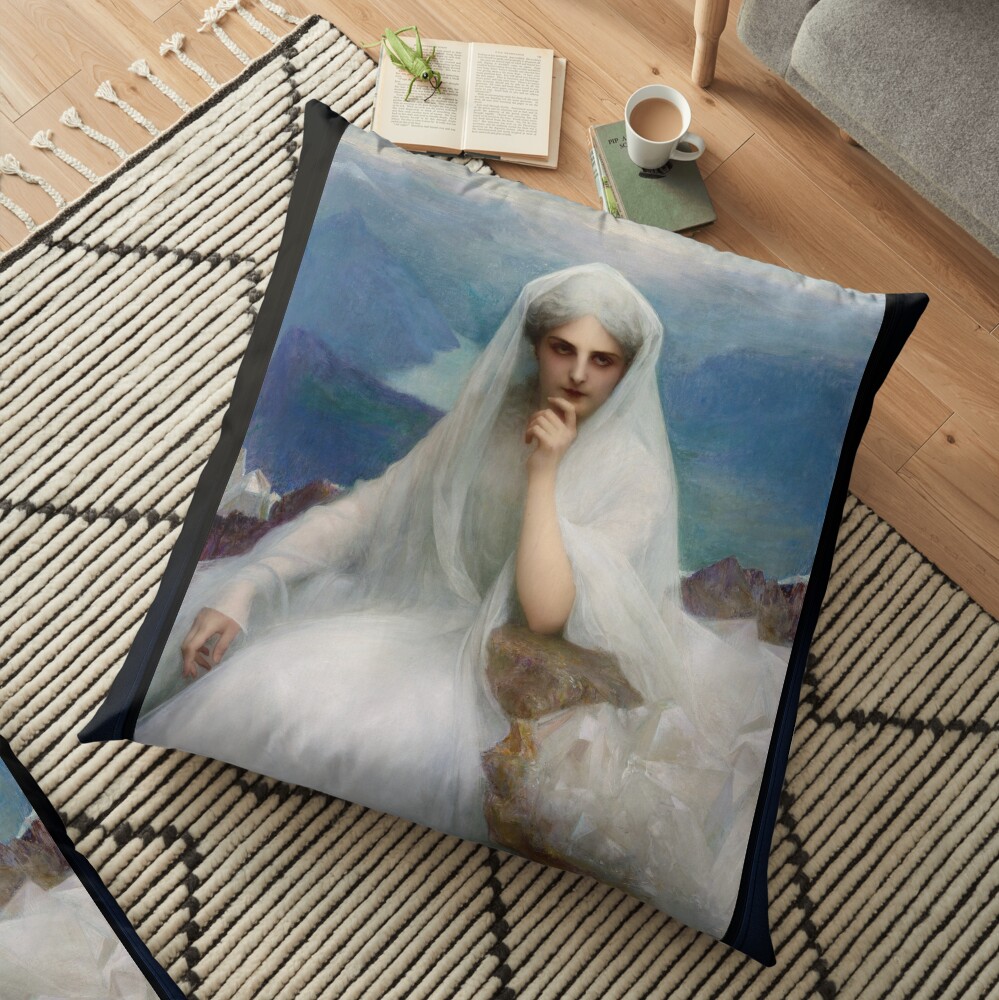
“On the Summit (Na Szczytach),” stworzony w 1903 by the renowned French painter Pascal-Adolphe-Jean Dagnan-Bouveret (1852 – 1929), is a compelling portrait that captures the serenity and grace of a woman amidst the stunning landscape of the Alps. This artwork demonstrates Dagnan-Bouveret’s exceptional skill in blending natural beauty with human emotion, portraying both the grandeur of nature and the introspection of the human spirit.
The scene is an evocative depiction of a solitary figure, a woman draped in a flowing white veil, sitting atop a rocky precipice, gazing contemplatively into the distance. The work is a perfect example of the Symbolist movement, which was prominent during the late 19th and early 20th centuries, and is also influenced by the realism and attention to detail for which Dagnan-Bouveret is known.
Spis treści
Centralna postać
At the heart of the composition is the woman, whose presence dominates the scene. She is depicted as an ethereal, almost spectral figure, her face partially obscured by a veil that billows around her, reminiscent of a divine or mythical entity. Zasłona, white and translucent, subtly contrasts with the surrounding rocky terrain, emphasizing her otherworldly nature.
Her expression is pensive, her eyes gazing into the distance with a contemplative and almost melancholic expression, as though she is caught in a moment of deep reflection. Jedna z jej dłoni spoczywa delikatnie na kamieniu obok niej, podczas gdy drugi jest gotowy dotknąć jej brody, sugerując chwilę introspekcji lub spokojnej medytacji.
Jej strój jest prosty, ale elegancki, zdominowany przez biały materiał jej welonu i sukni. Biel jej szat symbolizuje czystość, niewinność, i być może duchowe połączenie z otaczającym ją światem przyrody.
Miękkość tkaniny kontrastuje z surowością gór i skał, wzmacniając zestawienie między kruchością człowieka a ogromem, trwała siła natury. Figura jest jednocześnie delikatna i sprężysta, przedstawienie ludzkiej wrażliwości w obliczu nieskończoności.
The Landscape
Tło obrazu przedstawia zapierający dech w piersiach alpejski krajobraz, z odległymi górami, które są zamglone i wyglądają niemal jak ze snu. Kolory gór są delikatne, stonowane błękity i fiolety, sugerując odległość i majestat krajobrazu. Szczyty spowija mgła, co nadaje scenie mistyczny charakter. Ogrom terenu dodatkowo potęguje samotność kobiety, podkreślając jej izolację i introspektywny charakter chwili.
Na pierwszym planie, skalista wychodnia, na której siedzi kobieta, jest pomalowana z najdrobniejszymi szczegółami, ostre krawędzie i szorstka faktura skał stanowią wyraźny kontrast w stosunku do gładkości, płynne linie jej sukni i welonu. Same skały stanowią integralną część kompozycji, zakotwiczenie postaci w ziemi, jednocześnie podkreślając jej oderwanie od otaczającego ją świata fizycznego. Te elementy krajobrazu skąpane są w miękkości, rozproszone światło, adding to the dreamlike atmosphere of the painting.
Symbolism and Themes
Dagnan-Bouveret’s use of symbolism in “On the Summit” invites viewers to interpret the painting on multiple levels. The woman’s white attire and veil suggest purity, but they also evoke themes of spiritual transcendence, as though she is part of an eternal, ethereal world. Her introspective gaze might symbolize a quest for understanding or a search for meaning in the face of nature’s immensity. Zasłona, an often-used symbol in art, may suggest a barrier between the material and spiritual realms, hinting at the idea of veiled truths or the mysteries of the universe.
The woman’s isolation on the summit of the mountain evokes themes of solitude, contemplation, and perhaps even existential reflection. In the face of the infinite landscape, she is small and insignificant, yet her calm demeanor suggests a harmonious relationship with her surroundings. Her quiet presence contrasts with the powerful forces of nature that dominate the painting, perhaps symbolizing the resilience of the human spirit in the face of the vast unknown.
The symbolism of the mountain itself is significant. Mountains have long been associated with strength, endurance, i transcendencja, and in many cultures, they represent a place where the divine meets the earth. In this context, the summit where the woman sits could be interpreted as a spiritual or meditative place, a threshold between the earthly and the celestial.
Styl i technika artystyczna
Dagnan-Bouveret’s painting demonstrates a mastery of both naturalism and idealization, characteristic of the Symbolist movement. Jego umiejętność uchwycenia niuansów światła i tekstury w krajobrazie jest widoczna w delikatnym malowaniu odległych gór, które w przeciwieństwie do ostrych wydają się prawie miękkie i parne, wyraźne linie postaci na pierwszym planie. Dbałość o szczegóły kobiecego ubioru i skalisty teren wskazują na przywiązanie artysty do realizmu, natomiast ogólny skład, dzięki delikatnej palecie kolorów i zjawiskowej jakości, podnosi obraz do sfery symbolicznej i wzniosłej.
Użycie światła w obrazie jest subtelne, ale skuteczne. Miękkie oświetlenie twarzy postaci i lśniąca biel jej welonu kontrastują z chłodnicą, bardziej ponure odcienie otaczającego krajobrazu. This interplay of light and shadow creates a sense of depth and volume, enhancing the three-dimensionality of the figures and the natural elements. The brushwork is delicate and fluid, with smooth transitions between light and dark, lending the painting a sense of atmosphere that is both tranquil and introspective.
Wniosek
“On the Summit (Na Szczytach)” c1903 is a profound work of art that combines realism, symbolizm, and an exploration of the relationship between humanity and nature. The solitary figure of the woman, her contemplation amidst the majestic alpine landscape, invites viewers to reflect on their own connection to the world around them. Dagnan-Bouveret’s delicate handling of light, kolor, and texture creates an otherworldly atmosphere, one in which the boundaries between the physical and spiritual realms seem to blur. The painting is both a visual feast and a thought-provoking meditation on solitude, transcendencja, and the eternal mysteries of the natural world.
On the Summit (Na Szczytach) c1903 by French Painter Pascal-Adolphe-Jean Dagnan-Bouveret (1852 – 1929); czołowy artysta szkoły przyrodniczej.
This painting depicts a maiden sitting on a mountain top that is dressed in a white robe and covered in a white veil which flows around her body and covers part of her head that is lightly covered with white frost.
By her left side is a stone cistern (a tank for storing water), filled with ice crystals and in the distance on her right is a valley that is surrounded by blue mountains and a glacial lake.
She has dark piercing eyes that are looking upward as if looking at something of great concern in the far distance has she rest her chin on her left hand with her elbow resting on the edge of the cistern; while her right hand rest on her right thigh.
Jest to zremasterowana cyfrowa reprodukcja starych mistrzów obrazu z domeny publicznej, która jest dostępna jako druk na płótnie online.
Bio artysty pochodzące z Wikipedia.org
Pascal was born in Paris France on January 7, 1852 and was raised by his grandfather, from which he took the name Bouveret after his father emigrated to Brazil.
He started his education in 1869, studying at the École des Beaux-Arts under French Painters Alexandre Cabanel (1823 – 1889) and Jean-Léon Gérôme (1824 – 1904) z 1869 do 1875.
Od 1875 Poprzez 1896 he exhibited at the Paris Salon, first exhibiting there in 1875, where in 1880 he won the first place for the painting “An Accident”; wtedy w 1885 he received the medal of honor for his piece “Horses At The Watering Trough”.
During the 1880s Pascal along with French Painter Gustave Courtois (1852 – 1923), maintained a studio in a fashionable part of Paris called Neuilly-sur-Seine; and by this time was a well known and established leading artist known for his peasant scenes, mystical creations and religious compositions.
W 1891 Pascal was made an Officer of the Legion of Honour, and nine years later became a member of the Institut de France.