

Pater Noster
Pater Noster (Our Father) c1900 by Czech Painter Alphonse Mucha (1860 – 1939); bem como um ilustrador e artista gráfico talentoso que foi uma grande força do período Art Nouveau; conhecido por seu estilizado, pôsteres teatrais ornamentados e decorativos.
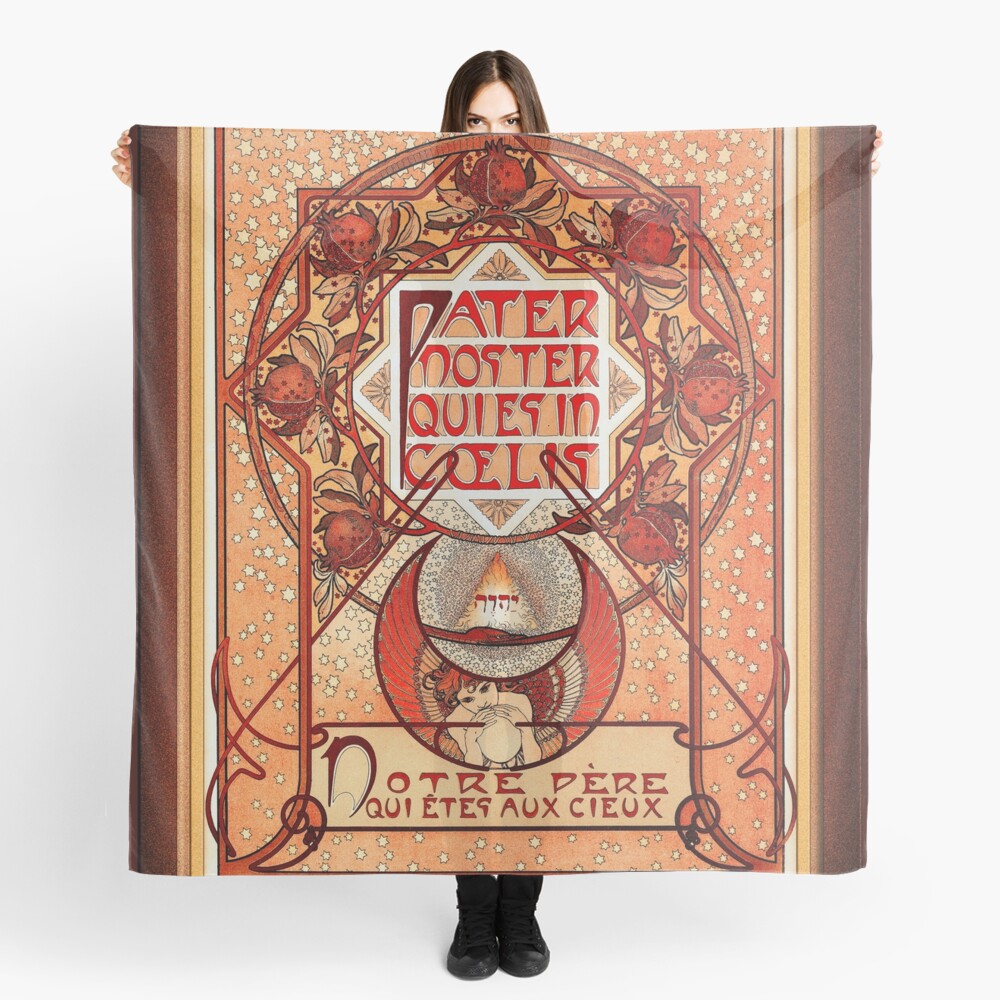
A beautiful illustrated poster that is a tribute to a beloved father that has passed away, with the words Pater Noster Quiesin Coelis (May Our Father Rest In Heaven) at the top and at the bottom the words Notre Pere Qui Etes Aux Cieux (Our Father Who Art In Heaven) that cite the beginning of he Lords prayer.
The top words are surrounded by a representation of the Star of David in the inner layer with a ring around it and a large like representation that also has open pomegranates at each point.
Below the words is another word in Hebrew that is placed in triangle with a fiery appearance, below that a woman grasping a sphere of sorts that has radiant orange, red and white wings; that may represent and angel.
Finally the rest of the illustration has flowing curves that also connect to the Star of David structure giving it a metal frame look with a multitude of starts filling every background space.
Esta é uma reprodução de mestres antigos de arte digital remasterizada de uma imagem de domínio público que está disponível para compra on-line como um impressão em tela enrolada.
Informações abaixo de Wikipedia.org
Alfons Maria Mucha julho 24, 1860 – julho 14, 1939), era conhecido internacionalmente como Alphonse Mucha. Ele era um pintor checo proeminente, ilustrador e artista gráfico, morando em Paris durante o período Art Nouveau, e é mais conhecido por seus pôsteres teatrais distintamente estilizados e decorativos, particularmente aqueles de Sarah Bernhardt.
Ele produziu ilustrações, propagandas, painéis decorativos, e designs, que se tornou uma das imagens mais conhecidas do período.
Na segunda parte de sua carreira, na idade de 43, ele voltou para sua terra natal, a região da Boêmia-Morávia, na Áustria, e se dedicou à pintura de uma série de vinte telas monumentais conhecidas como A Epopéia Eslava, retratando a história de todos os povos eslavos do mundo, que ele pintou entre 1912 e 1926.
Dentro 1928, no 10º aniversário da independência da Tchecoslováquia, ele apresentou a série para a nação tcheca. Ele considerou seu trabalho mais importante. Agora está em exibição em Praga.