

Perezosa (Idle Woman) C1406
“Perezosa (Idle Woman)” is a captivating ritrattu creatu in 1906 by Daniel Hernández Morillo, a distinguished Peruvian painter who lived from 1856 à 1932. The painting captures the allure of a moment suspended in time, drawing the viewer into a scene of peaceful repose. Morillo, known for his ability to blend realism with sensuality, presents a female figure in a state of languid idleness, her pose graceful yet suggestive of a world where the passage of time is irrelevant. This scene, though simple in its composition, reveals much about Morillo’s skill in portraying not only the human form but also the emotional undertones of quiet moments.
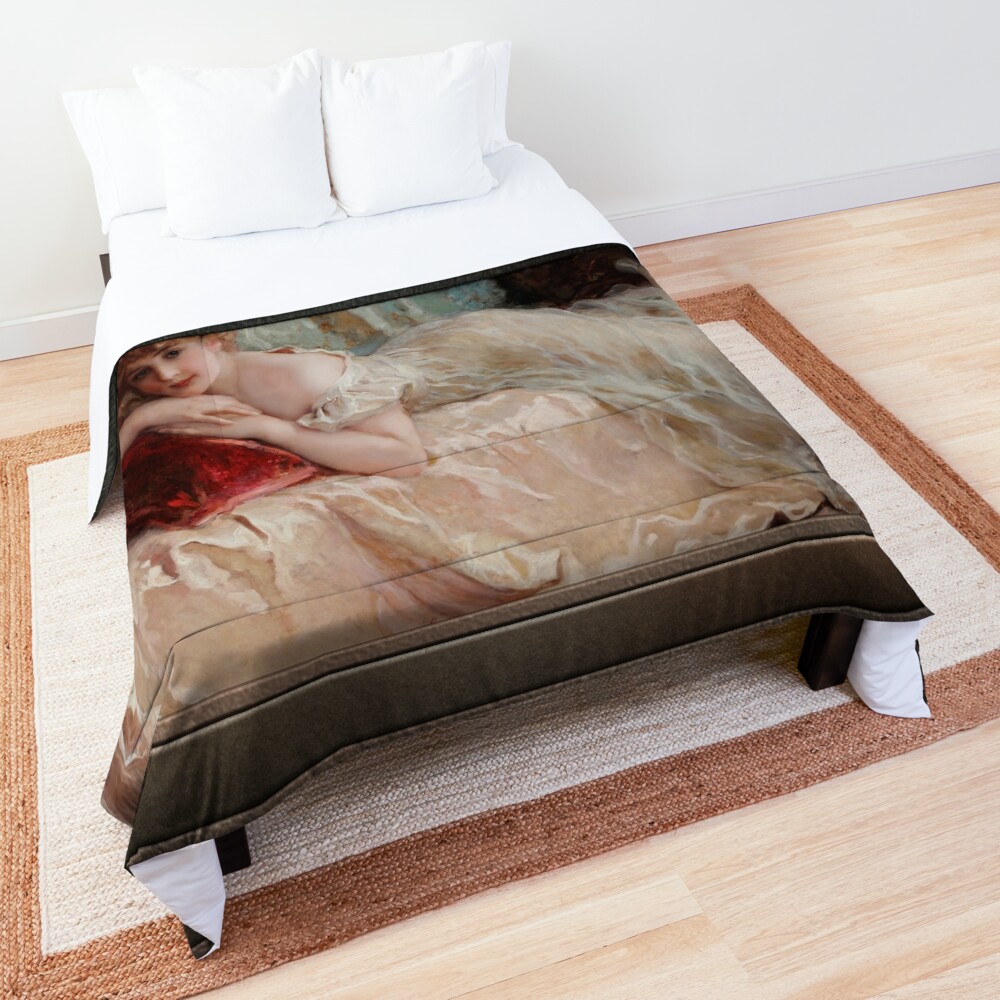
Table of Contents
Sugettu principale è cumpusizioni
The central focus of “Perezosa” hè a figura femina reclining, portrayed in a serene yet sensuous posture. She lies on a luxurious bed, her upper body propped up by a rich, red velvet cushion. The subject’s gaze is both inviting and introspective, as she looks slightly to the side, lost in thought. Her expression conveys an air of peaceful contemplation, evoking a sense of intimate solitude. She rests languorously, her posture relaxed but still composed, with one arm placed gently over the pillow, while the other hand rests on her chest.
Her attire consists of a flowing, delicate gown of ivory fabric, which clings to her figure with soft folds, suggesting both elegance and an effortless sensuality. The transparency of the fabric in the painting suggests the artist’s mastery in rendering textures and light, as the soft, muted tones of the dress contrast beautifully with the vivid crimson of the cushions and the deep blue of the backdrop. The gown’s draping contrasts with the figure’s languid, almost lazy pose, which emphasizes the theme of repose. The woman’s hair is styled simply yet elegantly, swept back from her face with soft curls cascading toward her shoulders.
Color and Light
A paleta di culori di “Perezosa” is rich, with deep, warm hues dominating the scene. The plush red cushion, contrasted against the pale, almost ethereal color of the woman’s gown, evokes a sense of warmth and comfort. U sfondate, painted in soft shades of blue and cream, suggests a dreamlike ambiance that enhances the feeling of tranquility and isolation. The light in the painting is diffused gently, illuminating the figure in a soft, almost romantic glow. This use of light serves not only to highlight the delicate contours of the woman’s body but also to soften the mood of the composition, enhancing the timeless nature of the subject.
Texture and Materials
Hernández Morillo’s mastery in rendering texture is evident in the painting’s fine details. The velvet cushion beneath the figure’s head is expertly portrayed, its rich, plush texture almost palpable. U vestitu, da l'altra parte, appears delicate and fluid, with its soft folds giving the impression of lightness and movement. The gentle blending of colors in the background creates a sense of atmospheric depth, where the fabric’s smoothness contrasts with the velvety softness of the bedding.
The artist also gives particular attention to the interplay of light and shadow, especially on the woman’s face and arms, which enhances the realistic portrayal of her form. The softness of the painting’s textures suggests a work created with great attention to detail, capturing both the materiality of the scene and the emotional resonance of the subject.
Umore è tema
L'umore generale di “Perezosa” is one of peaceful idleness and serene contemplation. There is a quiet elegance in the woman’s pose, and her repose reflects a timeless, universal theme: the human desire for rest and retreat from the outside world. U titulu “Perezosa” (which translates to “Idle Woman”) speaks to this theme directly, capturing the essence of stillness and restfulness.
The artist’s choice to depict the subject in such a relaxed, almost languorous pose conveys a sense of indulgence in solitude, highlighting the feminine experience of enjoying a moment of personal space away from societal expectations. This idleness does not suggest laziness, but rather an embrace of personal serenity. The tranquil nature of the scene invites the viewer to pause, to be still, and to reflect on the beauty of a moment free from the pressures of the world outside.
Style and Influence
Daniel Hernández Morillo’s style is rooted in realism, with a marked attention to detail and a deep understanding of human anatomy. He was influenced by the European art traditions of his time, particularly the academic style that sought to capture the beauty of the human form with precision and grace. Tuttavia, Morillo infused his works with a softness that reflects a more romanticized view of reality. Stu pittura, with its carefully controlled brushstrokes and attention to light and texture, demonstrates his ability to blend realism with the intimate mood of his subjects.
The style in “Perezosa” is also marked by a certain fluidity in the rendering of fabrics and the human body, which gives the work a sense of both motion and stillness. The soft edges of the figures and the blending of colors evoke a sense of timelessness, while the underlying realism ensures that the viewer recognizes the authenticity of the subject’s form.
Cunclusione
“Perezosa (Idle Woman)” stands as a stunning example of Daniel Hernández Morillo’s skill in portraying the human figure with grace and subtlety. The serene composition, combined with the soft light, ricche texture, and intimate mood, creates a captivating portrayal of a woman at rest. The artist’s attention to detail and mastery of color and texture invite the viewer to enter the quiet world of the painting, where time seems to stand still. Morillo’s ability to convey a moment of tranquility with such depth and beauty ensures the lasting appeal of this work, which remains a powerful expression of stillness and feminine repose.
This is a remastered digital art old masters reproduction of a public domain image that is available online as a stampa di tela.
Artist Bio Derived from Wikipedia.org
Daniel hè natu à un babbu spagnolu è una mamma peruviana è à l'età di 14 anni hà iniziatu a so educazione artistica in l'atelier di u pittore di ritratti italianu Leonardo Barbieri (1818 – 1896) in Lima Peru; chì era ancu un Daguerreotype [I primi prucessi fotografici utilizati durante l'anni 1840 è 1850, chì hè stata inventata da Louis Daguerre (1787 – 1851)].
Quandu Barbieri abbandunò Lima, Daniel hà pigliatu i so classi d'arti cum'è istruttore; è à l'età di 16 hà guadagnatu ricunniscenza da u guvernu di u presidente Manuel Pardo (1834 – 1878) per a so interpretazione di a Morte di Socrate, chì hà risultatu in ellu riceve una borsa chì li hà permessu di lascià u Perù è viaghjà in Europa per studià in 1874.
À a so ghjunta in Parigi, hà scontru cù u so cumpagnu pittore peruvianu Ignacio Merino Muñoz (1817 – 1876), chì hà cunsigliatu di andà in Roma, L'Italia invece di studià; è cusì fece restà quì per i nove anni dopu travagliendu cù u pittore spagnolu Marià Josep Maria Bernat Fortuny (1838 – 1874) è altri; finu à ch'ellu tornò in Parigi, Francia in 1883, induve fù elettu presidente di a Società di i Pittori Spagnoli; chì era cumpostu di l'artista spagnolu chì vive in Francia.
Daniel era ancu un membru di a Société des Artistes Français è hà ancu esposto regolarmente à u Salon di Parigi; mentre chì dopu in a so carriera fù dumandatu da u presidente di u Perù per esse parte di un gruppu per stabilisce una nova scola d'arte, chì si chjamava Scola Naziunale Superiore Autonuma di Belle Arti; aprendu e so porte in 1919, è à quale ellu seria u so primu direttore per u prossimu 13 anni, finu à a so morte in 1932.