

Petite Fille et Chat
Übersicht über das Kunstwerk
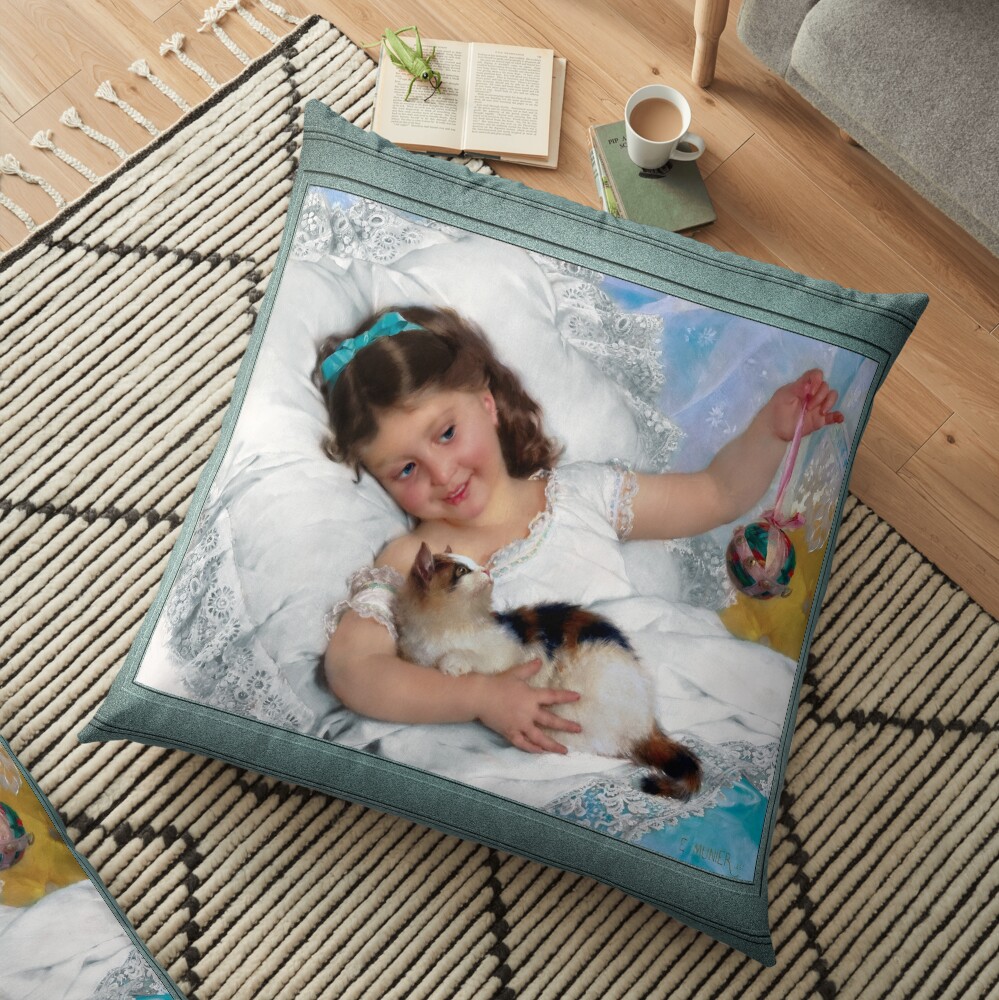
Petite Fille et Chat (Junges Mädchen mit Katze) c1882 is an exquisite example of 19th-century French academic painting, erstellt von Emile Munier (1840 – 1895), a renowned French painter known for his detailed depictions of children and their emotional depth. Gemalt 1882, this portrait captures a delicate moment of childhood innocence, perfectly encapsulated through the innocent gaze of a young girl who is lovingly interacting with a cat. Die akribische Liebe zum Detail des Künstlers, his ability to capture human expression, and his expert use of light and color make this piece a standout in the genre of academic realism.
Inhaltsverzeichnis
Das Hauptthema: The Young Girl
Im Herzen von “Petite Fille et Chat” is the young girl, whose porcelain-like skin and gentle expression convey both fragility and joy. She is depicted in a moment of quiet delight as she reclines on a cushion, her body slightly turned towards the viewer while her gaze is directed downward at the small cat resting beside her. The girl’s soft brown hair is styled in loose waves, with a bright blue ribbon nestled at the crown of her head, adding a touch of playfulness to her appearance. The pale blue ribbon contrasts beautifully with the softness of her white gown, further emphasizing the purity and simplicity of her childhood.
The fabric of her gown is rendered in soft, flowing folds that suggest a fine, luxurious material. Its delicate lace trims at the neckline and sleeves add an element of refinement, capturing the high level of craftsmanship typical of the period. The girl’s posture and demeanor evoke an image of serene contentment, perfectly in tune with the theme of childhood innocence that the artist sought to portray.
The Cat: A Companion in Innocence
The cat, nestled contentedly beside the girl, plays a pivotal role in the composition. It is rendered with extraordinary attention to detail, particularly in its fur, which exhibits the artist’s characteristic skill in portraying texture. The cat’s distinctive coat of fur—patches of white, Orange, and brown—creates a sense of realism, while its playful yet peaceful demeanor adds to the tranquil atmosphere of the painting. The young girl’s hand rests gently on the cat’s back, a tender gesture that reinforces the bond between the child and her pet, a universal symbol of innocence and companionship.
The cat’s presence in the painting also serves as a subtle contrast to the girl’s softness and elegance. It represents a more spontaneous and untamed element, yet in this context, it becomes a gentle companion, further enhancing the serene mood of the artwork.
Hintergrund und Einstellung
The background of the painting is as meticulously composed as the figures in the foreground. The setting appears to be an indoor space, possibly a child’s nursery or a drawing room, where the soft textures of a luxurious fabric and a gentle play of light are at the forefront. Behind the young girl and cat, a soft, ethereal blue hue transitions to a creamy pastel yellow, creating a dreamy, almost otherworldly atmosphere. The background is delicately painted, featuring light touches of drapery that hint at the artist’s attention to both the natural light filtering through the space and the textures of the fabrics.
Lace and other delicate elements such as floral patterns also appear in the background, adding complexity and depth to the scene without overwhelming the primary subject. Das Zimmer, filled with these light, soft tones, emphasizes the purity of childhood, offering a quiet sanctuary where the girl and her cat are free to indulge in their peaceful moment.
The Use of Color and Light
Munier’s use of light and color is central to the emotional impact of “Petite Fille et Chat.” Das Weiche, pastel tones—predominantly blues, Weiße, and subtle hints of pink—dominate the composition, creating a serene and almost dreamlike quality. The delicate color palette enhances the theme of innocence, furthering the narrative of childhood purity and happiness.
The interplay of light and shadow on the girl’s face and gown is masterfully handled. Munier uses light to bring out the luminous quality of her skin, contrasting it with the subtle shadowing beneath her chin and along her collarbone, which adds depth to her features. The glow of her cheeks and the soft illumination around her eyes suggest a youthful vitality, yet this is contrasted by the calm serenity of the scene.
Emotional Impact and Theme
“Petite Fille et Chat” captures a moment of innocence and tranquility. The theme of childhood—its purity, tenderness, and closeness to nature—is rendered with delicate precision. The interaction between the girl and her cat is both intimate and gentle, a visual expression of the love and affection that often characterizes the bond between children and their pets.
The emotional atmosphere of the painting is one of warmth and comfort, a sanctuary from the outside world. Das Weiche, intimate moment between the girl and her cat seems to freeze time, inviting the viewer into a quiet, peaceful world where the only concerns are love and companionship. Munier’s portrayal of the girl’s sweet expression and the peaceful setting imbue the work with a sense of nostalgia, evoking a longing for simpler times and the beauty of childhood.
Künstlerischer Stil: Academic Realism
Emile Munier was a master of academic realism, a style characterized by its focus on the careful study of light, human anatomy, and the natural world. His works often feature children in idyllic settings, exploring themes of innocence, Reinheit, und emotionale Tiefe. The precision with which Munier renders the details of the girl’s face, the textures of her gown, and the softness of the cat’s fur speaks to his exceptional technical skill and dedication to realism. His careful attention to detail in both the figures and the background elements reflects the high standards of academic painting in the 19th century.
Abschluss
“Petite Fille et Chat” is a timeless portrayal of childhood innocence and the beauty of quiet moments shared between a child and her pet. Through his exquisite use of light, Farbe, und Textur, Munier creates a scene that resonates with emotional warmth and tenderness. The piece stands as a perfect example of academic realism, blending technical skill with an intimate portrayal of the human experience.
Petite Fille et Chat ist eine remasterte digitale Kunstreproduktion alter Meister eines gemeinfreien Bildes, das als verfügbar ist Leinwanddruck online.
Über den Künstler
Info unten abgeleitet von Wikipedia.org
Emil wurde in Paris geboren, Frankreich an Pierre Francois Munier; ein künstlerischer Polsterer in der Gobelinfabrik Nationale des Gobelins (in Paris Frankreich) und Marie Louise Carpentier, ein Polierer in einer Kaschmirstofffabrik.
Er hatte auch zwei Brüder François und Florimond; das zusammen mit ihm, der eine Zeit lang bei der Nationale des Gobelins ausgebildet und als Künstler gearbeitet hat.
In der Fabrik wurde Emile von Abel Lucas zum Zeichner ausgebildet, und würde eine enge Beziehung zu Abel und seiner Familie aufbauen, was dazu führte, dass Emile Lucas heiratete’ Tochter Heriette ein 1861.
Leider drin 1867, sechs Wochen nachdem seine Frau ihren Sohn Emile Henri zur Welt gebracht hatte, Sie erkrankte an schwerem Rheuma, und starb früh.
Im 1871 Emile verließ die Wandteppichfabrik, um sich ganz der Malerei zu widmen, sowie Malkurse für Erwachsene an drei Abenden in der Woche.
Dann in 1872 Emile heiratete Sargine Augrand, eine Schülerin von Abel Lucas und Freundin von Emile und Henriette; Das Paar hatte eine Tochter Marie-Louise, der geboren wurde 1874.
Im 1884 Er erhielt von Gouverneur Leland Stanford aus Kalifornien und seiner Frau Jane Stanford den Auftrag, ein Gemälde ihres Sohnes Leland Stanford zu schaffen, Jr., der im Alter von verstorben war 15 Jahre; ahd betitelte er das Stück Angel Comforting His Grieving Mother; die der Junge als Engel, der auf die Erde zurückkehrte, um seine Mutter zu trösten, indem er seine Hand auf ihre Schulter legte.
Einer von Emiles einflussreichsten Lehrern war der französische Maler William-Adolphe Bouguereau (1825 – 1905), und man kann den Einfluss, den er auf Emile hatte, in vielen der von ihm geschaffenen Stücke sehen, und im Laufe der Zeit wurden die beiden auch enge Freunde.
Eines seiner berühmtesten Werke, das diesen Einfluss zeigte, ist sein Stück Trois Amis or Three Friends, die er im Pariser Salon ausstellte 1885; das ein molliges kleines Mädchen zeigte, das mit ihrem Kätzchen und ihrem Hund auf ihrem Bett spielte.
Diese Arbeit wurde von der Öffentlichkeit so gut gemocht, dass es in vielen Formen reproduziert und auch von der britischen Seifenfirma Pears Soap für die Öffentlichkeitsarbeit verwendet wurde; die gegründet wurde 1807, Herstellung der weltweit ersten transparenten Seife.
Dieses Gemälde trug dazu bei, ihn als einen der führenden Maler von kleinen Kindern und ihren Haustieren zu etablieren; und er würde weiterhin solche Szenen zusammen mit Tierfischszenen malen, Meereslandschaften, Landschaften, Genre Bauernszenen, mythologische und religiöse Themen in den frühen 1890er Jahren bis zu seinem frühen Tod in 1895 im Alter von 55.