

Petite Fille et Chat
Yleiskatsaus taideteoksesta
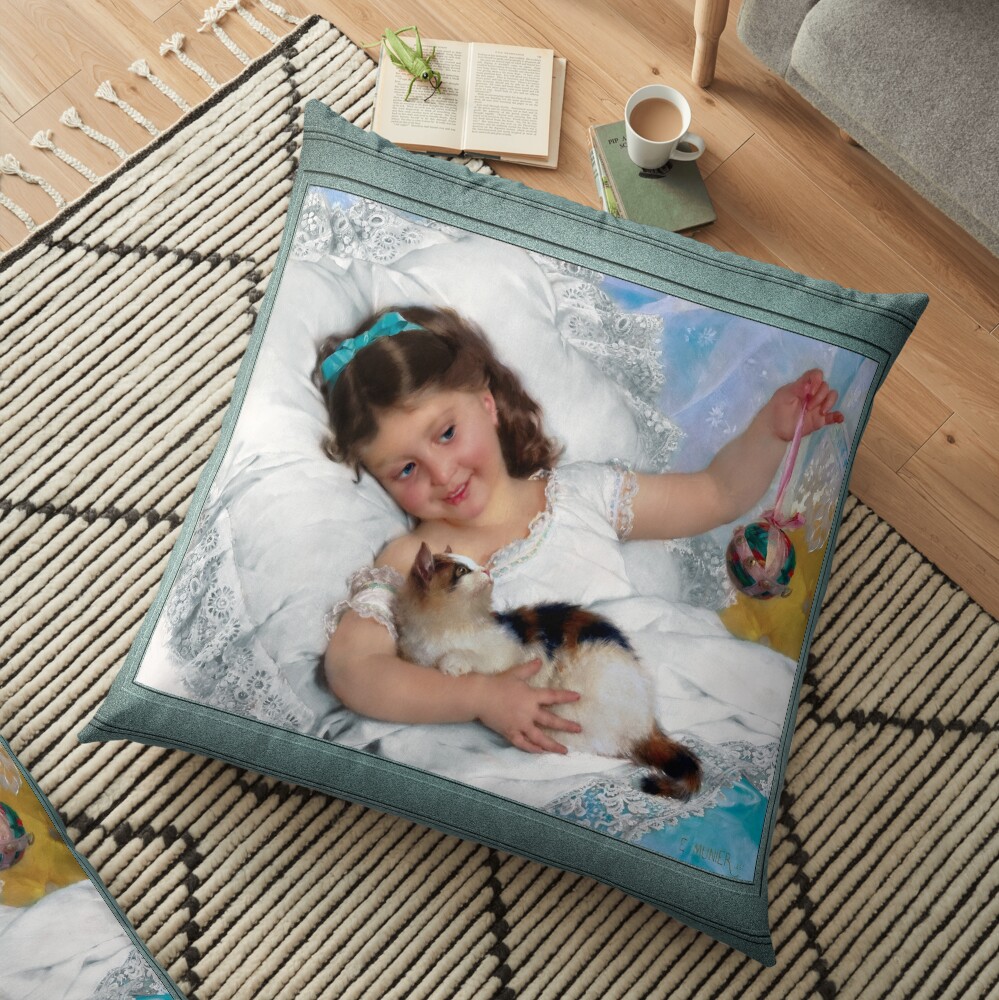
Petite Fille et Chat (Nuori tyttö kissan kanssa) c1882 is an exquisite example of 19th-century French academic painting, created by Emile Munier (1840 – 1895), a renowned French painter known for his detailed depictions of children and their emotional depth. Maalattu 1882, this portrait captures a delicate moment of childhood innocence, perfectly encapsulated through the innocent gaze of a young girl who is lovingly interacting with a cat. Taiteilijan huolellinen huomio yksityiskohtiin, his ability to capture human expression, and his expert use of light and color make this piece a standout in the genre of academic realism.
Sisällysluettelo
Pääaihe: The Young Girl
Ytimessä “Petite Fille et Chat” is the young girl, whose porcelain-like skin and gentle expression convey both fragility and joy. She is depicted in a moment of quiet delight as she reclines on a cushion, her body slightly turned towards the viewer while her gaze is directed downward at the small cat resting beside her. The girl’s soft brown hair is styled in loose waves, with a bright blue ribbon nestled at the crown of her head, adding a touch of playfulness to her appearance. The pale blue ribbon contrasts beautifully with the softness of her white gown, further emphasizing the purity and simplicity of her childhood.
The fabric of her gown is rendered in soft, flowing folds that suggest a fine, luxurious material. Its delicate lace trims at the neckline and sleeves add an element of refinement, capturing the high level of craftsmanship typical of the period. The girl’s posture and demeanor evoke an image of serene contentment, perfectly in tune with the theme of childhood innocence that the artist sought to portray.
The Cat: A Companion in Innocence
The cat, nestled contentedly beside the girl, plays a pivotal role in the composition. It is rendered with extraordinary attention to detail, particularly in its fur, which exhibits the artist’s characteristic skill in portraying texture. The cat’s distinctive coat of fur—patches of white, oranssi, and brown—creates a sense of realism, while its playful yet peaceful demeanor adds to the tranquil atmosphere of the painting. The young girl’s hand rests gently on the cat’s back, a tender gesture that reinforces the bond between the child and her pet, a universal symbol of innocence and companionship.
The cat’s presence in the painting also serves as a subtle contrast to the girl’s softness and elegance. It represents a more spontaneous and untamed element, yet in this context, it becomes a gentle companion, further enhancing the serene mood of the artwork.
Tausta ja asetukset
The background of the painting is as meticulously composed as the figures in the foreground. The setting appears to be an indoor space, possibly a child’s nursery or a drawing room, where the soft textures of a luxurious fabric and a gentle play of light are at the forefront. Behind the young girl and cat, pehmeä, ethereal blue hue transitions to a creamy pastel yellow, creating a dreamy, miltei ulkomaalainen tunnelma. The background is delicately painted, featuring light touches of drapery that hint at the artist’s attention to both the natural light filtering through the space and the textures of the fabrics.
Lace and other delicate elements such as floral patterns also appear in the background, adding complexity and depth to the scene without overwhelming the primary subject. Huone, filled with these light, soft tones, emphasizes the purity of childhood, offering a quiet sanctuary where the girl and her cat are free to indulge in their peaceful moment.
The Use of Color and Light
Munier’s use of light and color is central to the emotional impact of “Petite Fille et Chat.” Pehmeä, pastel tones—predominantly blues, valkoiset, and subtle hints of pink—dominate the composition, creating a serene and almost dreamlike quality. The delicate color palette enhances the theme of innocence, furthering the narrative of childhood purity and happiness.
The interplay of light and shadow on the girl’s face and gown is masterfully handled. Munier uses light to bring out the luminous quality of her skin, contrasting it with the subtle shadowing beneath her chin and along her collarbone, which adds depth to her features. The glow of her cheeks and the soft illumination around her eyes suggest a youthful vitality, yet this is contrasted by the calm serenity of the scene.
Emotional Impact and Theme
“Petite Fille et Chat” captures a moment of innocence and tranquility. The theme of childhood—its purity, arkuus, and closeness to nature—is rendered with delicate precision. The interaction between the girl and her cat is both intimate and gentle, a visual expression of the love and affection that often characterizes the bond between children and their pets.
The emotional atmosphere of the painting is one of warmth and comfort, a sanctuary from the outside world. Pehmeä, intimate moment between the girl and her cat seems to freeze time, inviting the viewer into a quiet, peaceful world where the only concerns are love and companionship. Munier’s portrayal of the girl’s sweet expression and the peaceful setting imbue the work with a sense of nostalgia, evoking a longing for simpler times and the beauty of childhood.
Taiteellinen tyyli: Academic Realism
Emile Munier was a master of academic realism, a style characterized by its focus on the careful study of light, human anatomy, and the natural world. His works often feature children in idyllic settings, tutkia viattomuuden teemoja, puhtaus, ja tunnesyvyys. Se tarkkuus, jolla Munier esittää tytön kasvojen yksityiskohdat, hänen pukunsa tekstuurit, ja kissan turkin pehmeys kertoo hänen poikkeuksellisesta teknisestä taidosta ja omistautumisestaan realismiin. Hänen huolellinen huomionsa yksityiskohtiin sekä hahmoissa että taustaelementeissä heijastelee 1800-luvun akateemisen maalauksen korkeaa tasoa..
Johtopäätös
“Petite Fille et Chat” on ajaton esitys lapsuuden viattomuudesta ja lapsen ja hänen lemmikkinsä jakamien hiljaisten hetkien kauneudesta. Hänen erinomaisen valonkäytönsä ansiosta, väri-, ja rakenne, Munier luo kohtauksen, joka resonoi tunnelämmöllä ja arkuudella. Teos on täydellinen esimerkki akateemisesta realismista, yhdistämällä tekniset taidot ihmiskokemuksen intiimiin kuvauksiin.
Petite Fille et Chat on remasteroitu digitaalisen taiteen vanhojen mestareiden kopio julkisessa käytössä olevasta kuvasta, joka on saatavilla kanvastulostus verkossa.
Tietoja Taiteilijasta
Alla olevat tiedot ovat peräisin Wikipedia.org
Emile syntyi Pariisissa, Ranska Pierre François Munierille; taiteilija verhoilija Nationale des Gobelinsin kuvakudostehtaassa (Pariisissa Ranskassa) ja Marie Louise Carpentier, kiillotuskone kashmirkangastehtaassa.
Hänellä oli myös kaksi veljeä François ja Florimond; että yhdessä hänen kanssaan, joka koulutti ja työskenteli taiteilijana jonkin aikaa Nationale des Gobelinsissa.
Tehtaalla Abel Lucas koulutti Emilen piirtäjäksi, ja kehittäisi läheisen suhteen Abeliin ja hänen perheeseensä, mikä johti siihen, että Emile meni naimisiin Lucasin kanssa’ tytär Heriette sisään 1861.
Ikävä kyllä sisään 1867, kuusi viikkoa sen jälkeen, kun hänen vaimonsa synnytti heidän poikansa Emile Henrin, hän sairastui vakavaan reumaan, ja kuoli ennenaikaisesti.
Sisään 1871 Emile lähti kuvakudostehtaasta jatkaakseen maalausta kokopäiväisesti, sekä maalaustunteja aikuisille kolmena iltana viikossa.
Sitten sisään 1872 Emile meni naimisiin Sargine Augrandin kanssa, joka oli Abel Lucasin oppilas ja Emilen ja Henrietten ystävä; parilla oli yksi tytär Marie-Louise, joka syntyi 1874.
Sisään 1884 hän sai Kalifornian kuvernööri Leland Stanfordilta ja hänen vaimoltaan Jane Stanfordilta toimeksiannon luoda maalauksen heidän poikastaan Leland Stanfordista, Jr., joka oli kuollut vuotiaana 15 vuotta; ahd hän nimesi teoksen Angel Comforting His Grieving Mother; jonka poika enkelinä palasi maan päälle lohduttamaan äitiään kädellään tämän olkapäälle.
Yksi Emilesin vaikutusvaltaisimmista opettajista oli ranskalainen taidemaalari William-Adolphe Bouguereau (1825 – 1905), ja hänen vaikutuksensa Emileen voidaan nähdä monissa hänen luomissaan teoksissa, ja ajan myötä heistä tuli myös läheisiä ystäviä..
Yksi hänen tunnetuimmista teoksistaan, joka osoitti tämän vaikutuksen, on hänen teos Trois Amis tai Kolme ystävää, jonka hän oli näytteillä Pariisin salongissa 1885; joka kuvasi pullea pikkutyttöä leikkimässä sängyllään kissanpentunsa ja koiransa kanssa.
Tämä teos oli suuren yleisön suosiossa, että sitä toistettiin monissa muodoissa ja että brittiläinen saippuayhtiö Pears Soap käytti sitä myös julkisuuteen; joka perustettiin vuonna 1807, valmistaa maailman ensimmäistä läpinäkyvää saippuaa.
Tämä maalaus auttoi vahvistamaan hänet yhdeksi pienten lasten ja heidän lemmikkiensä tärkeimmistä maalareista; ja hän jatkoi tällaisten kohtausten maalaamista eläinten kalastuskohtausten ohella, merimaisemat, maisemia, genren talonpoikakohtaukset, mytologinen ja uskonnollinen aihe 1890-luvun alussa hänen ennenaikaiseen kuolemaansa saakka 1895 iässä 55.