

Petite Fille et Chat
Overview of the Artwork
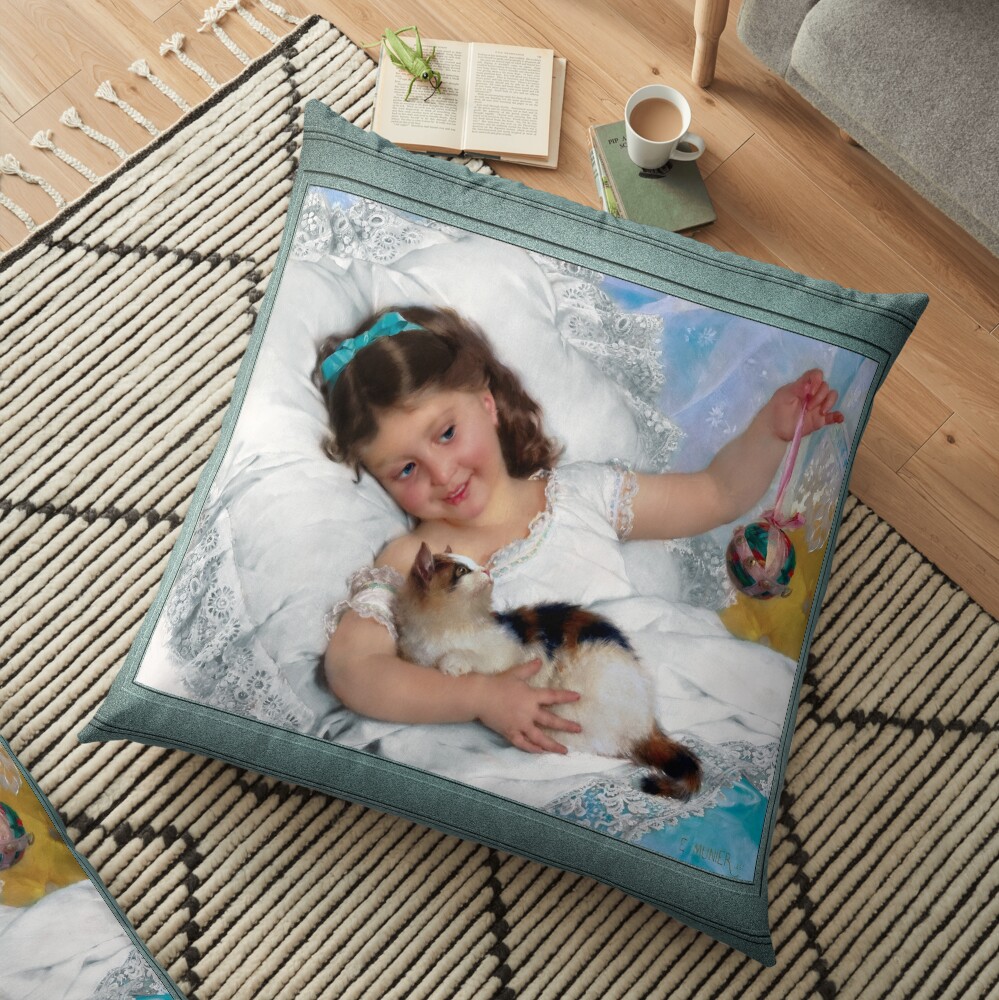
Petite Fille et Chat (Young Girl With Cat) c1882 is an exquisite example of 19th-century French academic painting, created by Emile Munier (1840 – 1895), a renowned French painter known for his detailed depictions of children and their emotional depth. Péinteáilte i 1882, this portrait captures a delicate moment of childhood innocence, perfectly encapsulated through the innocent gaze of a young girl who is lovingly interacting with a cat. Aird ghéar an ealaíontóra ar mhionsonraí, his ability to capture human expression, and his expert use of light and color make this piece a standout in the genre of academic realism.
Clár na nÁbhar
An príomh -ábhar: The Young Girl
I gcroílár na “Petite Fille et Chat” is the young girl, whose porcelain-like skin and gentle expression convey both fragility and joy. She is depicted in a moment of quiet delight as she reclines on a cushion, her body slightly turned towards the viewer while her gaze is directed downward at the small cat resting beside her. The girl’s soft brown hair is styled in loose waves, with a bright blue ribbon nestled at the crown of her head, Ag cur le spraíúlacht lena cuma. The pale blue ribbon contrasts beautifully with the softness of her white gown, further emphasizing the purity and simplicity of her childhood.
The fabric of her gown is rendered in soft, flowing folds that suggest a fine, luxurious material. Its delicate lace trims at the neckline and sleeves add an element of refinement, capturing the high level of craftsmanship typical of the period. The girl’s posture and demeanor evoke an image of serene contentment, perfectly in tune with the theme of childhood innocence that the artist sought to portray.
The Cat: A Companion in Innocence
The cat, nestled contentedly beside the girl, plays a pivotal role in the composition. It is rendered with extraordinary attention to detail, particularly in its fur, which exhibits the artist’s characteristic skill in portraying texture. The cat’s distinctive coat of fur—patches of white, oráiste, and brown—creates a sense of realism, while its playful yet peaceful demeanor adds to the tranquil atmosphere of the painting. The young girl’s hand rests gently on the cat’s back, a tender gesture that reinforces the bond between the child and her pet, a universal symbol of innocence and companionship.
The cat’s presence in the painting also serves as a subtle contrast to the girl’s softness and elegance. It represents a more spontaneous and untamed element, yet in this context, it becomes a gentle companion, further enhancing the serene mood of the artwork.
Cúlra agus Socrú
The background of the painting is as meticulously composed as the figures in the foreground. The setting appears to be an indoor space, possibly a child’s nursery or a drawing room, where the soft textures of a luxurious fabric and a gentle play of light are at the forefront. Behind the young girl and cat, a soft, ethereal blue hue transitions to a creamy pastel yellow, creating a dreamy, atmaisféar beagnach eile ar domhan. The background is delicately painted, featuring light touches of drapery that hint at the artist’s attention to both the natural light filtering through the space and the textures of the fabrics.
Lace and other delicate elements such as floral patterns also appear in the background, adding complexity and depth to the scene without overwhelming the primary subject. An seomra, filled with these light, toin bhog, emphasizes the purity of childhood, offering a quiet sanctuary where the girl and her cat are free to indulge in their peaceful moment.
The Use of Color and Light
Munier’s use of light and color is central to the emotional impact of “Petite Fille et Chat.” An bog, pastel tones—predominantly blues, gealáin, and subtle hints of pink—dominate the composition, creating a serene and almost dreamlike quality. The delicate color palette enhances the theme of innocence, furthering the narrative of childhood purity and happiness.
The interplay of light and shadow on the girl’s face and gown is masterfully handled. Munier uses light to bring out the luminous quality of her skin, contrasting it with the subtle shadowing beneath her chin and along her collarbone, which adds depth to her features. The glow of her cheeks and the soft illumination around her eyes suggest a youthful vitality, yet this is contrasted by the calm serenity of the scene.
Emotional Impact and Theme
“Petite Fille et Chat” captures a moment of innocence and tranquility. The theme of childhood—its purity, déine, and closeness to nature—is rendered with delicate precision. The interaction between the girl and her cat is both intimate and gentle, a visual expression of the love and affection that often characterizes the bond between children and their pets.
The emotional atmosphere of the painting is one of warmth and comfort, a sanctuary from the outside world. An bog, intimate moment between the girl and her cat seems to freeze time, inviting the viewer into a quiet, peaceful world where the only concerns are love and companionship. Munier’s portrayal of the girl’s sweet expression and the peaceful setting imbue the work with a sense of nostalgia, evoking a longing for simpler times and the beauty of childhood.
Stíl Ealaíne: Academic Realism
Emile Munier was a master of academic realism, a style characterized by its focus on the careful study of light, human anatomy, agus an domhan nádúrtha. His works often feature children in idyllic settings, exploring themes of innocence, íonachta, and emotional depth. The precision with which Munier renders the details of the girl’s face, the textures of her gown, and the softness of the cat’s fur speaks to his exceptional technical skill and dedication to realism. His careful attention to detail in both the figures and the background elements reflects the high standards of academic painting in the 19th century.
Conclúid
“Petite Fille et Chat” is a timeless portrayal of childhood innocence and the beauty of quiet moments shared between a child and her pet. Through his exquisite use of light, dath, agus uigeacht, Munier creates a scene that resonates with emotional warmth and tenderness. The piece stands as a perfect example of academic realism, blending technical skill with an intimate portrayal of the human experience.
Petite Fille et Chat is a remastered digital art old masters reproduction of a public domain image that is available as a priontáil chanbhás ar líne.
Faoin Ealaíontóir
Faisnéis Thíos Díorthaithe ó Wikipedia.org
Emile was born in Paris, France to Pierre François Munier; an artist upholsterer at the Nationale des Gobelins tapestry factory (in Paris France) and Marie Louise Carpentier, a polisher in a cashmere cloth mill.
He also had two brothers François and Florimond; that along with him who trained and worked as artist for a period at the Nationale des Gobelins.
At the factory Emile was trained as a draughtsman by Abel Lucas, and would develop a close relationship with Abel and his family, which led to Emile marrying Lucas’ daughter Heriette in 1861.
Sadly in 1867, six weeks after his wife gave birth to their son Emile Henri, she contracted severe rheumatism, and died prematurely.
I 1871 D’fhág Emile monarcha na taipéise chun dul sa tóir ar phéintéireacht go lánaimseartha, chomh maith le ranganna péintéireachta a chur ar fáil do dhaoine fásta trí oíche sa tseachtain.
Ansin isteach 1872 Phós Emile Sargine Augrand mac léinn de chuid Abel Lucas agus cara le Emile agus Henriette; bhí iníon amháin ag an lánúin Marie-Louise, a rugadh i 1874.
I 1884 fuair sé coimisiún ón nGobharnóir Leland Stanford as California agus a bhean Jane Stanford chun péintéireacht a dhéanamh dá mac Leland Stanford, Jr., a fuair bás in aois a 15 bliana; ahd thug sé teideal ar an bpíosa Aingeal Comforting His Grieving Mother; a chuir an buachaill mar aingeal a d'fhill ar an talamh chun a mháthair a chompord lena lámh a chur ar a gualainn.
Bhí an péintéir Francach William-Adolphe Bouguereau ar dhuine de na múinteoirí is mó a raibh tionchar ag Emiles air (1825 – 1905), agus is féidir an tionchar a bhí aige ar Emile a fheiceáil i go leor de na píosaí a chruthaigh sé agus le himeacht ama tháinig an bheirt ina gcairde chomh maith..
Ceann de na saothair is cáiliúla dá chuid, is é a phíosa Trois Amis nó Three Friends a léirigh an tionchar seo, gur thaispeáin sé ag Salon Paris i 1885; a thaispeánann cailín beag cuagach ag súgradh ar a leaba lena piscín agus a madra.
Thaitin an obair seo go mór leis an bpobal, gur atáirgeadh i go leor foirmeacha é agus gur úsáideadh an comhlacht gallúnach Briotanach Pears Soap é le haghaidh poiblíochta; a bunaíodh i 1807, an chéad gallúnach trédhearcach ar domhan a tháirgeadh.
Chabhraigh an phéintéireacht seo é a bhunú mar dhuine de na príomh-phéintéirí leanaí óga agus a gcuid peataí; agus leanfadh sé ag péinteáil radhairc den sórt sin in éineacht le radhairc iascaireachta ainmhithe, muirdhreacha, tírdhreacha, radhairc tuathánach seánra, ábhar miotaseolaíochta agus reiligiúnach ar feadh na 1890í luatha go dtí a bhás anabaí i 1895 ag aois 55.