

Petite Fille et Chat
Yfirlit yfir listaverkið
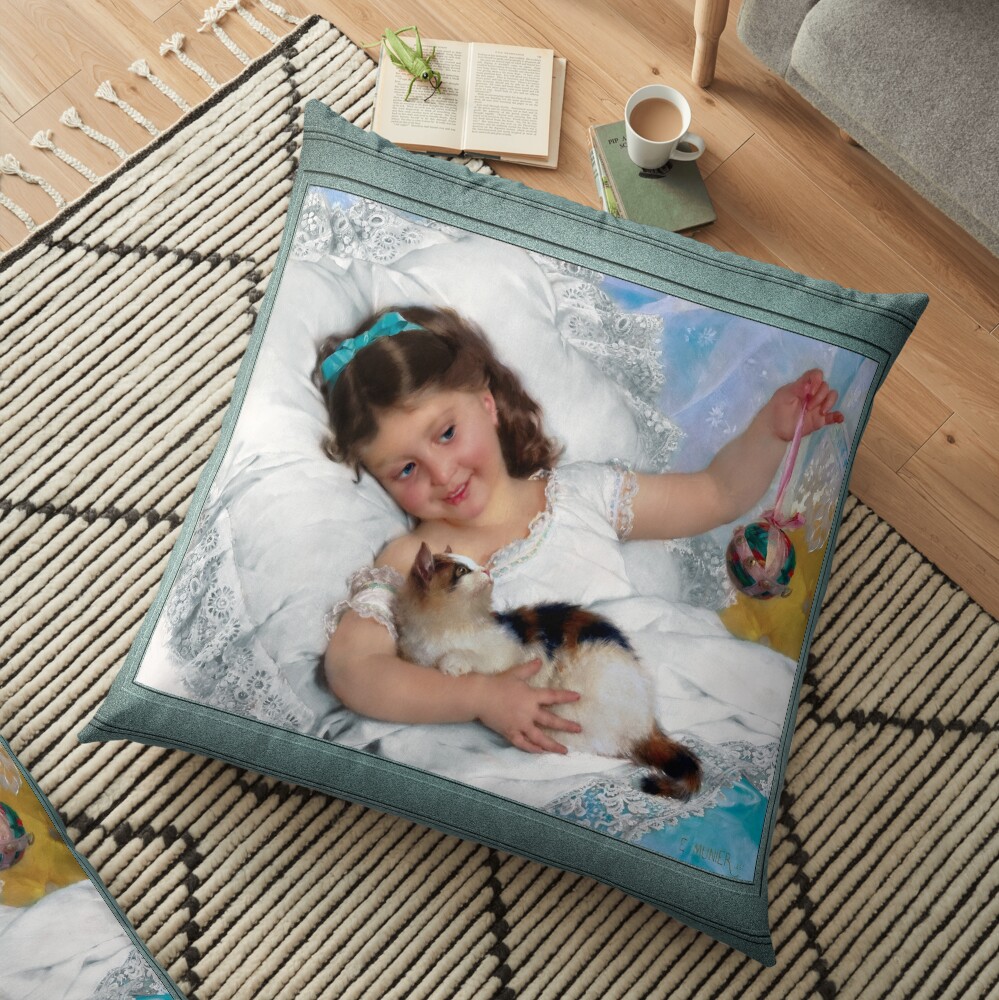
Petite Fille et Chat (Ung stúlka með kött) c1882 is an exquisite example of 19th-century French academic painting, created by Emile Munier (1840 – 1895), a renowned French painter known for his detailed depictions of children and their emotional depth. Málað inn 1882, this portrait captures a delicate moment of childhood innocence, perfectly encapsulated through the innocent gaze of a young girl who is lovingly interacting with a cat. Nákvæm athygli listamannsins á smáatriðum, his ability to capture human expression, and his expert use of light and color make this piece a standout in the genre of academic realism.
Efnisyfirlit
Aðalviðfangsefnið: The Young Girl
Í hjarta “Petite Fille et Chat” is the young girl, whose porcelain-like skin and gentle expression convey both fragility and joy. She is depicted in a moment of quiet delight as she reclines on a cushion, her body slightly turned towards the viewer while her gaze is directed downward at the small cat resting beside her. The girl’s soft brown hair is styled in loose waves, with a bright blue ribbon nestled at the crown of her head, adding a touch of playfulness to her appearance. The pale blue ribbon contrasts beautifully with the softness of her white gown, further emphasizing the purity and simplicity of her childhood.
The fabric of her gown is rendered in soft, flowing folds that suggest a fine, luxurious material. Its delicate lace trims at the neckline and sleeves add an element of refinement, capturing the high level of craftsmanship typical of the period. The girl’s posture and demeanor evoke an image of serene contentment, perfectly in tune with the theme of childhood innocence that the artist sought to portray.
The Cat: A Companion in Innocence
The cat, nestled contentedly beside the girl, plays a pivotal role in the composition. It is rendered with extraordinary attention to detail, particularly in its fur, which exhibits the artist’s characteristic skill in portraying texture. The cat’s distinctive coat of fur—patches of white, appelsínugult, and brown—creates a sense of realism, while its playful yet peaceful demeanor adds to the tranquil atmosphere of the painting. The young girl’s hand rests gently on the cat’s back, a tender gesture that reinforces the bond between the child and her pet, a universal symbol of innocence and companionship.
The cat’s presence in the painting also serves as a subtle contrast to the girl’s softness and elegance. It represents a more spontaneous and untamed element, yet in this context, it becomes a gentle companion, further enhancing the serene mood of the artwork.
Bakgrunn og stilling
The background of the painting is as meticulously composed as the figures in the foreground. The setting appears to be an indoor space, possibly a child’s nursery or a drawing room, where the soft textures of a luxurious fabric and a gentle play of light are at the forefront. Behind the young girl and cat, a soft, ethereal blue hue transitions to a creamy pastel yellow, búa til draumkennda, næstum annars veraldlegt andrúmsloft. The background is delicately painted, featuring light touches of drapery that hint at the artist’s attention to both the natural light filtering through the space and the textures of the fabrics.
Lace and other delicate elements such as floral patterns also appear in the background, adding complexity and depth to the scene without overwhelming the primary subject. The room, filled with these light, soft tones, emphasizes the purity of childhood, offering a quiet sanctuary where the girl and her cat are free to indulge in their peaceful moment.
Notkun lita og ljóss
Munier’s use of light and color is central to the emotional impact of “Petite Fille et Chat.” Mjúkt, pastel tones—predominantly blues, hvítum, and subtle hints of pink—dominate the composition, creating a serene and almost dreamlike quality. The delicate color palette enhances the theme of innocence, furthering the narrative of childhood purity and happiness.
The interplay of light and shadow on the girl’s face and gown is masterfully handled. Munier uses light to bring out the luminous quality of her skin, contrasting it with the subtle shadowing beneath her chin and along her collarbone, which adds depth to her features. The glow of her cheeks and the soft illumination around her eyes suggest a youthful vitality, yet this is contrasted by the calm serenity of the scene.
Emotional Impact and Theme
“Petite Fille et Chat” captures a moment of innocence and tranquility. The theme of childhood—its purity, tenderness, and closeness to nature—is rendered with delicate precision. The interaction between the girl and her cat is both intimate and gentle, a visual expression of the love and affection that often characterizes the bond between children and their pets.
The emotional atmosphere of the painting is one of warmth and comfort, a sanctuary from the outside world. Mjúkt, intimate moment between the girl and her cat seems to freeze time, inviting the viewer into a quiet, peaceful world where the only concerns are love and companionship. Munier’s portrayal of the girl’s sweet expression and the peaceful setting imbue the work with a sense of nostalgia, evoking a longing for simpler times and the beauty of childhood.
Listrænn stíll: Academic Realism
Emile Munier was a master of academic realism, a style characterized by its focus on the careful study of light, human anatomy, og náttúrunni. His works often feature children in idyllic settings, exploring themes of innocence, hreinleiki, og tilfinningalega dýpt. The precision with which Munier renders the details of the girl’s face, the textures of her gown, and the softness of the cat’s fur speaks to his exceptional technical skill and dedication to realism. His careful attention to detail in both the figures and the background elements reflects the high standards of academic painting in the 19th century.
Niðurstaða
“Petite Fille et Chat” is a timeless portrayal of childhood innocence and the beauty of quiet moments shared between a child and her pet. Through his exquisite use of light, lit, og áferð, Munier creates a scene that resonates with emotional warmth and tenderness. The piece stands as a perfect example of academic realism, blending technical skill with an intimate portrayal of the human experience.
Petite Fille et Chat is a remastered digital art old masters reproduction of a public domain image that is available as a strigaprentun á netinu.
Um Listamanninn
Upplýsingar hér að neðan fengnar af Wikipedia.org
Emile fæddist í París, Frakklandi til Pierre François Munier; listamannsbólstrara við veggteppaverksmiðju Nationale des Gobelins (í París Frakklandi) og Marie Louise Carpentier, pússari í kasmírdúkaverksmiðju.
Hann átti einnig tvo bræður François og Florimond; that along with him who trained and worked as artist for a period at the Nationale des Gobelins.
At the factory Emile was trained as a draughtsman by Abel Lucas, and would develop a close relationship with Abel and his family, which led to Emile marrying Lucas’ daughter Heriette in 1861.
Sadly in 1867, six weeks after his wife gave birth to their son Emile Henri, she contracted severe rheumatism, and died prematurely.
Í 1871 Emile left the tapestry factory to pursue painting full time, as well as providing painting classes to adults three nights a week.
Síðan inn 1872 Emile married Sargine Augrand a student of Abel Lucas and friend of Emile and Henriette; the couple had one daughter Marie-Louise, who was born in 1874.
Í 1884 hann fékk umboð frá ríkisstjóra Leland Stanford í Kaliforníu og konu hans Jane Stanford til að búa til málverk af syni þeirra Leland Stanford, Jr., sem hafði látist á aldrinum 1 15 ár; ahd hann nefndi verkið Angel Comforting His Grieving Mother; sem drengurinn sem engill sem sneri aftur til jarðar til að hugga móður sína með hendinni á öxl hennar.
Einn af áhrifamestu kennurum Emiles var franski málarinn William-Adolphe Bouguereau (1825 – 1905), og maður getur séð áhrifin sem hann hafði á Emile í mörgum af verkunum sem hann bjó til og með tímanum urðu þeir tveir líka nánir vinir.
Eitt frægasta verk hans, sem sýndi þessi áhrif er verk hans Trois Amis eða Three Friends, sem hann sýndi á Salon í París í 1885; sem sýndi bústna litla stúlku að leika á rúminu sínu með kettlingnum sínum og hundinum.
Þetta verk var svo vel þegið af almenningi, að hún hafi verið endurgerð í mörgum myndum og einnig notuð til kynningar af breska sápufyrirtækinu Pears Soap; sem stofnað var í 1807, framleiðir heims fyrstu gagnsæju sápuna.
Þetta málverk hjálpaði honum að koma honum sem einn af fremstu málurum ungra barna og gæludýra þeirra; og hann myndi halda áfram að mála slík atriði ásamt dýraveiðisenum, sjávarmyndir, landslag, tegund bænda senur, goðafræðilegt og trúarlegt viðfangsefni snemma á níunda áratugnum þar til hann lést í ótímabærum dauða 1895 á aldrinum 55.