

Phryne revelado antes del areópago: A Study in Classical Drama
Jean-Léon Gérôme’s “Phryne Revealed Before the Areopagus,"Pintado alrededor 1861, is a compelling work of historical genre painting that draws heavily from classical antiquity. It depicts a dramatic scene rooted in ancient Greek legal proceedings, specifically the trial of Phryne, a celebrated courtesan of Athens. Gérôme was renowned for his meticulous attention to detail and his ability to recreate historical settings with remarkable accuracy, and this piece exemplifies those qualities. The painting is not merely an illustration of a story; it’s a carefully constructed tableau designed to evoke a sense of tension, anticipation, and the weight of societal judgment.
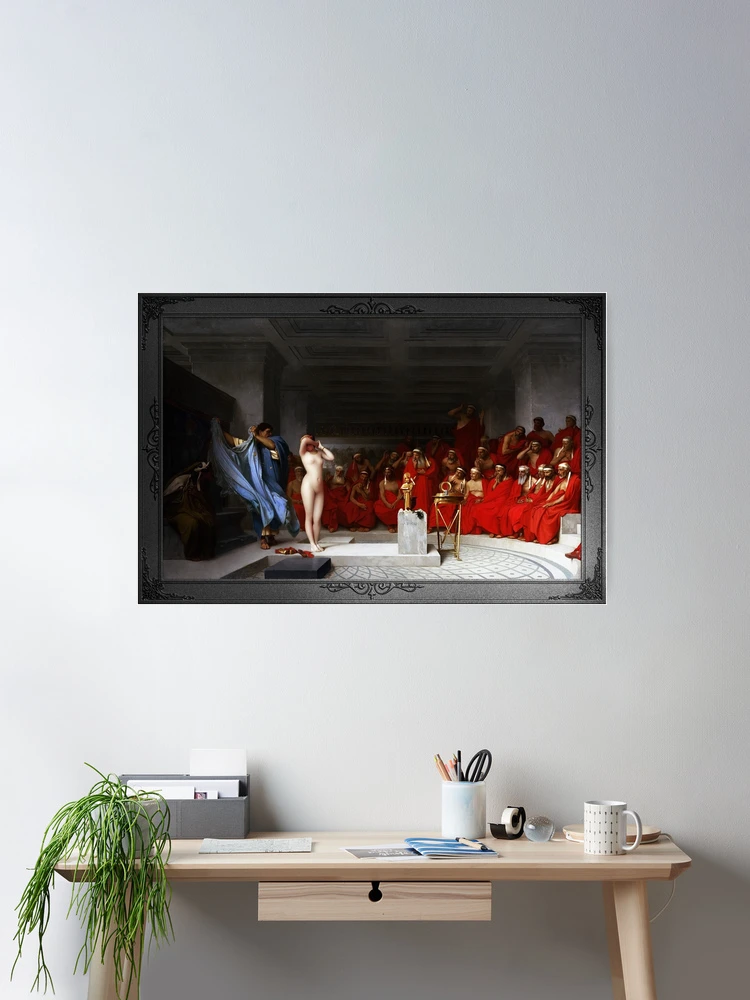
Tabla de contenido
Estructura compositiva & Configuración
The composition is meticulously structured, guiding the viewer’s eye through the unfolding drama. The scene unfolds within a grand hall, likely representing the Areopagus, the ancient Athenian court known for its gravity and importance. Architectural elements dominate the background: tall columns with ornate capitals support a coffered ceiling, suggesting a space of considerable authority and permanence. Light streams in from an unseen source on the left, illuminating the central figures while casting long shadows that heighten the sense of drama. The hall is filled with seated men, all clad in similar crimson robes, forming a dense audience observing the proceedings. Their uniformity emphasizes their role as collective judges, representing Athenian society’s scrutiny.
Phryne: La figura central
At the heart of the composition stands Phryne herself. She is depicted nude, her body rendered with anatomical precision and a classical idealization reminiscent of ancient Greek sculpture. Her pose is one of vulnerability and exposure; she appears to be in the process of disrobing, perhaps as part of an attempt at legal maneuvering or a demonstration of innocence. Her expression is difficult to definitively interpret – it could suggest defiance, resignation, or even a hint of melancholy. The artist avoids any overt display of emotion, instead opting for a subtle and restrained portrayal that allows viewers to project their own interpretations onto her character.
The Legal Processors & Supporting Characters
To Phryne’s left stands a man in Roman attire, likely an advocate or legal representative. He is actively engaged in the scene, holding back a drape of fabric as if revealing Phryne to the court. His posture suggests a degree of authority and control over the unfolding events. Further back, seated figures form the Areopagus itself. Their faces are largely obscured by shadow and their expressions are difficult to discern, contributing to an atmosphere of solemnity and impartiality. A small altar or pedestal stands in the foreground, upon which rests a bronze statue – possibly representing Athena, the goddess of wisdom and justice, subtly alluding to the divine sanction underpinning Athenian law.
Gérôme’s Technical Skill & Influencias artísticas
Gérôme’s mastery of realism is evident throughout the painting. The textures of the fabrics, the smoothness of Phryne’s skin, and the cool marble of the architectural elements are rendered with remarkable fidelity. His use of chiaroscuro – the dramatic contrast between light and shadow – enhances the sense of depth and creates a theatrical atmosphere. The work reflects Gérôme’s deep interest in classical antiquity and his desire to recreate historical scenes with accuracy and authenticity. He was influenced by earlier masters such as Jacques-Louis David, but he developed his own distinctive style characterized by meticulous detail and a focus on narrative clarity. The painting’s composition also draws inspiration from theatrical staging, creating a sense of dramatic tension that engages the viewer directly.
Contexto histórico & Interpretación
The story behind “Phryne Revealed Before the Areopagus” is rooted in ancient Greek history. Phryne was a renowned courtesan known for her beauty and wealth. She was accused of impiety and brought before the Areopagus. According to accounts, she offered a substantial bribe to the court officials, which was then used to fund the construction of a statue of Hermes at the Temple of Ares. The painting captures this moment of legal drama, focusing on the tension between Phryne’s vulnerability and the power of the Athenian court. While Gérôme’s work is based on historical accounts, it also transcends mere illustration; it explores themes of justice, societal judgment, and the complexities of human relationships within a specific cultural context.
Legado & Significado
“Phryne Revealed Before the Areopagus” remains one of Jean-Léon Gérôme’s most celebrated works. It exemplifies his skill as a historical genre painter and his ability to create compelling narratives through meticulous detail and dramatic composition. The painting has been admired for its technical virtuosity, su atmósfera evocadora, and its exploration of timeless themes related to law, moralidad, y la condición humana. It continues to be studied by art historians and appreciated by audiences for its enduring power and historical significance.
Los acentos decorativos utilizados en esta pieza están disponibles en HeritageType
Biografía del artista derivada de Wikipedia.org
Jean-Léon Gérôme (11 Mayo 1824 - 10 enero 1904) fue un pintor y escultor francés en el estilo ahora conocido como academicismo. Sus pinturas se reprodujeron tan ampliamente que fue “posiblemente el artista vivo más famoso del mundo en 1880.”[1] La gama de su obra incluyó la pintura histórica, mitología griega, orientalismo, retratos, y otros temas, Llevar la tradición de la pintura académica a un clímax artístico.. Es considerado uno de los pintores más importantes de este período académico..
En 1840 se fue a paris, donde estudió con Paul Delaroche, a quien acompañó a Italia en 1843. Visitó florencia, Roma, el Vaticano y Pompeya. A su regreso a París en 1844, como muchos estudiantes de Delaroche, se unió al atelier de Charles Gleyre y estudió allí por un breve tiempo. Luego asistió a la Escuela de Bellas Artes. En 1846 intentó entrar en el prestigioso Prix de Rome, pero falló en la etapa final porque su dibujo de figura era inadecuado.
Su pintura La pelea de gallos (1846) es un ejercicio académico que representa a un joven desnudo y a una joven vestida muy finamente con dos gallos de pelea, con la bahía de Nápoles al fondo. Envió esta pintura al Salón de París de 1847, donde le valió una medalla de tercera clase. Este trabajo fue visto como el epítome del movimiento Neo-Grec que se había formado a partir del estudio de Gleyre. (incluidos Henri-Pierre Picou y Jean-Louis Hamon), y fue defendido por el influyente crítico francés Théophile Gautier, cuya revisión hizo famoso a Gérôme y lanzó efectivamente su carrera.
Gérôme abandonó su sueño de ganar el Prix de Roma y aprovechó su repentino éxito. Sus cuadros La Virgen, el Niño Jesús y San Juan y Anacreonte, Baco y Eros se llevaron una medalla de segunda clase en el Salón de París en 1848. En 1849, produjo las pinturas de Miguel Ángel (también llamado en su estudio) y un retrato de una dama.
En 1851, decoró un jarrón que más tarde le ofreció el emperador Napoleón III de Francia al príncipe Alberto, ahora parte de la Royal Collection en St. Palacio de James, Londres. Expuso Interior griego, Recuerdo de Italia, Baco y el amor, Borracho en 1851; Paestum en 1852; y un idilio en 1853
En 1852, Gérôme recibió el encargo de pintar un gran mural de un tema alegórico de su elección.. La edad de Augusto, el nacimiento de cristo, que combinaría el nacimiento de Cristo con naciones conquistadas rindiendo homenaje a Augusto, puede haber tenido la intención de halagar a Napoleón III, cuyo gobierno encargó el mural y que fue identificado como un “nuevo augusto.
Un pago inicial considerable permitió a Gérôme viajar e investigar, primero en 1853 a Constantinopla, junto con el actor Edmond Got, y en 1854 a Grecia y Turquía y las orillas del Danubio, donde estuvo presente en un concierto de reclutas rusos haciendo música bajo la amenaza de un latigazo.
En 1853, Gérôme se mudó a Tea Box, un grupo de estudios en la Rue Notre-Dame-des-Champs, París. Este se convertiría en un lugar de encuentro para artistas., escritores y actores, donde George Sand entretuvo a los compositores Héctor Berlioz, Johannes Brahms y Gioachino Rossini y los novelistas Théophile Gautier e Ivan Turgenev.
En 1854, completó otra importante comisión, decorando la Capilla de San. Jerónimo en la iglesia de St. Séverin en París. Su Última Comunión de San. Jerónimo en esta capilla refleja la influencia de la escuela de Ingres en sus obras religiosas..
A la Exposición Universal de 1855 el aporto Pifferaro, Pastor, y la era de Augusto, el nacimiento de cristo, pero fue el cuadro modesto Recreación en un campamento ruso lo que atrajo la mayor atención ...
Phryne Revealed Before The Areópagus es una reproducción de antiguos maestros de arte digital retocada de una imagen de dominio público.