

Phryne ujawniona przed areopagami: A Study in Classical Drama
Jean-Leon Gerome’s “Phryne Revealed Before the Areopagus,”Namalował 1861, is a compelling work of historical genre painting that draws heavily from classical antiquity. It depicts a dramatic scene rooted in ancient Greek legal proceedings, specifically the trial of Phryne, a celebrated courtesan of Athens. Gérôme was renowned for his meticulous attention to detail and his ability to recreate historical settings with remarkable accuracy, and this piece exemplifies those qualities. The painting is not merely an illustration of a story; it’s a carefully constructed tableau designed to evoke a sense of tension, anticipation, and the weight of societal judgment.
Spis treści
Struktura kompozycyjna & Ustawienie
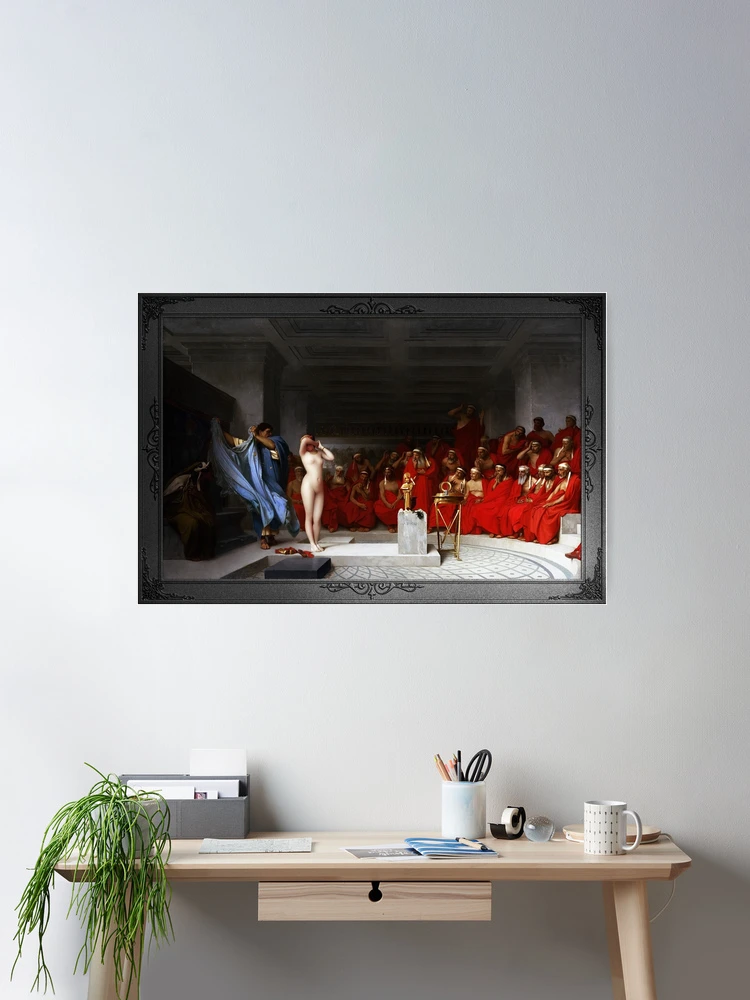
The composition is meticulously structured, guiding the viewer’s eye through the unfolding drama. The scene unfolds within a grand hall, likely representing the Areopagus, the ancient Athenian court known for its gravity and importance. Architectural elements dominate the background: tall columns with ornate capitals support a coffered ceiling, suggesting a space of considerable authority and permanence. Light streams in from an unseen source on the left, illuminating the central figures while casting long shadows that heighten the sense of drama. The hall is filled with seated men, all clad in similar crimson robes, forming a dense audience observing the proceedings. Their uniformity emphasizes their role as collective judges, representing Athenian society’s scrutiny.
Phryne: Centralna postać
At the heart of the composition stands Phryne herself. She is depicted nude, her body rendered with anatomical precision and a classical idealization reminiscent of ancient Greek sculpture. Her pose is one of vulnerability and exposure; she appears to be in the process of disrobing, perhaps as part of an attempt at legal maneuvering or a demonstration of innocence. Her expression is difficult to definitively interpret – it could suggest defiance, resignation, or even a hint of melancholy. The artist avoids any overt display of emotion, instead opting for a subtle and restrained portrayal that allows viewers to project their own interpretations onto her character.
The Legal Processors & Supporting Characters
To Phryne’s left stands a man in Roman attire, likely an advocate or legal representative. He is actively engaged in the scene, holding back a drape of fabric as if revealing Phryne to the court. His posture suggests a degree of authority and control over the unfolding events. Further back, seated figures form the Areopagus itself. Their faces are largely obscured by shadow and their expressions are difficult to discern, contributing to an atmosphere of solemnity and impartiality. A small altar or pedestal stands in the foreground, upon which rests a bronze statue – possibly representing Athena, the goddess of wisdom and justice, subtly alluding to the divine sanction underpinning Athenian law.
Gérôme’s Technical Skill & Wpływ artystyczny
Gérôme’s mastery of realism is evident throughout the painting. The textures of the fabrics, the smoothness of Phryne’s skin, and the cool marble of the architectural elements are rendered with remarkable fidelity. His use of chiaroscuro – the dramatic contrast between light and shadow – enhances the sense of depth and creates a theatrical atmosphere. The work reflects Gérôme’s deep interest in classical antiquity and his desire to recreate historical scenes with accuracy and authenticity. He was influenced by earlier masters such as Jacques-Louis David, but he developed his own distinctive style characterized by meticulous detail and a focus on narrative clarity. The painting’s composition also draws inspiration from theatrical staging, creating a sense of dramatic tension that engages the viewer directly.
Historical Context & Interpretacja
The story behind “Phryne Revealed Before the Areopagus” is rooted in ancient Greek history. Phryne was a renowned courtesan known for her beauty and wealth. She was accused of impiety and brought before the Areopagus. According to accounts, she offered a substantial bribe to the court officials, which was then used to fund the construction of a statue of Hermes at the Temple of Ares. The painting captures this moment of legal drama, focusing on the tension between Phryne’s vulnerability and the power of the Athenian court. While Gérôme’s work is based on historical accounts, it also transcends mere illustration; it explores themes of justice, societal judgment, and the complexities of human relationships within a specific cultural context.
Dziedzictwo & Znaczenie
“Phryne Revealed Before the Areopagus” remains one of Jean-Léon Gérôme’s most celebrated works. It exemplifies his skill as a historical genre painter and his ability to create compelling narratives through meticulous detail and dramatic composition. The painting has been admired for its technical virtuosity, jego sugestywną atmosferę, and its exploration of timeless themes related to law, moralność, and the human condition. It continues to be studied by art historians and appreciated by audiences for its enduring power and historical significance.
Akcenty dekoracyjne użyte w tym kawałku są dostępne w Typ dziedzictwa
Bio artysty pochodzące z Wikipedia.org
Jean-Leon Gerome (11 Móc 1824 – 10 styczeń 1904) był francuskim malarzem i rzeźbiarzem w stylu znanym obecnie jako akademizm. Jego obrazy były tak szeroko reprodukowane, że był “prawdopodobnie najsłynniejszy żyjący artysta na świecie do 1880 roku.”[1] W swoim dorobku miał malarstwo historyczne, mitologia grecka, orientalizm, portrety, i inne przedmioty, doprowadzenie tradycji malarstwa akademickiego do artystycznej kulminacji. Uważany jest za jednego z najważniejszych malarzy tego okresu akademickiego.
W 1840 pojechał do Paryża, gdzie studiował pod kierunkiem Paula Delaroche, którym towarzyszył do Włoch w 1843. Odwiedził Florencję, Rzym, Watykan i Pompeje. Po powrocie do Paryża w 1844, jak wielu studentów Delaroche, dołączył do atelier Charlesa Gleyre'a i studiował tam przez krótki czas. Następnie uczęszczał do Szkoły Sztuk Pięknych. W 1846 próbował wejść do prestiżowej Prix de Rome, ale nie powiodło się w ostatnim etapie, ponieważ jego rysunek był niewystarczający.
Jego obraz Walka kogutów (1846) to ćwiczenie akademickie przedstawiające nagiego młodego mężczyznę i bardzo cienką udrapowaną młodą kobietę z dwoma walczącymi kutasami, z Zatoką Neapolitańską w tle. Wysłał ten obraz do paryskiego salonu 1847, gdzie zdobył medal III klasy. Ta praca była postrzegana jako uosobienie ruchu neo-greckiego, który powstał ze studia Gleyre'a (w tym Henri-Pierre Picou i Jean-Louis Hamon), i był orędownikiem wpływowego francuskiego krytyka Théophile Gautier, którego recenzja przyniosła Gérôme'owi sławę i skutecznie zapoczątkowała jego karierę.
Gérôme porzucił marzenie o zdobyciu Prix de Rome i wykorzystał swój nagły sukces. Jego obrazy Dziewica, Dzieciątko Jezus oraz św. Jan i Anakreon, Bacchus i Eros zdobyli medal II klasy na Salonie Paryskim w 1848. W 1849, wyprodukował obrazy Michał Anioł (zwany także W swoim Studio) i Portret damy.
W 1851, ozdobił wazę, którą później cesarz Napoleon III podarował księciu Albertowi, obecnie część Królewskiej Kolekcji w St. Pałac Jakuba, Londyn. Wystawiał greckie wnętrze, Pamiątka z Włoch, Bachus i miłość, Pijany w 1851; Paestum w 1852; i Idylla w 1853
W 1852, Gérôme otrzymał zlecenie namalowania dużego muralu przedstawiającego alegoryczny temat, który wybrał. Wiek Augusta, narodziny Chrystusa, która łączyłaby narodziny Chrystusa z podbitymi narodami oddającymi hołd Augustowi, mógł być przeznaczony do schlebiania Napoleonowi III, czyj rząd zlecił wykonanie muralu i kto został zidentyfikowany jako “nowy August.
Znaczna zaliczka umożliwiła Gérôme podróżowanie i badania, pierwszy w 1853 do Konstantynopola, razem z aktorem Edmondem Got, i w 1854 do Grecji i Turcji oraz wybrzeży Dunaju, gdzie był obecny na koncercie rosyjskich poborowych muzykujących pod groźbą bata.
W 1853, Gérôme przeniósł się do Tea Box, grupa studiów przy Rue Notre-Dame-des-Champs, Paryż. Stałoby się to miejscem spotkań artystów, pisarze i aktorzy, gdzie George Sand bawiła kompozytorów Hectora Berlioz, Johannes Brahms i Gioachino Rossini oraz powieściopisarze Théophile Gautier i Ivan Turgieniew.
W 1854, wykonał kolejne ważne zlecenie, dekorowanie kaplicy św. Hieronim w kościele św. Severin w Paryżu. Jego ostatnia komunia św. Hieronim w tej kaplicy odzwierciedla wpływ szkoły Ingresa na jego dzieła religijne.
Na Wystawę Powszechną 1855 przyczynił się do Pifferaro, Pasterz, i Wiek Augusta, narodziny Chrystusa, ale to skromny obraz Rekreacja w rosyjskim obozie przyciągnął najwięcej uwagi…
Phryne Revealed Before The Areopagus to wyretuszowana cyfrowa reprodukcja starych mistrzów obrazu z domeny publicznej.