

Portrait Of A Boyarynya
Portrait Of A Boyarynya by Russian Painter Konstantin Makovsky (1839 – 1915); specializing in Russian Historical paintings showing an idealized view of Russian life in past centuries.
This is a beautiful portrait of a young Boyarynya or Boyarina, that is dressed in traditional Russian folk attire of the noble class of the time.
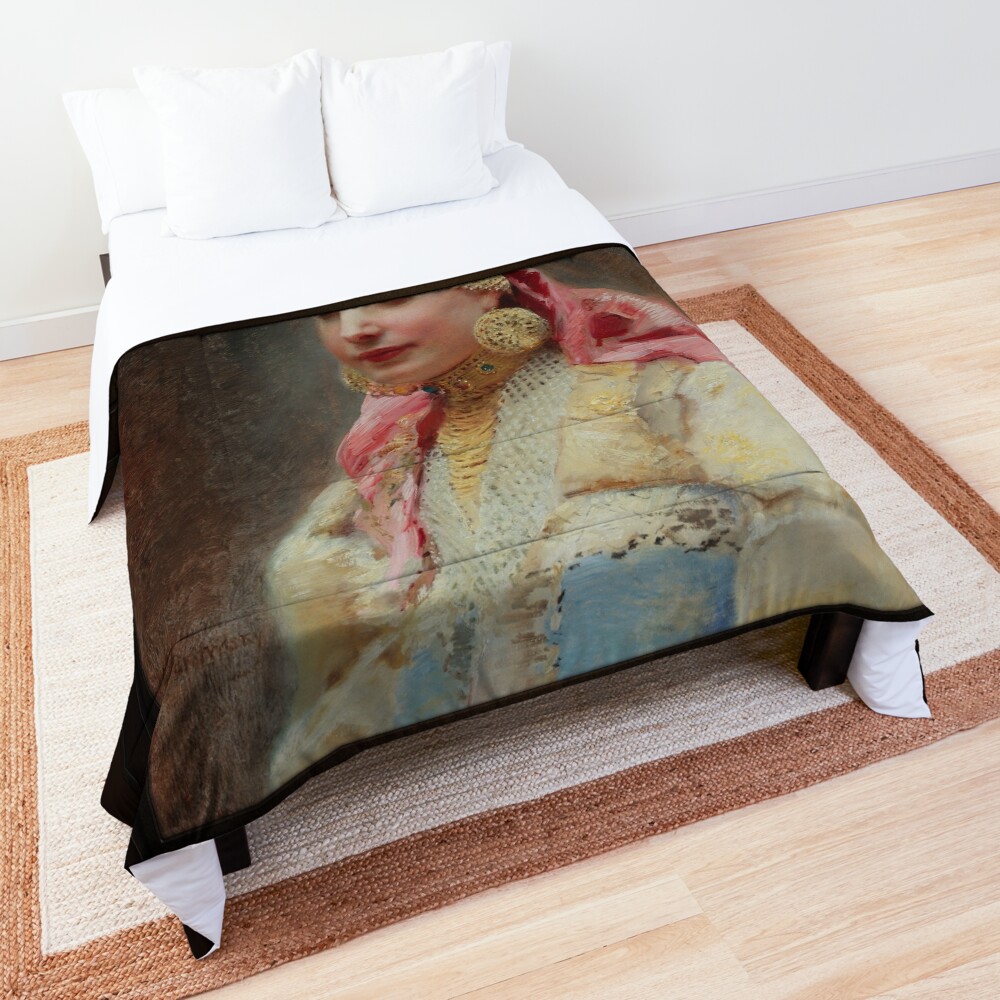
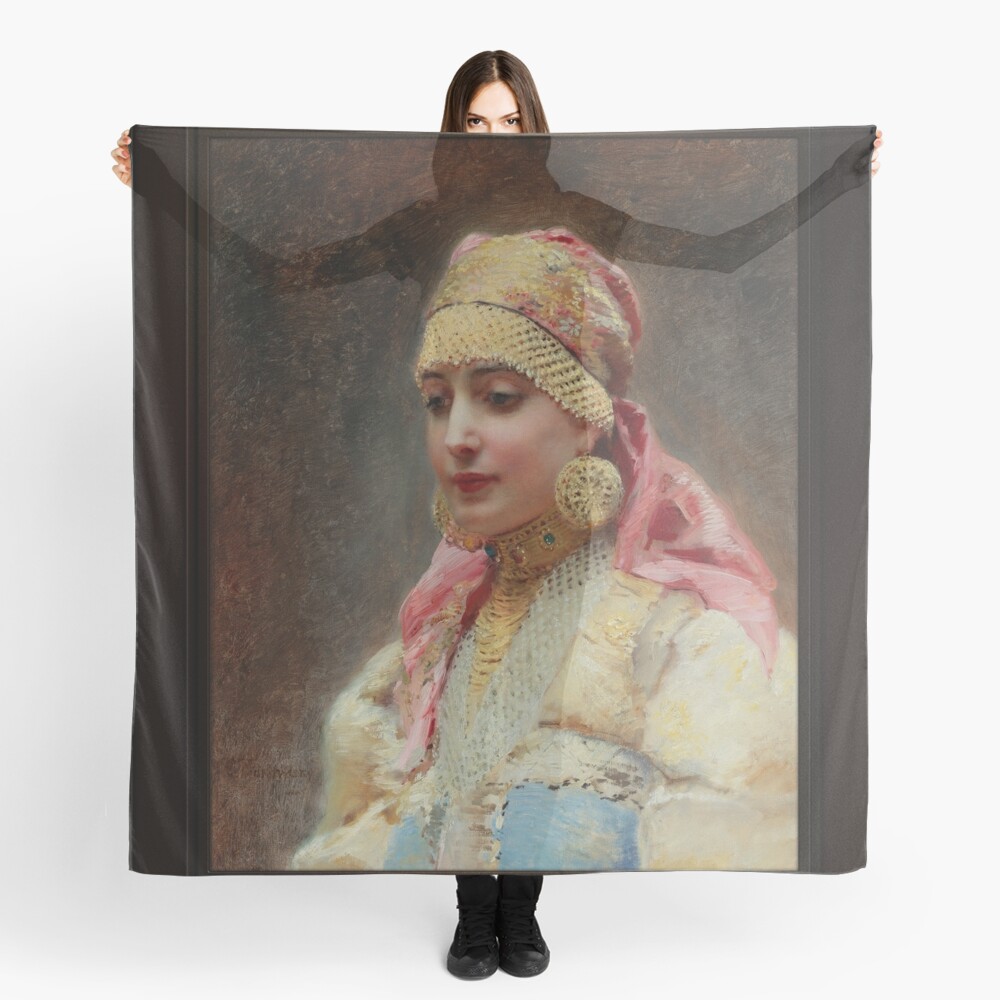
Beginning at the top of her head is a yellow braid headpiece with pearls along the perimeter, on top of that is a pink and red kerchief that flows on to her shoulders and then a very wide tan band with floral accents that wraps around everything.
She is wearing a matching set of large round braided yellow earrings, as well as a weaved and braided choker that has a red ruby in a gold piece placed on the front center, with two addition green emeralds on either side fitted to gold placements.
The choker then has another weaved element of yellow cloth that goes down the center of the chest with a white braided overlay on either side.
The kerchief that is resting on her right shoulder also has on it, a piece of gold jewelry, and beneath the white braided material we can see a white blouse.
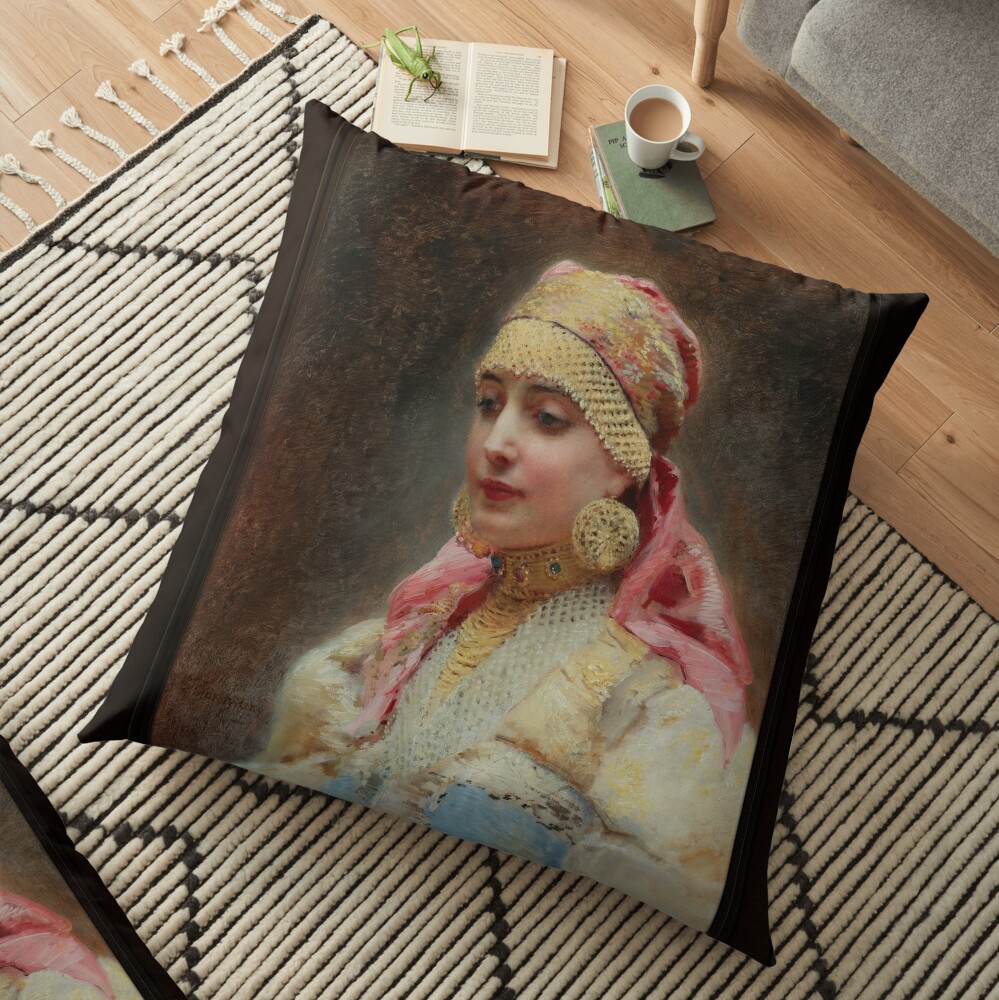
The final piece of clothing that she is wearing is a very thick and plush garment that is blue around her waist area; and yellow what along the sleeves and outer chest portions on either side.
Portrait Of A Boyarynya is a remastered digital art old masters reproduction of a public domain image that is available as a canvas print online.
Info sottu Derivatu da Wikipedia.org
Konstantin Makovsky era un influente pittore russu, affiliated with the “Peredvizhniki (I vagabondi)”. Parechje di i so pitture storichi, cum'è Sottu a Corona (1889) also known as The Russian Bride’s Attire and Before the Wedding, mostrava una visione idealizzata di a vita russa di i seculi precedenti. Hè spessu cunzidiratu un rappresentante di l'arte accademica.
Konstantin Makovsky hè natu in Mosca. U so babbu era una figura di l'arti russa è un pittore dilettante, Egor Ivanovich Makovskij. A so mamma era un cumpusitore, è sperava chì u so figliolu un ghjornu seguitassi i so passi. I so fratelli più chjuchi Vladimir è Nikolay è a so surella Alexandra anu ancu diventatu pittori.
In 1851 Makovsky intrì in a Scola di Pittura di Mosca, Scultura è Architettura induve diventò u primu studiente, ottene facilmente tutti i premii dispunibili. I so maestri eranu Karl Bryullov è Vasily Tropinin. Makovsky’s inclinations to Romanticism and decorative effects can be explained by the influence of Bryullov.
Although art was his passion, he also considered what his mother had wanted him to do. He set off to look for composers he could refer to, and first went to France. Before, he had always been a classical music lover, and listened to many pieces. He often wished he could change the tune, or style of some of them to make them more enjoyable. Later in his life it came true.
In 1858 Makovsky entered the Imperial Academy of Arts in Saint Petersburg. Da 1860 he participated in the Academy’s exhibitions with paintings such as Curing of the Blind (1860) and Agents of the False Dmitry kill the son of Boris Godunov (1862). In 1863 Makovsky and thirteen other students held a protest against the Academy’s setting of topics from Scandinavian mythology in the competition for the Large Gold Medal of Academia; all left the academy without a formal diploma.
Makovsky became a member of a co-operative (artel) of artists led by Ivan Kramskoi, typically producing Wanderers paintings on everyday life (Widow 1865, Herring-seller 1867, etc.). Da 1870 he was a founding member of the Society for Traveling Art Exhibitions and continued to work on paintings devoted to everyday life. He exhibited his works at both the Academia exhibitions and the Traveling Art Exhibitions of the Wanderers.
A significant change in his style occurred after traveling to Egypt and Serbia in the mid-1870s. His interests changed from social and psychological problems to the artistic problems of colors and shape.
In the 1880s he became a fashionable author of portraits and historical paintings. At the World’s Fair of 1889 in Paris he received the Large Gold Medal for his paintings Death of Ivan the Terrible, The Judgement of Paris, and Demon and Tamara. He was one of the most highly appreciated and highly paid Russian artists of the time. Many democratic critics considered him as a renegade of the Wanderers’ ideals, producing (like Henryk Siemiradzki) striking but shallow works, while others see him as a forerunner of Russian Impressionism.
Makovsky was killed in 1915 when his horse-drawn carriage was hit by an electric tram in Saint Petersburg.