

Portrait Of A Girl
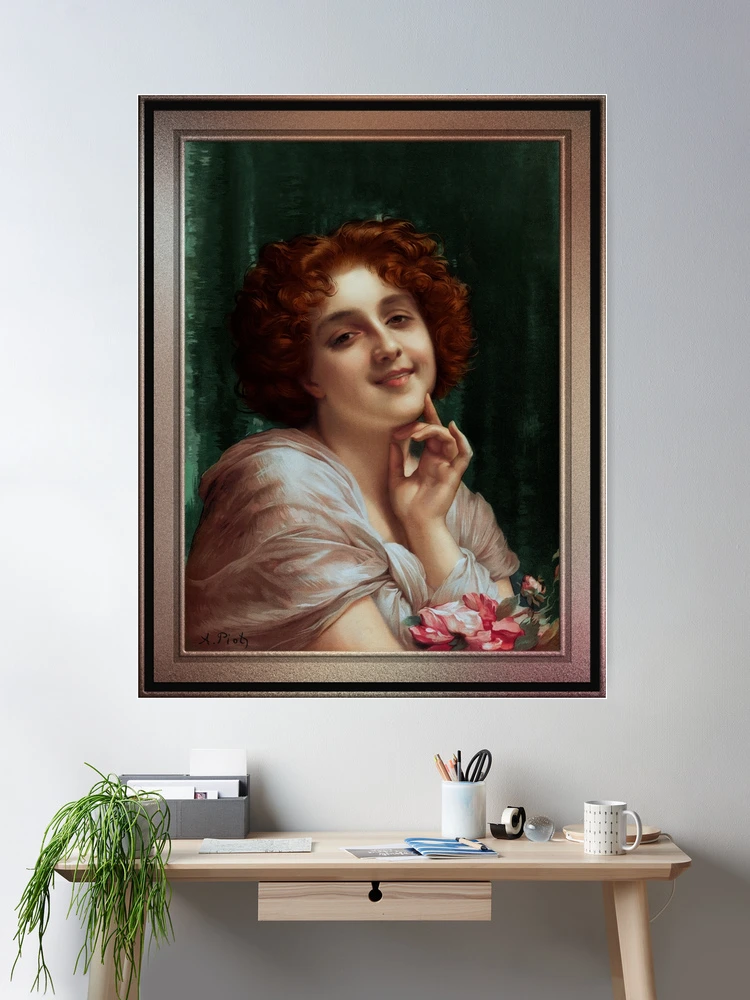
De “Portrait Of A Girl” av fransk målare Etienne Adolphe Piot (1825 – 1910) is a captivating work of art, characteristic of the 19th century’s elegant and romantic portraiture. This painting demonstrates Piot’s exceptional mastery of light, textur, and the delicate portrayal of human emotion, making it a testament to his skill as one of the preeminent portraitists of his time.
Innehållsförteckning
Ämnet: A Glimpse Into Innocence and Beauty
The central figure in this artwork is a young woman with radiant auburn hair styled in soft, natural curls that frame her delicate face. Her expression exudes an enchanting combination of warmth and confidence, drawing the viewer into her world. Her slight smile and direct gaze suggest a serene yet playful demeanor, a hallmark of Piot’s ability to imbue his subjects with a lifelike and approachable aura. Posen, her hand lightly touching her chin, is relaxed and introspective, further enhancing the sense of intimacy between the subject and the viewer.
Bakgrund och komposition: A Harmonious Setting
The background of the painting is a rich, dark green curtain, rendered with textured strokes to provide depth and contrast to the subject. The choice of green not only complements the subject’s auburn hair but also evokes a sense of natural elegance, grounding the composition in simplicity without distracting from the central figure. The understated backdrop allows the warm tones of her skin and the soft hues of her attire to dominate the visual narrative.
Kläder och accessoarer: A Study in Softness
The girl is draped in a gossamer-like fabric, likely a fine, sheer shawl or wrap, that flows gracefully around her shoulders. The translucent quality of the fabric is depicted with remarkable detail, as Piot captures the way it gently clings to her form while reflecting subtle light. This mastery of texture underscores the painter’s ability to convey the ethereal and delicate qualities of fabric, adding to the overall impression of refinement.
In the lower portion of the painting, delvis synlig, are red and pink flowers. These blooms, placed subtly yet purposefully, enhance the romantic theme of the work. Their inclusion not only adds a splash of vibrant color but also symbolizes youth, skönhet, and fleeting moments of life—concepts frequently explored in 19th-century portraiture.
Stil och teknik: A Romantic Realism
Etienne Adolphe Piot is renowned for his Romantic Realism, a style that combines the emotive qualities of Romanticism with the precision and accuracy of Realism. I detta porträtt, he employs a soft, almost luminous palette that enhances the gentle features of the subject. The brushstrokes are smooth and meticulous, particularly in the rendering of the girl’s skin and hair, showcasing Piot’s dedication to detail and his ability to capture the subtleties of human anatomy.
The interplay of light and shadow is another striking feature of this painting. The subject’s face is bathed in soft, diffused light that highlights her cheeks and brow, creating a sense of three-dimensionality. This use of lighting not only draws attention to her features but also imparts a glowing, almost otherworldly quality to her visage.
Humör och atmosfär: A Celebration of Feminine Grace
Den övergripande stämningen av “Portrait Of A Girl” is one of tenderness and admiration for feminine grace and beauty. The tranquil expression of the subject, coupled with the soft colors and elegant composition, creates an atmosphere of calm and introspection. The painting radiates a sense of timelessness, capturing a fleeting moment of youth and innocence that transcends the constraints of time and space.
Konstnärlig kontext: Piot’s Legacy
Etienne Adolphe Piot was celebrated for his ability to convey the inner world of his subjects through their outward expressions. Detta porträtt, like much of his work, focuses on the beauty and individuality of the sitter, avoiding overt symbolism or elaborate storytelling. I stället, it emphasizes the intrinsic value of the human form and the emotional resonance of a single moment captured on canvas.
Piot’s skillful blending of Romantic ideals with realistic techniques placed him among the notable artists of his era, och “Portrait Of A Girl” serves as a quintessential example of his oeuvre. The painting reflects not only his technical proficiency but also his deep appreciation for the human spirit, making it a work of enduring appeal.
Slutsats
“Portrait Of A Girl” by Etienne Adolphe Piot is a masterful example of 19th-century portraiture, showcasing the artist’s remarkable ability to blend realism with romanticism. Through its detailed rendering, harmonious composition, and evocative mood, the painting captures the essence of youthful beauty and timeless elegance. The work stands as a testament to Piot’s skill and artistic vision, ensuring its place among the treasured masterpieces of its time.
Porträtt av en flicka är en retuscherad digital konst gamla mästare reproduktion av en offentlig egendom bild.
Artist Bio härledd från Wikipedia.org
Étienne-Adolphe Piot föddes i Digoin, Saone-et-Loire, Frankrike. Han flyttade till Paris och studerade under Léon Cogniet, och först utställd på Paris Salon i 1850, så det antas att han förmodligen föddes i mitten av 1820 -talet.
I 1860 han var bland de målare vars verk visades på Exposition de Bourdeaux, och i 1864 när han bodde i New York City, han ställde ut ett porträtt på National Academy of Design.
Fram till 1876 Piot ställde ut sina konstverk under namnet Adolphe Piot, efter detta började han också använda namnen Adolphe-Étienne Piot och Étienne-Adolphe Piot på sina konstverk.
Piot var mycket framgångsrik kommersiellt, dra nytta av den ökande efterfrågan på porträtt från rika parisare. Under Belle Époque fick varje debutant måla sitt porträtt, och Piot var skicklig på att skapa de fängslande porträtt som unga damer sökte.
Piot blev medlem i Société des Artistes Français i 1883, och i 1890 fick ett hedrande omnämnande för det arbete han ställde ut på 1889 Världsutställning. Hans sista salongpost verkar ha skickats in 1909, ett år före hans död.