

Portrait of a Lady
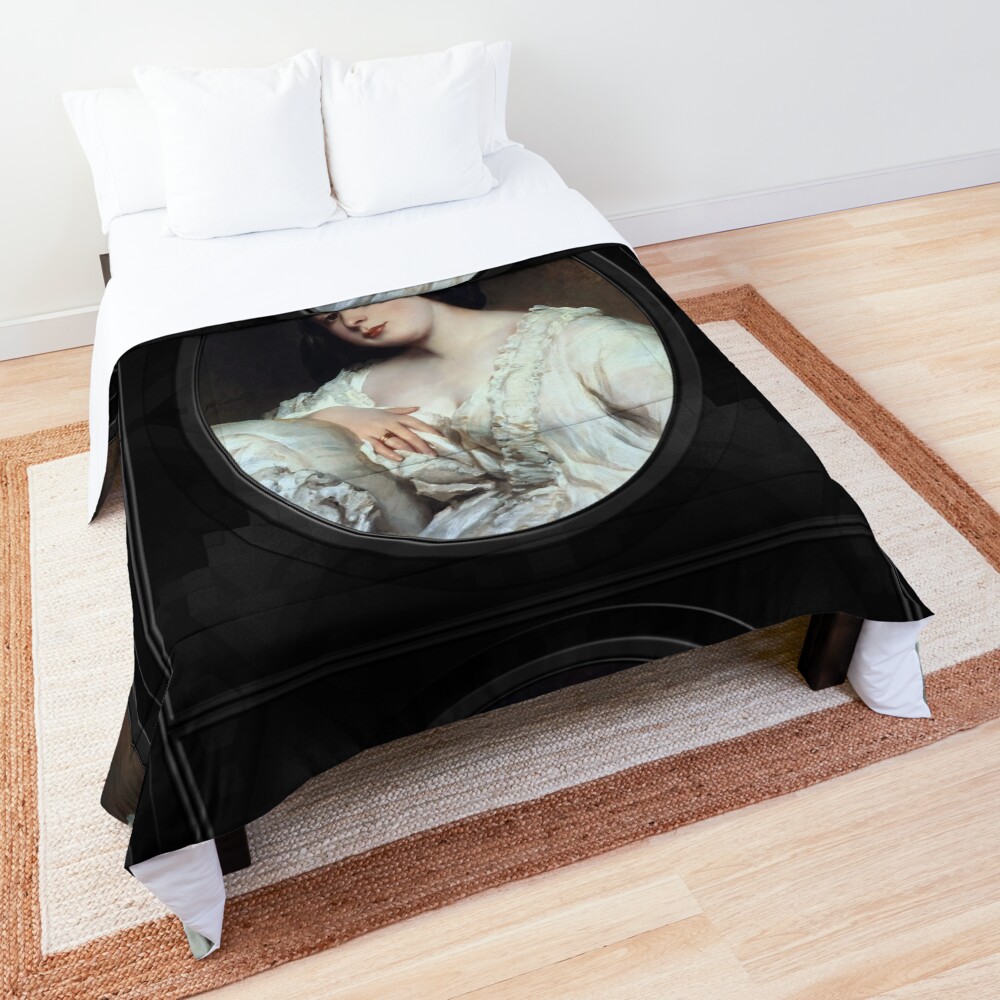
Franz Xaver Winterhalter’s Portrait of a Lady (c. 1850s) stands as a quintessential representation of mid-19th-century European portraiture. Winterholder (1805 – 1873), a German artist renowned for his highly polished, elegant works; and older brother of German painter Hermann Fidel Winterhalter (1808 – 1891), often painted the aristocracy and elite of Europe, capturing them in ways that highlighted both their opulence and refinement.
This portrait, an example of his mastery, features a lady in a delicate pose, her somber yet poised expression framed by the soft, almost ethereal quality of her attire and the setting. Sylw manwl yr artist i fanylion, and his ability to create lifelike textures and warm tones, bring the subject to life with remarkable realism and grace.
Tabl Cynnwys
Y Testun a'r Cyfansoddiad
The portrait is a close-up of a young lady, likely from the European upper classes, given the sophistication and quality of her attire. Her white gown, characterized by soft ruffles and intricate folds, drapes gently across her shoulders and chest, creating a sense of movement and grace.
Her calm yet enigmatic expression is the focal point of the piece, drawing the viewer’s attention to her delicate features. The lady’s dark hair, parted in the center and styled in a smooth, controlled manner, contrasts beautifully with the light fabric of her dress, enhancing the overall balance of light and dark within the composition.
Mae ei llaw yn gorffwys yn ysgafn ar ei glin, bysedd yn lledaenu'n gain, gyda modrwy i'w gweld ar ei llaw chwith, gan ddynodi ei statws ac efallai perthynas neu dreftadaeth bwysig. Mae'r ystum gynnil yn ychwanegu naws o fireinio ac uchelwyr i'r olygfa, gan gynnwys urddas y gwrthrych. Mae Winterhalter yn cyfleu gwead meddal ei chroen a goleuedd tôn ei chroen gyda'r un parch ag y mae'n ei roi i ffabrig ei gŵn. Dyma nodwedd o'i arddull, obsesiwn gyda gwead sy'n cyfoethogi ansawdd bywydol y testunau a beintiodd.
Deunyddiau a Thechneg
Gweithiodd Winterhalter gydag olew, defnyddio techneg haenog a oedd yn caniatáu iddo gyflawni dyfnder a naws rhyfeddol yn ei liwiau. Y meddal, almost translucent nature of the lady’s white dress suggests Winterhalter’s ability to master the subtleties of fabric, creating lifelike textures that capture the way light interacts with different materials. The texture of her skin, delicate and luminous, is painted with equal precision, as is the smoothness of her black hair, which appears to shimmer under the light.
The use of shadows in the portrait is also striking. Winterhalter’s mastery of chiaroscuro, where light and dark are carefully balanced, gives the painting a sense of three-dimensionality, making the subject appear as though she could step off the canvas. The background is softly blurred, with dark, muted tones that help the figure stand out sharply. Mae'r dechneg hon, which blurs the boundary between figure and ground, is characteristic of the artist’s work and helps the viewer focus entirely on the subject, free from distraction.
Thema a Hwyliau
The overall theme of this portrait can be understood as one of quiet elegance, lle harddwch, uchelwyr, and refinement are represented not through grand gestures but through subtlety and restraint. The lady in the portrait, while dressed in a lavish gown, does not express exuberance or overt joy. Yn lle hynny, there is an air of quiet contemplation or perhaps melancholy. Her serious expression suggests introspection, possibly hinting at the societal pressures or expectations placed upon women of her class during the time.
The mood of the painting is serene and dignified. The muted color palette, with its emphasis on soft whites, duon, and warm browns, evokes a sense of tranquility, while the lady’s composed demeanor adds a layer of solemnity. Ei syllu, directed slightly to the left, seems contemplative, as though she is lost in thought, or perhaps pondering something beyond the viewer’s reach. This gives the portrait an almost timeless quality, as though it captures a fleeting moment in the life of the subject, one that is both personal and universally relatable.
The Style of Winterhalter
Franz Xaver Winterhalter was known for his refined, flattering portraits of aristocrats and royalty. His style blends elements of both academic realism and romanticism, capturing the likeness of the subject with precision while also idealizing their form.
Y meddal, smooth lines, glowing flesh tones, and harmonious composition suggest an aesthetic ideal that was highly popular during the mid-19th century, especially in the courtly circles Winterhalter often painted for. While his subjects are rendered realistically, there is an element of stylization in the way he emphasizes elegance and poise, presenting his sitters as paragons of beauty and grace.
The soft focus of the background, with minimal detail, allows the subject to be the central focus of the composition. Mae'r dechneg hon, paired with Winterhalter’s skill in capturing human emotion and character, made his portraits highly sought after by royal families and aristocrats.
The portrait’s atmosphere, combined with the artist’s characteristic style, speaks to the social and cultural values of the time: the ideal of refined beauty, the status of the subject, and the artist’s desire to create a lasting, timeless image of aristocratic life.
Nghasgliad
Portrait of a Lady by Franz Xaver Winterhalter remains an exemplary piece of 19th-century portraiture. With its exquisite detailing, careful attention to the subject’s demeanor, and the subtle interplay of light and shadow, the work embodies the grace and sophistication that Winterhalter was known for.
The painting captures not only the physical likeness of the subject but also evokes the mood and atmosphere of the time, one of poised elegance and quiet introspection. Winterhalter’s ability to depict the subject’s character, through both the delicate textures of her attire and the nuanced expression on her face, makes this painting a lasting testament to the high art of portraiture during the Victorian era.
Portrait of a Lady is a retouched digital art old masters reproduction of a public domain image.
Artist Bio From Wikipedia.org
Ganed Franz Xaver Winterhalter ym mhentref bach Menzenschwand, (bellach yn rhan o Sankt Blasien), yng Nghoedwig Ddu yr Almaen[1] yn Etholaeth Baden, ymlaen 20 Ebrill 1805.[2] Roedd yn chweched plentyn Fidel Winterhalter (1773–1863), ffermwr a chynhyrchydd resin yn y pentref, a'i wraig Eva Meyer (1765–1838), aelod o deulu Menzenschwand hirsefydlog.
Roedd ei dad o werin stoc ac yn ddylanwad pwerus yn ei fywyd. O'r wyth brawd a chwaer, dim ond pedwar a oroesodd eu babandod. Ar hyd ei oes arhosodd Franz Xaver yn agos iawn at ei deulu, yn enwedig i'w frawd Hermann (1808–1891), a oedd hefyd yn arlunydd.
Ar ôl mynychu ysgol mewn mynachlog Benedictaidd yn St. Blasien, Gadawodd Winterhalter Menzenschwand i mewn 1818 yn oed 13 i astudio lluniadu ac engrafiad. Hyfforddodd fel drafftiwr a lithograffydd yng ngweithdy Karl Ludwig Schüler (1785–1852) yn Freiburg im Breisgau. Yn 1823, yn oed 18, aeth i Munich, noddir gan y diwydiannwr Baron von Eichtal (1775–1850).
Yn 1825, rhoddwyd cyflog iddo gan Ludwig I, Dug Mawr Baden (1763–1830) a dechreuodd ar gwrs astudio yn Academi y Celfyddydau ym Munich gyda Peter von Cornelius (1783–1867), yr oedd ei ddulliau academaidd yn ei wneud yn anghyfforddus. Daeth Winterhalter o hyd i fentor mwy cartrefol yn y portreadwr ffasiynol Joseph Karl Stieler (1781–1858). Yn ystod y cyfnod hwn, cynhaliodd ei hun yn gweithio fel lithograffydd.
Aeth Winterhalter i mewn i gylchoedd y llys pan oedd i mewn 1828 daeth yn feistr lluniadu i Sophie Margravine o Baden, yn Karlsruhe.[6] Daeth ei gyfle i sefydlu ei hun y tu hwnt i dde'r Almaen i mewn 1832 pan oedd yn gallu teithio i'r Eidal, 1833–1834, gyda chefnogaeth y Grand Duke Leopold o Baden. Yn Rhufain cyfansoddodd olygfeydd genre rhamantaidd yn null Louis Léopold Robert ac ymlynodd wrth gylch cyfarwyddwr yr Academi Ffrengig, Horace Vernet. Ar ôl dychwelyd i Karlsruhe peintiodd bortreadau o'r Grand Duke Leopold o Baden a'i wraig, a phenodwyd ef yn arlunydd i'r llys ducal.
Serch hynny, gadawodd Baden i symud i Ffrainc, lle denodd ei olygfa genre Eidalaidd Il dolce Farniente sylw yn y Salon of 1836. Canmolwyd Il Decameron flwyddyn yn ddiweddarach hefyd; cyfansoddiadau academaidd yn arddull Raphael yw'r ddau baentiad. Yn Salon of 1838 arddangosodd bortread o Dywysog Wagram gyda'i ferch ifanc. Buan y sicrhawyd ei yrfa fel peintiwr portreadau pan baentiodd Louise Marie o Orleans yn yr un flwyddyn, Brenhines y Belgiaid, a'i mab. Mae'n debyg mai trwy'r paentiad hwn y daeth Winterhalter i sylw Maria Amalia o'r Ddwy Sisili, Brenhines y Ffrancod, mam Brenhines y Belgiaid.