

Portrait d'une dame
Franz Xaver Winterhalter’s Portrait d'une dame (c. 1850s) stands as a quintessential representation of mid-19th-century European portraiture. Halter d'hiver (1805 – 1873), a German artist renowned for his highly polished, elegant works; and older brother of German painter Hermann Fidel Winterhalter (1808 – 1891), often painted the aristocracy and elite of Europe, capturing them in ways that highlighted both their opulence and refinement.
Ce portrait, an example of his mastery, features a lady in a delicate pose, her somber yet poised expression framed by the soft, almost ethereal quality of her attire and the setting. The artist’s meticulous attention to detail, and his ability to create lifelike textures and warm tones, bring the subject to life with remarkable realism and grace.
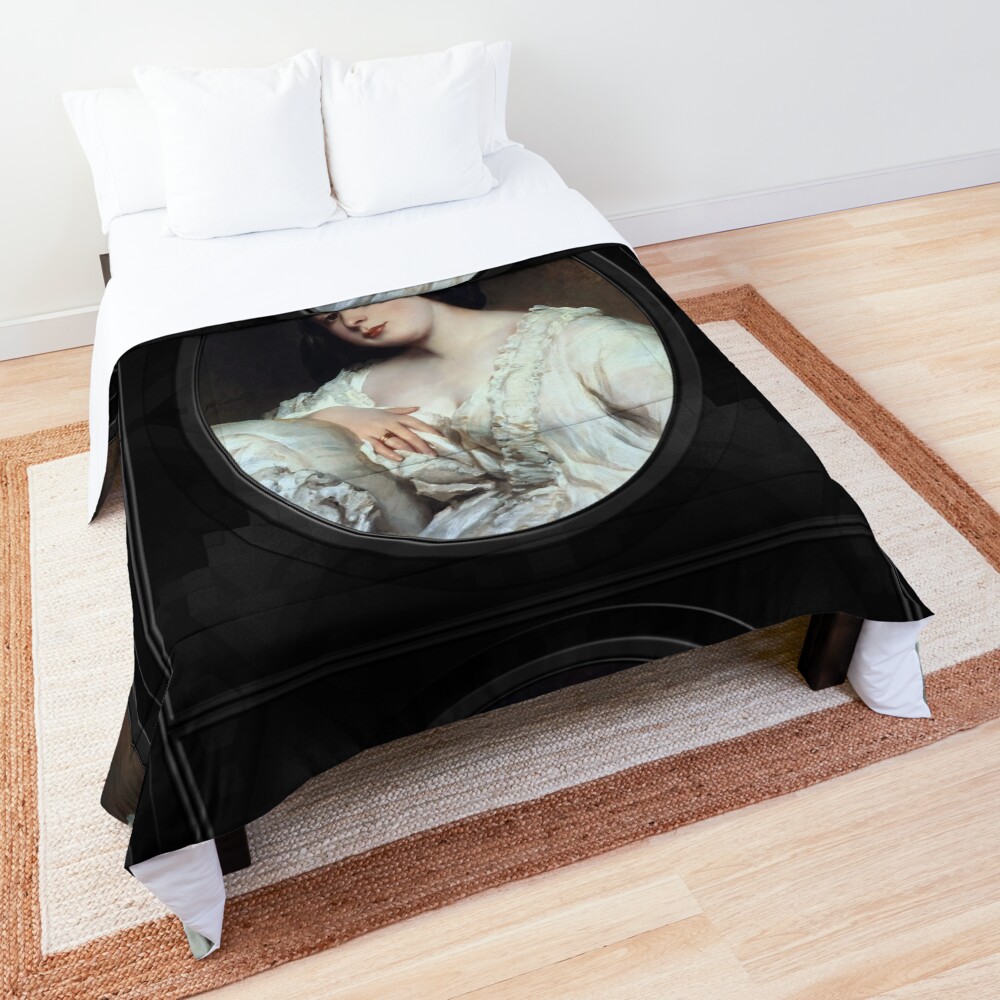
Table des matières
Le sujet et la composition
The portrait is a close-up of a young lady, likely from the European upper classes, given the sophistication and quality of her attire. Sa robe blanche, characterized by soft ruffles and intricate folds, drapes gently across her shoulders and chest, creating a sense of movement and grace.
Her calm yet enigmatic expression is the focal point of the piece, drawing the viewer’s attention to her delicate features. The lady’s dark hair, parted in the center and styled in a smooth, controlled manner, contrasts beautifully with the light fabric of her dress, enhancing the overall balance of light and dark within the composition.
Her hand rests lightly on her lap, fingers elegantly spread, with a ring visible on her left hand, signifying her status and perhaps an important relationship or heritage. The subtle gesture adds an air of refinement and nobility to the scene, encapsulating the dignity of the subject. Winterhalter captures the soft textures of her skin and the luminosity of her skin tone with the same reverence that he bestows upon the fabric of her gown. This is a hallmark of his style, an obsession with texture that enhances the lifelike quality of the subjects he painted.
Matériaux et techniques
Winterhalter worked with oils, employing a layered technique that allowed him to achieve remarkable depth and nuance in his colors. Le doux, almost translucent nature of the lady’s white dress suggests Winterhalter’s ability to master the subtleties of fabric, creating lifelike textures that capture the way light interacts with different materials. The texture of her skin, delicate and luminous, is painted with equal precision, as is the smoothness of her black hair, which appears to shimmer under the light.
The use of shadows in the portrait is also striking. Winterhalter’s mastery of chiaroscuro, where light and dark are carefully balanced, gives the painting a sense of three-dimensionality, making the subject appear as though she could step off the canvas. The background is softly blurred, with dark, muted tones that help the figure stand out sharply. This technique, which blurs the boundary between figure and ground, is characteristic of the artist’s work and helps the viewer focus entirely on the subject, free from distraction.
Thème et humeur
The overall theme of this portrait can be understood as one of quiet elegance, Où la beauté, nobility, and refinement are represented not through grand gestures but through subtlety and restraint. The lady in the portrait, while dressed in a lavish gown, does not express exuberance or overt joy. Au lieu, there is an air of quiet contemplation or perhaps melancholy. Her serious expression suggests introspection, possibly hinting at the societal pressures or expectations placed upon women of her class during the time.
The mood of the painting is serene and dignified. The muted color palette, with its emphasis on soft whites, blacks, and warm browns, evokes a sense of tranquility, while the lady’s composed demeanor adds a layer of solemnity. Son regard, directed slightly to the left, seems contemplative, as though she is lost in thought, or perhaps pondering something beyond the viewer’s reach. This gives the portrait an almost timeless quality, as though it captures a fleeting moment in the life of the subject, one that is both personal and universally relatable.
The Style of Winterhalter
Franz Xaver Winterhalter was known for his refined, flattering portraits of aristocrats and royalty. His style blends elements of both academic realism and romanticism, capturing the likeness of the subject with precision while also idealizing their form.
Le doux, smooth lines, glowing flesh tones, and harmonious composition suggest an aesthetic ideal that was highly popular during the mid-19th century, especially in the courtly circles Winterhalter often painted for. While his subjects are rendered realistically, there is an element of stylization in the way he emphasizes elegance and poise, presenting his sitters as paragons of beauty and grace.
The soft focus of the background, with minimal detail, allows the subject to be the central focus of the composition. This technique, paired with Winterhalter’s skill in capturing human emotion and character, made his portraits highly sought after by royal families and aristocrats.
The portrait’s atmosphere, combined with the artist’s characteristic style, speaks to the social and cultural values of the time: the ideal of refined beauty, the status of the subject, and the artist’s desire to create a lasting, timeless image of aristocratic life.
Conclusion
Portrait d'une dame by Franz Xaver Winterhalter remains an exemplary piece of 19th-century portraiture. With its exquisite detailing, careful attention to the subject’s demeanor, and the subtle interplay of light and shadow, the work embodies the grace and sophistication that Winterhalter was known for.
The painting captures not only the physical likeness of the subject but also evokes the mood and atmosphere of the time, one of poised elegance and quiet introspection. Winterhalter’s ability to depict the subject’s character, through both the delicate textures of her attire and the nuanced expression on her face, makes this painting a lasting testament to the high art of portraiture during the Victorian era.
Portrait of a Lady is a retouched digital art old masters reproduction of a public domain image.
Artiste Bio de Wikipedia.org
Franz Xaver Winterhalter est né dans le petit village de Menzenschwand, (fait maintenant partie de Sankt Blasien), dans la Forêt-Noire allemande[1] dans l'électorat de Bade, sur 20 avril 1805.[2] Il était le sixième enfant de Fidel Winterhalter (1773–1863), un agriculteur et producteur de résine dans le village, et sa femme Eva Meyer (1765–1838), membre d'une famille Menzenschwand établie de longue date.
Son père était d'origine paysanne et avait une influence puissante dans sa vie. Des huit frères et sœurs, seulement quatre ont survécu à la petite enfance. Tout au long de sa vie, Franz Xaver est resté très proche de sa famille, en particulier à son frère Hermann (1808–1891), qui était aussi peintre.
Après avoir fréquenté l'école dans un monastère bénédictin à St. Blasien, Winterhalter a quitté Menzenschwand en 1818 à l'âge de 13 étudier le dessin et la gravure. Il a suivi une formation de dessinateur et lithographe dans l'atelier de Karl Ludwig Schüler (1785–1852) à Fribourg-en-Brisgau. Dans 1823, à l'âge de 18, il est allé à Munich, parrainé par l'industriel Baron von Eichtal (1775–1850).
Dans 1825, il a reçu une allocation de Ludwig I, Grand-duc de Bade (1763–1830) et a commencé un cursus à l'Académie des Arts de Munich avec Peter von Cornelius (1783–1867), dont les méthodes académiques le mettaient mal à l'aise. Winterhalter a trouvé un mentor plus sympathique dans le portraitiste à la mode Joseph Karl Stieler (1781–1858). Pendant ce temps, il s'est soutenu en travaillant comme lithographe.
Winterhalter est entré dans les cercles judiciaires lorsqu'il 1828 il devient maître de dessin de Sophie Margravine de Bade, à Karlsruhe.[6] Son opportunité de s'établir au-delà du sud de l'Allemagne s'est présentée 1832 quand il a pu voyager en Italie, 1833–1834, avec le soutien du Grand-Duc Léopold de Bade. A Rome il compose des scènes de genre romantiques à la manière de Louis Léopold Robert et s'attache au cercle du directeur de l'Académie française., Horace Vernet. De retour à Karlsruhe, il peint des portraits du Grand-Duc Léopold de Bade et de son épouse, et fut nommé peintre à la cour grand-ducale.
Néanmoins, il a quitté Baden pour s'installer en France, où sa scène de genre italienne Il dolce Farniente s'est fait remarquer au Salon de 1836. Il Decameron un an plus tard a également été félicité; les deux tableaux sont des compositions académiques dans le style de Raphaël. Au Salon de 1838 il expose un portrait du prince de Wagram avec sa jeune fille. Sa carrière de portraitiste est vite assurée quand, la même année, il peint Louise Marie d'Orléans, Reine des Belges, et son fils. C'est probablement à travers ce tableau que Winterhalter a attiré l'attention de Maria Amalia des Deux-Siciles, Reine des Français, mère de la reine des Belges.