

Rousse Beauté
“Rousse Beauté” is a captivating portrait created by British painter Abbaye Abraham Altson, who lived between 1866 et 1949. Known for his refined portraiture, Altson’s work elegantly captures the essence of his subjects with a focus on delicate details and subtle, lifelike tones. This particular painting stands as a prime example of his technical prowess and unique ability to bring depth and humanity to the canvas. The composition features a young woman, her piercing eyes inviting the viewer into a world of elegance and mystery. The sitter’s features are delicate and graceful, with a subtle yet powerful presence that commands attention.
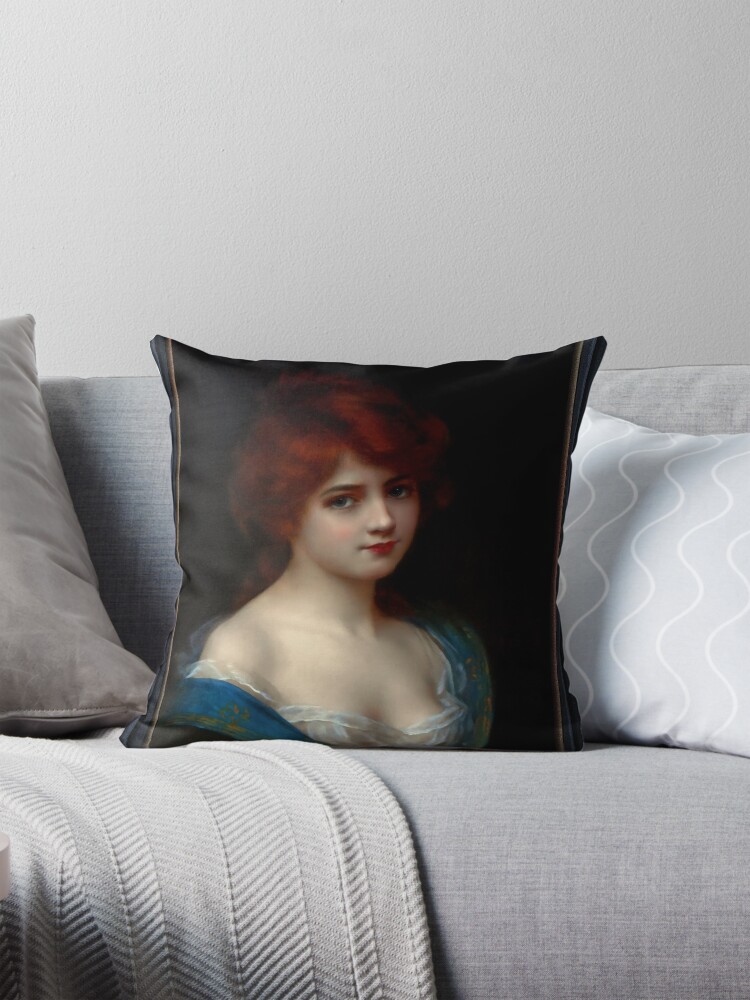
Table des matières
Le sujet
Le centre d'intervention de “Rousse Beauté” is the young woman portrayed in the portrait. She exudes a timeless charm, characterized by her striking red hair, which forms a soft halo around her face. The artist skillfully captures the sheen and texture of her hair, rendering it with a warm, natural glow that contrasts beautifully with the dark background. Her facial expression is serene yet engaging, with slightly parted lips that suggest a quiet contemplation. Ses yeux, grand et expressif, hold an enigmatic quality, as if inviting the viewer to delve into her thoughts, yet remaining elusive in their full meaning.
The woman is depicted in a classical, manière presque éthérée. She has a delicate, porcelain-like complexion, with subtle blushes of pink at her cheeks, giving her an almost angelic appearance. The simplicity of her attire, with its elegant neckline and minimal ornamentation, further directs attention to her face and the emotional depth she embodies. This restrained use of clothing and jewelry allows Altson to focus on the soft contrasts of light and shadow that define the subject’s features.
Matériaux et Techniques
Abbey Abraham Altson’s choice of materials and his mastery of technique are evident throughout this portrait. The painting is executed with oil paints, a medium that allows for the rich blending of hues and a smooth finish that enhances the lifelike quality of the piece. Altson’s application of paint is both soft and controlled, with each brushstroke contributing to the overall harmony of the work. The artist’s ability to build layers of color creates depth, particularly in the textures of the woman’s skin and hair. The delicate handling of the skin tones contrasts with the richness of the deep blues and greens in her attire, further enhancing her radiance.
The artist’s attention to detail is particularly evident in the depiction of the woman’s hair. Altson has captured the vibrancy of her red locks, utilizing light and shadow to give the hair volume and movement. The subtle highlights and dark shadows within the hair suggest its natural texture and richness, providing a dynamic contrast to the smoothness of her skin and the soft drapery of her clothing.
The background of the portrait is intentionally dark, which serves to emphasize the figure and elevate her presence. The soft transition from light to dark behind her creates a sense of depth, drawing the viewer’s eye directly to the subject’s face. The lack of excessive detail in the background allows the viewer to remain focused on the woman, making her the central figure in the painting.
Style et thème
“Rousse Beauté” is firmly rooted in the classical tradition of portraiture, with its emphasis on realism and subtle emotional expression. Altson, a British artist who worked during the late 19th and early 20th centuries, drew upon the techniques and styles popularized by the Old Masters while also infusing his works with a sense of modernity. The smooth finish, détails fins, and balanced composition all speak to the artist’s classical training, while the subject’s poised yet introspective nature suggests a more contemporary sensibility.
The painting’s theme is one of beauty and quiet elegance, se concentrer sur la nature intemporelle de la forme humaine. Le choix d'une jeune femme comme sujet permet une exploration de la jeunesse et de la grâce., mais il y a aussi un sentiment de maturité dans la façon dont son visage est rendu. L'attention d'Altson sur ses yeux expressifs suggère qu'il y a plus en elle que la simple beauté : il y a de la profondeur., prévenance, et une certaine réserve qui attire le spectateur, créer un récit visuel convaincant.
L'ambiance du tableau est douce, introspectif, et légèrement mystérieux. La douce lumière qui baigne le visage de la femme et le calme de son expression véhiculent un sentiment de tranquillité., tandis que son regard crée une tension subtile, comme s'il y avait quelque chose de plus sous la surface dont le spectateur n'est pas pleinement au courant. Cette interaction dynamique entre sérénité et mystère fait du tableau plus qu'un simple portrait., mais une œuvre qui invite le spectateur à s’attarder et à contempler le monde intérieur du sujet.
Conclusion
Abbaye d'Abraham Altson “Rousse Beauté” témoigne de la capacité de l’artiste à capturer à la fois la beauté physique et la profondeur émotionnelle de son sujet.. Les petits détails, exécution fluide, et l'élégance intemporelle contribuent toutes à un portrait qui parle au spectateur à plusieurs niveaux. Grâce à une utilisation judicieuse de la lumière, ombre, et texture, Altson crée non seulement une image réaliste, mais imprègne également le tableau d'une résonance émotionnelle qui persiste longtemps après que le spectateur se soit détourné..
Le style raffiné du tableau, influence classique, et son ambiance énigmatique en font une œuvre d'un attrait durable. Il transcende son époque, évoquant un sentiment de sophistication tranquille et invitant les spectateurs à réfléchir sur les courants émotionnels plus profonds qui se cachent sous la surface de la beauté.
Il s'agit d'une reproduction de maîtres anciens d'art numérique retouchée d'une image du domaine public qui est disponible à l'achat en ligne en tant que impression sur toile roulée.
Artiste Bio de ArtRecord.com
Abbey Abraham Altson est né à Middlesbororough-on-Tees, Yorkshire dans l'année 1864. En septembre de 1883 lui et son frère Barnett Hayman Altson sont allés en Australie ; et commençant dans 1885 Abraham a commencé à étudier le dessin deux soirs par semaine à la National Gallery School of Design, situé à Melbourne.
je 1886 il s'inscrit ensuite comme étudiant à temps plein à l'école de peinture; étudier avec un autre artiste bien connu, comme Fred McCubbin, John Longstaff, Emmanuel Phillips Fox, David Davies, Rue Tudor. George Tucker et Fred Williams.
Abraham a remporté des prix chaque année où il était à l'école, et les critiques le présentent comme l'élève le plus prometteur du futur.