

Портрет дамы
Franz Xaver Winterhalter’s Портрет дамы (c. 1850s) stands as a quintessential representation of mid-19th-century European portraiture. зимний держатель (1805 – 1873), a German artist renowned for his highly polished, elegant works; and older brother of German painter Hermann Fidel Winterhalter (1808 – 1891), often painted the aristocracy and elite of Europe, capturing them in ways that highlighted both their opulence and refinement.
Этот портрет, an example of his mastery, features a lady in a delicate pose, her somber yet poised expression framed by the soft, almost ethereal quality of her attire and the setting. Тщательное внимание художника к деталям, and his ability to create lifelike textures and warm tones, bring the subject to life with remarkable realism and grace.
Оглавление
Тема и композиция
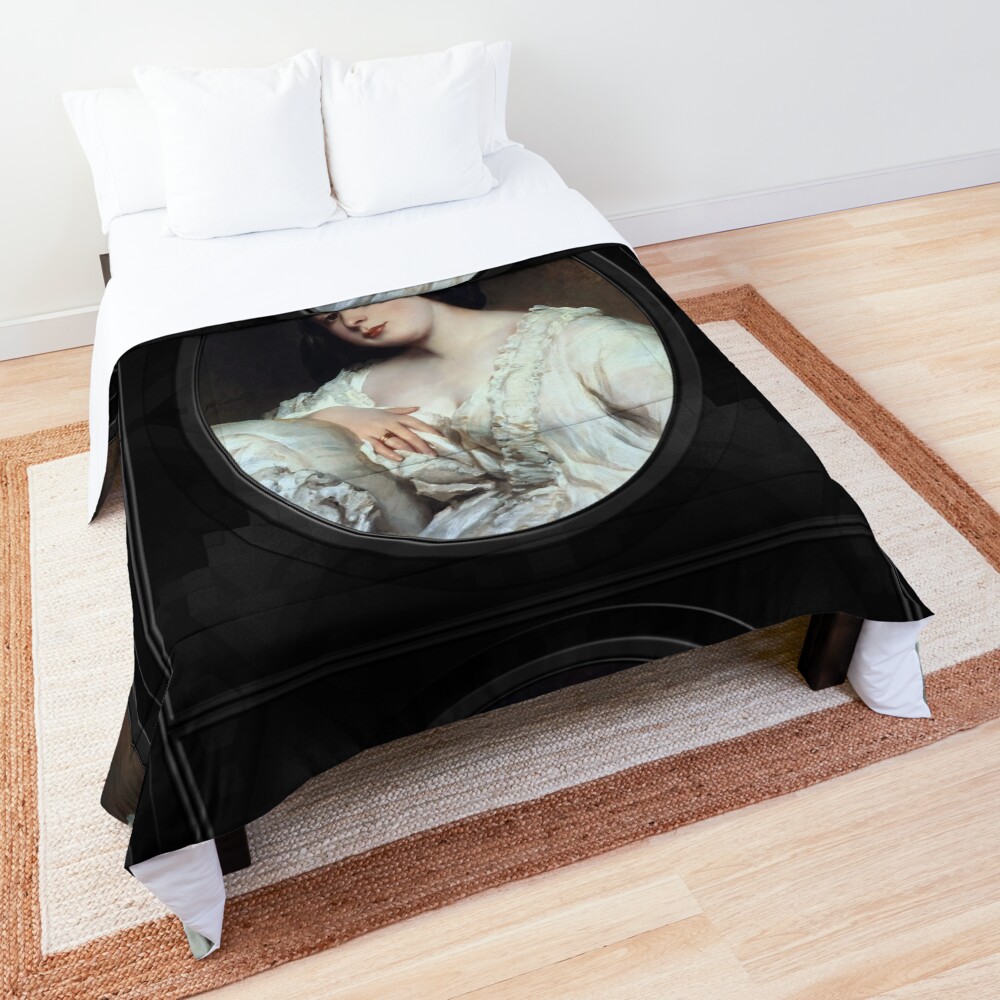
The portrait is a close-up of a young lady, likely from the European upper classes, given the sophistication and quality of her attire. Her white gown, characterized by soft ruffles and intricate folds, drapes gently across her shoulders and chest, creating a sense of movement and grace.
Her calm yet enigmatic expression is the focal point of the piece, drawing the viewer’s attention to her delicate features. The lady’s dark hair, parted in the center and styled in a smooth, controlled manner, contrasts beautifully with the light fabric of her dress, enhancing the overall balance of light and dark within the composition.
Her hand rests lightly on her lap, fingers elegantly spread, with a ring visible on her left hand, signifying her status and perhaps an important relationship or heritage. The subtle gesture adds an air of refinement and nobility to the scene, encapsulating the dignity of the subject. Winterhalter captures the soft textures of her skin and the luminosity of her skin tone with the same reverence that he bestows upon the fabric of her gown. This is a hallmark of his style, an obsession with texture that enhances the lifelike quality of the subjects he painted.
Материалы и техника
Winterhalter worked with oils, employing a layered technique that allowed him to achieve remarkable depth and nuance in his colors. Мягкий, almost translucent nature of the lady’s white dress suggests Winterhalter’s ability to master the subtleties of fabric, creating lifelike textures that capture the way light interacts with different materials. The texture of her skin, delicate and luminous, is painted with equal precision, as is the smoothness of her black hair, which appears to shimmer under the light.
The use of shadows in the portrait is also striking. Winterhalter’s mastery of chiaroscuro, where light and dark are carefully balanced, gives the painting a sense of three-dimensionality, making the subject appear as though she could step off the canvas. Фон мягко размыт, с темным, muted tones that help the figure stand out sharply. Эта техника, which blurs the boundary between figure and ground, is characteristic of the artist’s work and helps the viewer focus entirely on the subject, free from distraction.
Тема и настроение
The overall theme of this portrait can be understood as one of quiet elegance, где красота, дворянство, and refinement are represented not through grand gestures but through subtlety and restraint. The lady in the portrait, while dressed in a lavish gown, does not express exuberance or overt joy. Вместо, there is an air of quiet contemplation or perhaps melancholy. Her serious expression suggests introspection, possibly hinting at the societal pressures or expectations placed upon women of her class during the time.
The mood of the painting is serene and dignified. Приглушенная цветовая палитра, with its emphasis on soft whites, негры, and warm browns, evokes a sense of tranquility, while the lady’s composed demeanor adds a layer of solemnity. Ее взгляд, направлен немного влево, seems contemplative, as though she is lost in thought, or perhaps pondering something beyond the viewer’s reach. This gives the portrait an almost timeless quality, as though it captures a fleeting moment in the life of the subject, one that is both personal and universally relatable.
The Style of Winterhalter
Franz Xaver Winterhalter was known for his refined, flattering portraits of aristocrats and royalty. His style blends elements of both academic realism and romanticism, capturing the likeness of the subject with precision while also idealizing their form.
Мягкий, smooth lines, glowing flesh tones, and harmonious composition suggest an aesthetic ideal that was highly popular during the mid-19th century, especially in the courtly circles Winterhalter often painted for. While his subjects are rendered realistically, there is an element of stylization in the way he emphasizes elegance and poise, presenting his sitters as paragons of beauty and grace.
The soft focus of the background, with minimal detail, allows the subject to be the central focus of the composition. Эта техника, paired with Winterhalter’s skill in capturing human emotion and character, made his portraits highly sought after by royal families and aristocrats.
The portrait’s atmosphere, combined with the artist’s characteristic style, speaks to the social and cultural values of the time: the ideal of refined beauty, the status of the subject, and the artist’s desire to create a lasting, timeless image of aristocratic life.
Заключение
Портрет дамы by Franz Xaver Winterhalter remains an exemplary piece of 19th-century portraiture. With its exquisite detailing, careful attention to the subject’s demeanor, и тонкая игра света и тени, the work embodies the grace and sophistication that Winterhalter was known for.
The painting captures not only the physical likeness of the subject but also evokes the mood and atmosphere of the time, one of poised elegance and quiet introspection. Winterhalter’s ability to depict the subject’s character, through both the delicate textures of her attire and the nuanced expression on her face, makes this painting a lasting testament to the high art of portraiture during the Victorian era.
«Портрет дамы» — ретушированная цифровая репродукция старых мастеров изображения, являющегося общественным достоянием..
Художник биография от Wikipedia.org
Франц Ксавер Винтерхальтер родился в небольшой деревне Менценшванд., (теперь часть Санкт-Блазиена), в немецком Шварцвальде[1] в электорате Бадена, на 20 апрель 1805.[2] Он был шестым ребенком Фиделя Винтерхальтера. (1773–1863 г.), фермер и производитель смолы в деревне, и его жена Ева Мейер (1765–1838 г.), член давней семьи Менценшванд.
Его отец был из крестьян и оказал сильное влияние на его жизнь.. Из восьми братьев и сестер, только четверо выжили в младенчестве. На протяжении всей своей жизни Франц Ксавер оставался очень близок со своей семьей., в частности его брату Герману (1808–1891 г.), кто также был художником.
После посещения школы при бенедиктинском монастыре в Св.. Blasien, Винтерхальтер покинул Менценшванд в 1818 в возрасте 13 изучать рисунок и гравюру. Получил образование рисовальщика и литографа в мастерской Карла Людвига Шулера. (1785–1852 г.) во Фрайбурге-им-Брайсгау. В 1823, в возрасте 18, он уехал в Мюнхен, при поддержке промышленника барона фон Эйхталя (1775–1850).
В 1825, он получил стипендию от Людвига I, Великий герцог Баден (1763–1830) и начал курс обучения в Академии художеств в Мюнхене у Петера фон Корнелиуса. (1783–1867), чьи академические методы вызывали у него дискомфорт. Винтерхальтер нашел более подходящего наставника в лице модного портретиста Йозефа Карла Стилера. (1781–1858). В течение этого времени, он поддерживал себя литографом.
Винтерхальтер вошел в придворные круги, когда в 1828 он стал мастером рисования Софи Маргравин из Бадена, в Карлсруэ.[6] Его возможность обосноваться за пределами южной Германии пришла в 1832 когда он смог поехать в Италию, 1833–1834, при поддержке великого герцога Леопольда Баденского. В Риме он сочинял жанровые романтические сцены в стиле Луи Леопольда Робера и примыкал к кругу директора Французской академии., Орас Верне. По возвращении в Карлсруэ он написал портреты великого герцога Леопольда Баденского и его жены., и был назначен художником при дворе великого князя.
тем не менее, он покинул Баден, чтобы переехать во Францию, где его итальянская жанровая сцена Il dolce Farniente привлекла внимание в Салоне 1836. Il Decameron годом позже тоже получил высокую оценку; обе картины представляют собой академические композиции в стиле Рафаэля.. В салоне 1838 он выставил портрет принца Ваграма с его маленькой дочерью. Его карьера портретиста вскоре была обеспечена, когда в том же году он написал Луизу Марию Орлеанскую., Королева бельгийцев, и ее сын. Вероятно, именно благодаря этой картине Винтерхальтер обратил внимание на Марию Амалию из Обеих Сицилий., Королева французов, мать королевы бельгийцев.