

Portrait of a Lady c1941
Style and Artistic Approach
La peinture “Portrait d'une dame” de 1941 by Russian artist Nikolai Vasilievich Kharitonov (1880 – 1944), also known as Nicholas Basil-Haritonoff, is an exquisite example of classical portraiture executed with masterful precision. The artist blends elements of realism with a softer romantic sensibility, capturing the sitter in a moment of dignified grace.
Le doux, gentle contours of the lady’s face, alongside the textured fabrics of her gown, reveal Kharitonov’s profound understanding of human expression and the interplay between light and shadow. His technique appears painstakingly deliberate, from the subtle gradations of color on her complexion to the delicate rendering of her lush, red hair.
The style adheres to the tradition of 19th-century portraiture that emphasizes the character and personality of the sitter. Kharitonov’s precise yet fluid brushwork displays his deep reverence for classical art forms, while also incorporating his own softer touches to create a fresh, modern elegance in the portrait. The piece invites viewers to engage deeply with both the sitter’s inner and outer world, presented through the use of luminous textures and nuanced shading.
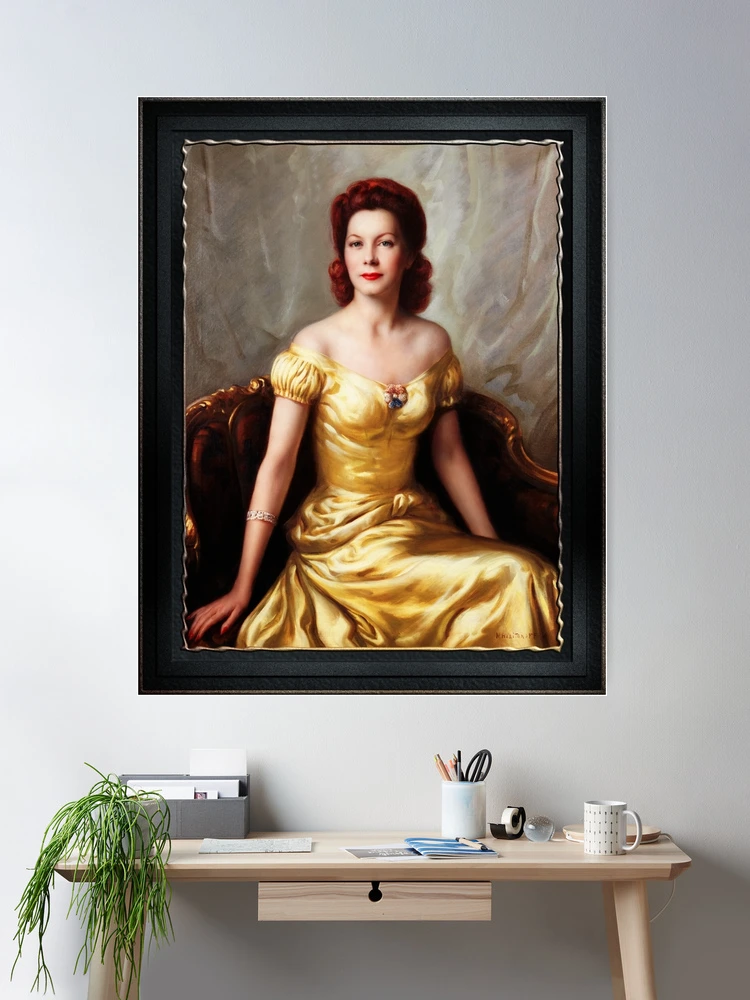
Table des matières
Le sujet et la composition
At the heart of the composition is the lady herself, seated with regal composure. Her soft yellow gown, with delicate puffed sleeves, is a striking focal point, and its rich texture seems to flow naturally with the contours of her body. The luxurious fabric of the dress is rendered with remarkable attention to detail, capturing the play of light on its satin surface. La robe, a symbol of sophistication and refinement, not only enhances the sitter’s noble stature but also adds a sense of timeless beauty to the portrait.
Ses cheveux, a deep shade of red, is styled in soft waves that frame her face and cascade gently over her shoulders. The meticulously painted curls add a layer of complexity to her personality, suggesting a sense of elegance and a well-maintained poise, suggesting a woman of both confidence and grace. Kharitonov has chosen to focus on the woman’s face, with minimal distractions in the background, allowing the viewer to become fully absorbed in her expression and the subtleties of her attire.
Color Palette and Materials
The artist employs a refined color palette, utilizing warm hues of golden yellow, soft browns, and cream to emphasize both the fabric of the gown and the warmth of the lady’s complexion. The palette of gold and yellow in the dress suggests the affluence and sophistication of the subject.
The soft background tones of beige and gray further enhance the lady’s presence, enveloping her in a light, airy atmosphere. The highlights on her face and shoulders are painted with a luminous quality that lends her a gentle, ethereal presence, almost as though she is illuminated by an inner light. The subtlety of the color transitions, from the darker tones of the folds of her gown to the lighter highlights around her face, speaks to Kharitonov’s expertise in rendering three-dimensionality on a flat canvas.
Kharitonov’s careful use of these colors suggests a careful mastery of oil paint, as the artist has used the medium’s natural properties to create a glowing, almost tactile effect. The intricate shading of the lady’s skin, the softness of the light falling across her features, and the smoothness of the fabric showcase his understanding of texture and depth. Each brushstroke, each layer of paint, builds upon the last to evoke a sense of living, breathing realism.
Expression and Mood
The mood of the portrait is one of quiet elegance and serene dignity. The lady’s expression is calm, composé, and slightly reserved, with her lips held in a soft, almost imperceptible smile. This small, controlled expression suggests an air of mystery and contemplation, inviting the viewer to delve into the inner world of the subject. Sa posture, sitting upright with her hand gently resting on the arm of her chair, reinforces the idea of a woman of noble demeanor and inner strength.
There is an unspoken sense of poise that emanates from the sitter, and Kharitonov’s subtle choices in depicting her facial features—her clear eyes, the soft curve of her cheekbones, and the smoothness of her skin, add to the portrait’s aura of grace. The overall mood is one of quiet refinement, and it evokes a sense of nostalgia for a bygone era of sophistication.
Historical Context and Artist’s Influence
Created during the early 1940s, a time when Russia was embroiled in the Second World War, this portrait seems to stand in stark contrast to the harsh realities of the world. Yet it reflects the enduring resilience of culture, art, and beauty amid turmoil. The fashion in the portrait, with its opulent detailing, is reminiscent of the styles popular in the late 19th and early 20th centuries, creating a sense of continuity in Russian portraiture.
Nikolai Vasilievich Kharitonov, like many of his contemporaries, embraced the stylistic principles of the Russian Academy of Arts, grounded in classical traditions. This approach, pourtant, was infused with his unique sensitivity to light, texture, et la représentation délicate de l'émotion humaine. His legacy as an artist who deftly merged classical realism with a more contemporary approach to portraiture ensures that works like “Portrait d'une dame” endure as iconic representations of Russian elegance.
Key Elements
- The Lady: Le personnage central, poised and graceful, embodies both physical and emotional refinement.
- Gown: The rich golden yellow dress, carefully detailed, becomes a symbol of both opulence and quiet dignity.
- Red Hair: The lady’s red hair, coiffé de vagues douces, adds a layer of depth to her personality.
- Expression: Her gentle, reserved smile hints at a thoughtful and introspective character.
- Composition: The simplicity of the composition, with a minimalistic background, draws the viewer’s attention entirely to the subject.
- Éclairage: The light play across her skin and gown is rendered with an ethereal quality that enhances her presence.
- Arrière-plan: The muted beige and gray tones in the background allow the lady’s figure to dominate the space, highlighting her significance.
- Travail au pinceau: The soft blending of colors and brushstrokes suggests Kharitonov’s skill in creating lifelike textures.
- Humeur: A serene, dignified mood pervades the portrait, evoking both admiration and curiosity.
- Contexte historique: Created during the turmoil of the Second World War, the painting represents a moment of stillness amidst the chaos.
- Palette de couleurs: Soft tones of gold, Jaune, and cream contrast with the deeper reds of the lady’s hair.
- Texture: The smooth rendering of skin and fabric suggests Kharitonov’s mastery of oil painting.
- Simplicity: The lack of complex elements in the background creates a quiet, reflective atmosphere.
- Soft Focus: The softening of features and use of light gives the painting a slightly dreamlike quality.
Portrait Of A Lady est une reproduction de maîtres anciens d'art numérique retouchée d'une image du domaine public.
Biographie de l'artiste avec l'aimable autorisation Galerie RA – Beaux-arts russes et internationaux
Nikolaï Kharitonov (Nicolas Basil Haritonoff) était un éminent peintre russe de l'école académique, considérer comme un brillant portraitiste et un maître du genre paysage. Il était aussi un élève de I. E. Repin, qui combinait également le réalisme et les tendances impressionnistes dans ses œuvres.
Nikolai Kharitonov est né en décembre 9, 1880, dans une simple famille paysanne du village de Plishkino (situé dans le village rural de Dubrovskoye, Quartier Yelovski, Kraï de Perm, Russie), qui n'existe plus.
Après avoir été diplômé de l'école rurale, à l'âge de douze ans, Kharitonov est allé vivre avec ses proches à St. Pétersbourg, et il a obtenu un emploi dans la papeterie, et, plus tard, a travaillé dans un atelier spécialisé dans la production d'enseignes pour magasins.
Nikolai Vasilyevich a ensuite commencé sa formation artistique et sa carrière d'une manière assez particulière. Environ 1895 il est allé à l'île de Valaam, où il est devenu apprenti au monastère Spaso-Preobrazhensky; là-bas, il a passé la plupart de son temps à peindre des icônes et des images religieuses pendant deux ans; étudier scrupuleusement cette ancienne technique de peinture des moines.
A son retour à St. Pétersbourg, Kharitonov a ensuite commencé à suivre des cours à l'école de dessin de la Société impériale pour l'encouragement des arts et a commencé à développer ses compétences en dessin dans un studio d'art privé d'un talentueux peintre et graveur académique., L. E. Dmitriev-Kavkazsky.
Dans 1901, Nikolai Vasilievich a rejoint le département de peinture de l'école supérieure d'art de l'Académie des arts, et un an plus tard a commencé à s'entraîner dans l'atelier de l'artiste célèbre et exceptionnel – je. E. Repin.