

Portrait of Hortense Mancini Duchesse de Mazarin, as Aphrodite
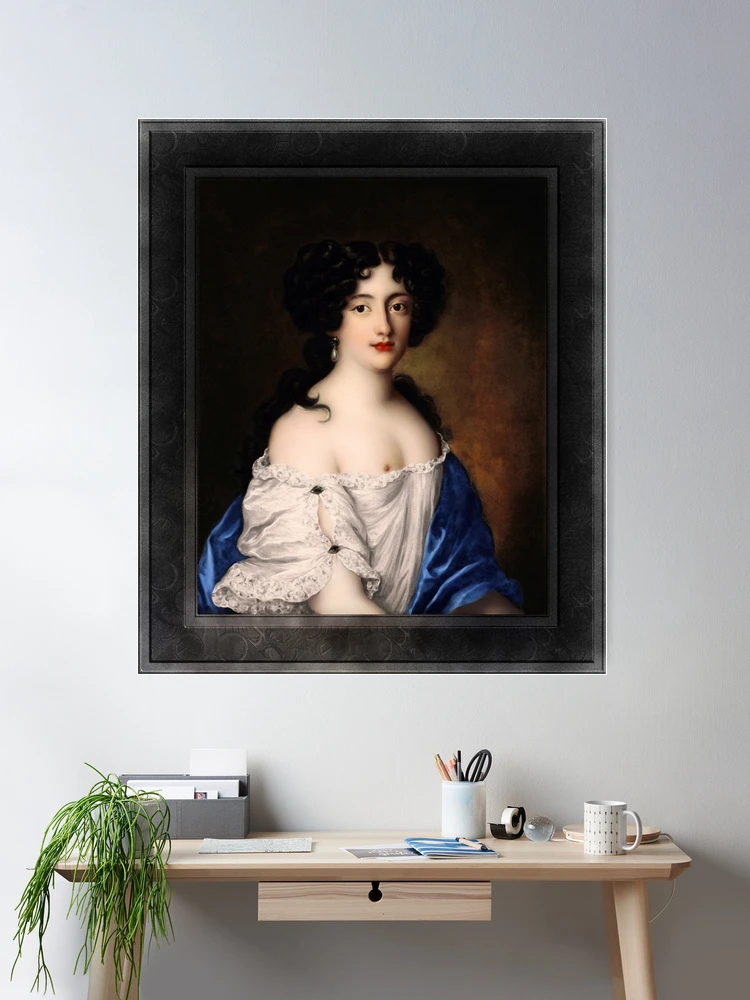
Jacob Ferdinand Voet‘s (1639 – 1689) “Porträt von Hortense Mancini (1646 – 1699), Herzogin von Mazarin, as Aphrodite,” umhergestellt 1675, presents a striking and graceful depiction of Hortense Mancini, one of the most celebrated women of her time. Born into the illustrious Mancini family, she was the niece of Cardinal Mazarin, and her life was marked by intrigue, Reichtum, und Schönheit. Voet’s painting exemplifies the opulence of the late 17th century, particularly the French court’s fascination with classical mythology, combining both her aristocratic status and mythological grandeur. Hortense Mancini is portrayed as Aphrodite, die Göttin der Liebe, Schönheit, und Verlangen, a figure whose essence permeates the entire composition.
Inhaltsverzeichnis
Subjekt und Komposition
The central figure of the painting, Hortense Mancini, is the epitome of refined elegance. She is depicted with soft yet assertive poise, her gaze meeting the viewer with a sense of subtle confidence. Voet carefully captures her beauty, infusing the painting with a sense of nobility and mythological grandeur. Hortense’s classical features, including a high forehead, volle Lippen, and well-shaped eyes, are meticulously rendered, adding an ethereal quality to the portrait.
Ihre Kleidung, a striking combination of rich fabrics, is an immediate visual focus. Die lockeren, partially draped gown, made from a shimmering white material, is held together by delicate clasps, creating an illusion of effortless luxury. The gown’s neckline is open and flowing, its folds evoking the natural movement of fabric, which draws attention to the softness of the skin and the graceful contours of her body. The deep blue robe, draped over her shoulders and cascading down her back, contrasts beautifully with the white dress. It serves to highlight the goddess-like radiance that Hortense exudes, enhancing her role as Aphrodite.
Aphrodite is often depicted with flowing, voluminöses Haar, and here, Voet adheres to this tradition. Hortense’s hair, dark and luxuriant, is styled in soft waves, flowing over her shoulders and further emphasizing her divine femininity. Her curls, meticulously painted, frame her face in a way that enhances the sensuality and softness of her expression.
To further emphasize her connection with the classical goddess, Voet includes subtle elements of the mythological world. A delicate pearl earring is visible in her ear, symbolizing both her wealth and divine status, while her hands rest gently on her gown, one hand slightly raised as though inviting the viewer into her world of beauty. These small yet significant details further elevate Hortense from a mere aristocratic subject to a symbolic embodiment of love and beauty.
Der Hintergrund und die Einstellung
The background of the portrait remains intentionally subdued, mit tief, dark hues that allow the figure of Hortense to emerge almost from the shadows. Die Reichen, velvety tones of the backdrop are characteristic of many Flemish and Baroque portraits of the time. The lack of a clear, detailed setting allows the viewer to focus entirely on the figure of Hortense and her symbolic role as Aphrodite. The subtle interplay of light and shadow helps create a sense of depth, with light subtly illuminating the folds of her gown and her radiant face, enhancing her almost otherworldly presence.
While the background remains neutral, the overall composition evokes the idealized and mythological, much like the romanticized depictions of classical goddesses. Voet, much like other artists of his time, understood that portraits of aristocratic women were often not just representations of physical beauty but also reflections of their power, status, and symbolic roles in society.
Künstlerischer Stil und Technik
Voet’s style reflects the Baroque tradition, with a focus on opulence, kompliziertes Detail, und emotionale Intensität. His rendering of texture, particularly in the depiction of fabrics, Haar, und haut, is masterful. The play of light on the different surfaces—glossy pearls, velvety fabric, and soft flesh—demonstrates his exceptional skill in capturing realism while still maintaining an idealized, almost dreamlike quality in the subject’s presentation.
Die Verwendung von Soft, Die gemischten Pinselstriche erzeugen einen nahtlosen Übergang zwischen Licht und Schatten, trägt zum Gesamtgefühl der Harmonie in der Komposition bei. Voets Technik ist raffiniert und sorgfältig, Besonders deutlich wird die Art und Weise, wie er die strahlende Qualität von Hortenses Teint einfängt, was einen schönen Kontrast zu den dunkleren Farbtönen des Hintergrunds bildet. Das Detail in ihrem Kleid, vor allem die zarten Falten, unterstreicht die Aufmerksamkeit des Künstlers für die taktile Qualität von Stoffen, ein wichtiges Element in Porträts aus der Barockzeit, wo die Darstellung von Reichtum ein Schlüsselfaktor bei der Symbolisierung des Adels war.
Stimmung und Thema
Die Stimmung des Porträts ist von ruhiger Würde geprägt, eine zarte Mischung aus Sinnlichkeit und Kraft. Hortenses Haltung und Gesichtsausdruck suggerieren sowohl Verletzlichkeit als auch Kontrolle, inviting the viewer into a world where beauty transcends the ordinary. By casting her as Aphrodite, Voet elevates her image from that of an aristocratic woman to a figure of mythological significance. The themes of love, Schönheit, and divine grace are interwoven throughout the painting, as Voet uses classical references to elevate the subject beyond her earthly role.
The portrait also suggests the complex and often contradictory nature of Hortense’s life. While she was celebrated for her beauty and status, her life was also marked by personal and political struggles. As Aphrodite, she becomes an idealized symbol of love and beauty, but this idealization also creates a distance from the complexities of her reality. The contrast between the idealized image and her actual life serves to deepen the emotional resonance of the painting, as it highlights the tension between appearance and reality that is often present in aristocratic portraiture.
Abschluss
Jacob Ferdinand Voet’s “Portrait of Hortense Mancini as Aphrodite” is a stunning work that combines meticulous technical skill with deep symbolic meaning. Through the lens of classical mythology, Voet transforms Hortense into a timeless figure of beauty and love, elevating her to a status beyond the earthly realm. The rich textures, the dramatic use of light and shadow, and the serene yet powerful expression on Hortense’s face all contribute to a portrait that speaks to both her personal elegance and her mythological significance. Es bleibt ein beispielhaftes Stück Porträtmalerei des 17. Jahrhunderts, Die Kombination der barocken Faszination mit mythologischer Symbolik mit der persönlichen Erhabenheit eines aristokratischen Subjekts.
Kunstwerk Hintergrundgeschichte
Dies ist ein wunderschönes Porträt von Hortense Mancini (Französisch) oder Ortensia Mancini (Italienisch), die Nichte des italienischen Kardinals Mazarin (1602 – 1661), Diplomat, Politiker, und oberster Minister Frankreichs unter den Königen von Frankreich Ludwig XIII. und Ludwig XIV. von 1642 bis zu seinem Tod in 1661.
Sie war die Geliebte Karls II, König von England, Schottland, und Irland; und war die vierte der fünf berühmten Mancini-Schwestern, die zusammen mit zwei ihrer Martinozzi-Cousinen, waren am Hofe von König Ludwig XIV. von Frankreich als die Mazarinetten bekannt.
In diesem Porträt soll sie die griechische Göttin Aphrodite darstellen, die Göttin, die mit Liebe verbunden ist,Vergnügen, Hingabe, Schönheit und Fortpflanzung.
Dies ist eine retuschierte Reproduktion eines gemeinfreien Bildes durch digitale Meister alter Meister.
Biografie des Künstlers mit freundlicher Genehmigung Wikipedia.org
Ein paar Details über Voets frühes Leben, Ausbildung und Karriere sind erhalten. Voet wurde in Antwerpen als Sohn des Malers Elias Voet . geboren. Er war eines der fünfzehn Kinder; sein älterer Bruder Carlo zog nach Amsterdam und heiratete in 1661 eine Tochter der wohlhabenden Joan Coymans und Sophia Trip. Jacob verließ seine Heimat Antwerpen und reiste nach Rom, wo er lebte 1663 zu 1680.
Voet wurde Mitglied der Bentvueghels, eine Vereinigung hauptsächlich niederländischer und flämischer Künstler, die in Rom tätig sind. Voet zeichnete ein Kohlebild aller Mitglieder der Bentvueghels an die weiß getünchte Wand eines Gasthauses in Rom, das ein beliebter Treffpunkt dieser Gruppe war. Das Bild wurde so geschätzt, dass es bei jedem Neuanstrich der Wände verschont blieb.
In Rom waren Voets Fähigkeiten als Porträtmaler am päpstlichen Hof und bei der römischen Aristokratie sehr gefragt, einschließlich der prominenten Familien Colonna und Odescalchi. Er wurde von Christina gefördert, Königin von Schweden, der damals in Rom wohnte. Er malte ihr Porträt ebenso wie das ihrer Freundin, Kardinal Azzolino. Engländer und andere Europäer, die Rom auf ihrer Grand Tour besuchen, haben auch Porträts von Voet . in Auftrag gegeben.
Im 1671 – 1672 Voet erhielt von Kardinal Chigi den Auftrag, Porträts junger Frauen zu malen, die in der römischen Gesellschaft bekannt waren. Er schuf eine erste Serie von 37 Porträts der bezauberndsten Frauen Roms ('Galerie der Feinen') zwischen 1672 und 1678 für das Esszimmer von Kardinal Chigi in seinem Palast in Ariccia (in den Albaner Bergen bei Rom). Später kopierte und erweiterte er die Serie sogar für andere römische und italienische Adelsfamilien. Dies löste eine Wut auf Porträts junger Frauen in Rom und im Ausland aus.