

Portráid de Madame Badouin saor in aisce,
Portráid de Madame Badouin saor in aisce,, The Artist’s Daughter c1758-60 by French Painter Francois Boucher (1703 – 1770); ar a dtugtar dréachtaí freisin, engraver agus maisitheoir i stíl Rocócó na Fraince, bhí aithne mhaith air mar gheall ar a mhiotaseolaíocht mhór, móitífeanna allegorical agus erotic agus ba é an péintéir cúirte de Louis XV agus ba fearr leis an Marquise de Pompadour.
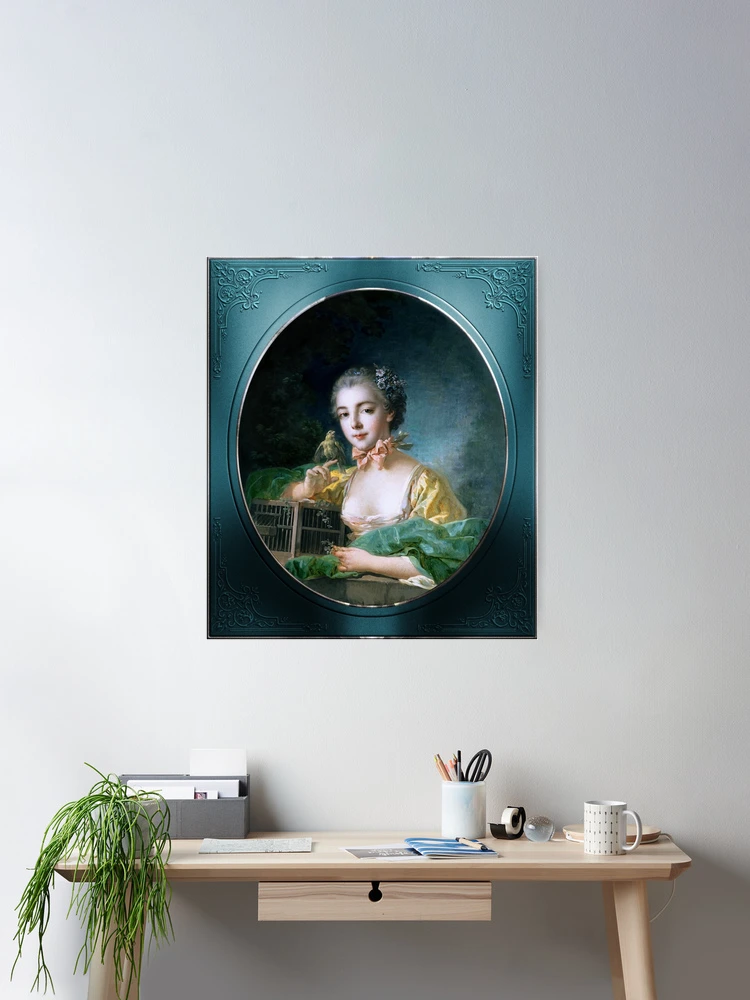
This artwork by the celebrated French Rococo painter François Boucher captures an exquisite moment of elegance and grace. This painting is a prime example of the Rococo style, which flourished in France during the early to mid-18th century, characterized by its lightness, grásta, and use of soft, pastel colors.
The subject of the portrait is Madame Badouin, the artist’s daughter, who is depicted with remarkable sensitivity and beauty. An bog, delicate nature of her features, her youthful countenance, and her serene expression all embody the grace and poise that were idealized in the Rococo period. The portrait has a gentle, intimate quality, inviting the viewer into the subject’s personal space.
At the center of the composition, Madame Badouin is presented in a three-quarter view, her head slightly turned as if she is caught in a moment of quiet contemplation. Her gaze is directed slightly off to the side, creating an impression of introspection, yet there is a subtle connection with the viewer, as if she is aware of being observed.
Her facial features are rendered with delicate precision: her fair skin is soft and smooth, her lips slightly parted in a demure expression, and her large, expressive eyes reflect a sense of intelligence and calm. The artist has emphasized the softness of her features, using subtle transitions between light and shadow to create a lifelike, cuma beagnach ethereal.
Madame Badouin’s attire is a masterful representation of the Rococo fashion of the time. She is dressed in an opulent gown of pale yellow and soft green hues, with layers of sheer fabric that flow gracefully around her. The gown’s texture is depicted with meticulous detail, showing the fine, almost weightless nature of the materials.
The artist has captured the flow and drape of the fabric with a sense of fluidity, suggesting the movement of the fabric as the subject sits serenely. A large pink ribbon is tied loosely at her throat, adding a touch of playful color that contrasts with the softness of the gown and further enhances the light, airy quality of the portrait.
Her coiffed hair, which is styled in soft waves and adorned with delicate flowers, is another hallmark of the Rococo period. The careful attention to detail in her hairstyle not only highlights the fashion trends of the time but also adds a sense of natural beauty, as though her appearance is effortlessly graceful. The flowers in her hair seem to symbolize youth and femininity, enhancing the overall sense of delicacy and refinement.
One of the most striking aspects of this portrait is the bird perched on the artist’s daughter’s finger. This small detail plays an important symbolic role in the painting, contributing to the overall theme of innocence and natural beauty.

The bird, with its muted plumage, contrasts with the lushness of the surrounding landscape and the softness of Madame Badouin’s attire. It also suggests a connection to nature, a recurring theme in Rococo art, which often celebrated the beauty of the natural world, the pastoral, and the idealized version of life in harmony with nature.
The background of the painting is equally carefully constructed. Behind the figure, a dark, lush landscape unfolds, with trees and foliage softly blurring into the distance. The use of a rich, muted green palette creates an almost dreamlike effect, enhancing the ethereal mood of the portrait.
This natural setting not only contrasts with the softness of the figure but also symbolizes a connection between Madame Badouin and the world around her. The painter’s skillful rendering of light and shadow creates depth and atmosphere, giving the scene a tranquil, almost timeless quality.
The overall mood of the portrait is one of calm elegance. The colors are soft and harmonious, with pastel shades predominating in both the subject’s attire and the background. The figure is illuminated in such a way that the face and hands are gently highlighted, creating a subtle focal point that draws the viewer’s attention to the subject’s expression and demeanor. There is a serene quality to the painting, one that evokes the idealized virtues of youth, áilleacht, and grace that were central to the Rococo aesthetic.
François Boucher’s technique in this painting is exemplary of his mastery of the Rococo style. His brushwork is fluid and refined, creating a soft, luminous texture that enhances the delicate nature of the subject. His use of light and color is equally sophisticated, with the artist skillfully capturing the interplay of natural light and shadow on Madame Badouin’s face and clothing. The soft transitions between colors and the subtle blending of tones demonstrate Boucher’s expertise in creating a smooth, bailchríoch snasta.
Mar fhocal scoir, François Boucher “Portrait of Madame Badouin, The Artist’s Daughter” is a stunning example of Rococo portraiture, where the subject’s beauty, grásta, and connection to nature are captured with sensitivity and elegance. The soft palette, delicate detailing, and serene mood of the painting convey the idealized qualities of youth and femininity that were highly valued during the Rococo period. Through this portrait, Boucher not only immortalizes his daughter but also provides a glimpse into the Rococo vision of beauty and refinement.
Portrait Of Madame Badouin is a retouched digital art old masters reproduction of a public domain image.
Faisnéis Thíos Díorthaithe ó Wikipedia.org
Páras ó dhúchas, Ba mhac é Boucher le péintéir nach raibh chomh cáiliúil sin Nicolas Boucher, a thug a chéad oiliúint ealaíne dó. Ag seacht mbliana déag d’aois, bhí meas ag an bpéintéir François Lemoyne ar phictiúr le Boucher. Cheap Lemoyne Boucher ina phrintíseach ina dhiaidh sin, ach tar éis trí mhí amháin, chuaigh sé ag obair don engraver Jean-François Cars.
I 1720, bhuaigh sé an Grand Prix de Rome mionlach as péinteáil, ach níor thapaigh sé an deis iarmhartach staidéar a dhéanamh san Iodáil go dtí cúig bliana ina dhiaidh sin, mar gheall ar fhadhbanna airgeadais san Acadamh Ríoga Péinteála agus Dealbhóireachta.[1] Nuair a d'fhill sé ar staidéar san Iodáil, glacadh leis an dealbhóireacht Académie de peinture et de 24 Samhain 1731. A phíosa fáiltithe (píosa fáiltithe) Ba é a Rinaldo agus Armida de 1734.
Phós Boucher Marie-Jeanne Buzeau i 1733. Bhí triúr páistí ag an lánúin le chéile. Tháinig Boucher chun bheith ina bhall dáimhe i 1734 agus luathaigh a shlí bheatha ón bpointe seo toisc gur tugadh ardú céime dó mar Ollamh ansin mar Reachtaire an Acadaimh, ag éirí mar chigire ag an Royal Gobelins Manufactory agus ar deireadh Premier Peintre du Roi (Céad Péintéir an Rí) in 1765. Portráid de Marie-Louise O’Murphy c. 1752
Fuair Boucher bás ar 30 Bealtaine 1770 ina Pháras dúchais. A ainm, mar aon le pátrún Madame de Pompadour, tar éis éirí comhchiallach le stíl Rocócó na Fraince, ag treorú na ndeartháireacha Goncourt a scríobh: “Tá Boucher ar cheann de na fir sin a léiríonn blas céad bliain, a chuireann in iúl, é a phearsanú agus a chorprú.”
Tá clú ar Boucher as a rá go bhfuil an dúlra “ró-ghlas agus droch-lit” (ró-ghlas agus droch-lit).
Bhí baint ag Boucher leis an engraver gemstone Jacques Guay, a mhúin sé a tharraingt. Rinne sé meantóireacht freisin ar an bpéintéir Moravian-Ostarach Martin Ferdinand Quadal chomh maith leis an bpéintéir neoclasaiceach Jacques-Louis David i 1767.[4] Níos déanaí, Rinne Boucher sraith líníochtaí de shaothair le Guay a rinne Madame de Pompadour a ghreamú agus a dháileadh mar imleabhar faoi cheangal dathúil ar chúirtéirí is fearr leo