

Portrett av en ung jente trodd å være prinsesse Essling
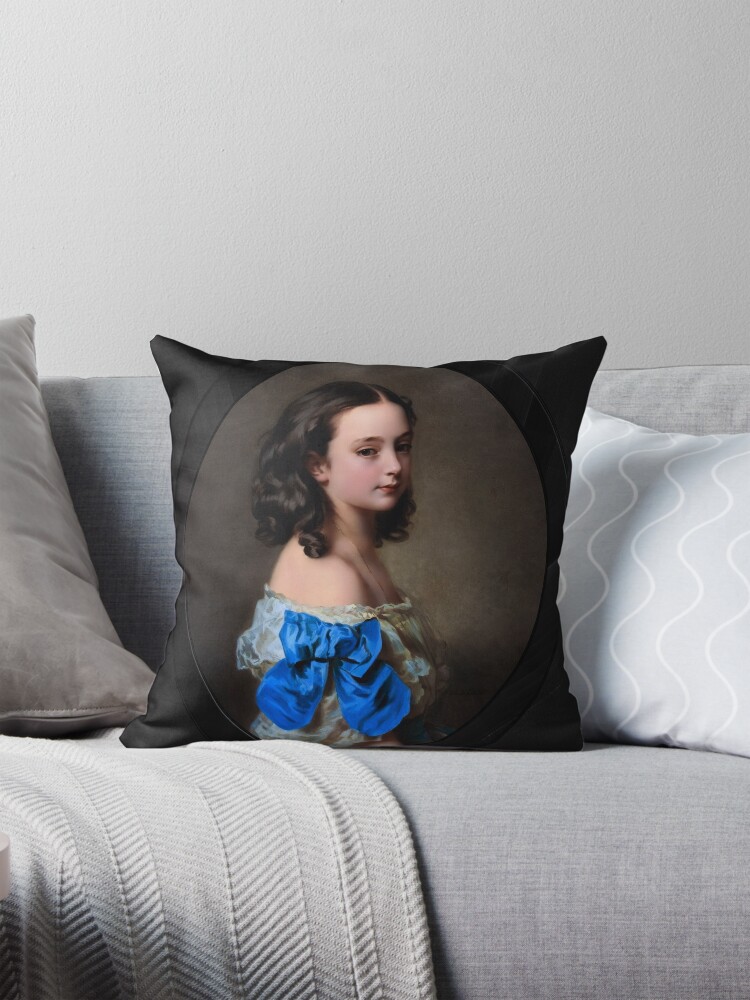
Portrettet med tittelen Portrait of a Young Girl Thought to Be Paula, Prinsesse Essling, Duchess of Rivoli, dated circa 1850, was created by the esteemed German-Swiss painter Hermann Winterhalter (1808 – 1891); yngre bror til portrettmaler Franz Xaver Winterhalter.
Known for his exquisite depictions of aristocratic figures and delicate portraits, Winterhalter captured the essence of high society through his refined techniques and detailed brushwork. I dette spesielle portrettet, the artist conveys both the youthful innocence and noble grace of a young girl believed to be Paula, Prinsesse Essling, Duchess of Rivoli, a prominent member of European aristocracy during the 19th century.
Innholdsfortegnelse
Hovedfag: The Young Girl
Det sentrale fokuset i maleriet er en ung jente, hodet hennes vendt litt mot betrakteren, presenterer et anstendig, men selvsikkert blikk. Hun utstråler en aura av stille adel, til tross for enkelheten i antrekket hennes. Med myke krøller som rammer inn ansiktet hennes, hennes ungdommelige trekk er gjengitt med en ekstraordinær følelse av realisme, fremhever kunstnerens dyktighet til å fange delikate detaljer.
Jenta er fremstilt med en luft av mild ynde, antyder en harmonisk blanding av uskyld og modenhet. Blikket hennes virker både kontemplativt og rolig, gir et innblikk i roen som forventes av en av hennes statuser. Det delikate i uttrykket hennes er et kjennetegn på Winterhalters evne til å skildre motivene sine ikke bare slik de så ut, men slik de ble oppfattet av datidens sosiale elite.
The young girl’s features are classical in style, her oval face, rosy cheeks, and soft lips embody the delicate beauty typical of aristocratic women in the mid-19th century. Hennes mørke, voluminous hair is arranged in soft waves, cascading down her shoulders. The subtlety of Winterhalter’s work allows the viewer to feel the texture of her hair, as though one could almost reach out and touch the smooth, dark strands.
The Attire and Symbolism of Clothing
The girl is dressed in a soft, off-the-shoulder white gown, which is complemented by a large, striking blue bow tied at the back of her waist. This garment, while modest in design, speaks volumes about her social standing, as the quality of the fabric and the precision of the bow suggest fine craftsmanship and noble origins. The white gown, a common symbol of purity and grace, juxtaposed with the bold, yet refined blue bow, conveys an interesting balance between youthful innocence and the emerging authority that the girl will likely inherit in her adulthood.
The blue bow, central to her attire, serves as a key element of the composition. Its vibrant hue contrasts beautifully with the neutral tones of the dress, creating visual interest and drawing attention to the girl’s back and the curves of her form. In many aristocratic portraits of the era, such symbolic details in clothing were often used to accentuate the subject’s stature and to impart a sense of individuality. The meticulous treatment of the fabric and its placement further reinforces the sense of elegance and order that Winterhalter aimed to capture in his portraits.
The Mood and Atmosphere of the Portrait
The mood of the painting is one of quiet introspection. The girl’s expression, combined with her delicate attire and the smooth, serene background, creates an atmosphere that is both intimate and regal. The soft light falling across her face lends a subtle glow to her skin, further enhancing the youthful, angelic qualities of her features. This softness is contrasted by the formality of her clothing and her poised demeanor, suggesting that she is not merely a child, but someone being prepared for the weight of noble responsibilities.
The background is soft and unobtrusive, a pale, gradient wash of color that allows the viewer to focus entirely on the girl herself. The absence of detailed scenery or any distractions in the backdrop directs the attention to the subject’s face, emphasizing her expression and the nuanced way in which her character is conveyed. Winterhalter’s choice to keep the background minimal also ensures that the viewer remains engaged with the subject’s humanity, her delicate form highlighted against the simplicity of the space surrounding her.
The Technique and Materials
Winterhalter’s technique is characterized by its meticulous attention to detail and its smooth, almost flawless surface. His use of oil paints allows for depth in the rendering of light and shadow, creating a lifelike representation of the girl’s skin and the soft textures of her gown.
The portrait is imbued with a sense of realism that speaks to Winterhalter’s mastery of chiaroscuro—his ability to depict light and shadow in a way that adds dimensionality to the two-dimensional surface of the canvas.
The skin tones are rendered with a soft palette, giving the young girl an ethereal quality. The transitions between light and shadow on her face are subtle but precise, suggesting that Winterhalter had an acute understanding of human anatomy and the ways in which light interacts with different surfaces.
The delicate brushstrokes used for the hair convey its fine texture, while the folds of her gown are portrayed with a soft, yet careful hand, capturing the flow of the fabric as it drapes around her form.
Konklusjon: A Portrait of Youth and Nobility
I Portrait of a Young Girl Thought to Be Paula, Prinsesse Essling, Duchess of Rivoli, Hermann Winterhalter encapsulates not only the physical beauty of the young girl but also the essence of aristocratic poise and refinement. The painting serves as a window into the world of European nobility during the 19th century, where youth and beauty were highly revered, yet accompanied by an underlying expectation of grace and responsibility.
Through his careful portrayal of this young girl, Winterhalter provides not just a likeness but a glimpse into the nobility of the era, presenting a figure poised to step into a world of authority while still possessing the innocence of childhood.
Portrett av en ung jente trodd å være prinsesse Essling er en retusjert digital kunst gamle mestere gjengivelse av et offentlig bilde.
Kunstnerbiografi
Info nedenfor fra Wikipedia.org
Franz Xaver Winterhalter ble født i den lille landsbyen Menzenschwand, (nå en del av Sankt Blasien), i Tysklands Schwarzwald[1] i velgerne i Baden, på 20 april 1805.[2] Han var det sjette barnet til Fidel Winterhalter (1773–1863), en bonde og harpiksprodusent i landsbyen, og kona Eva Meyer (1765–1838), medlem av en lenge etablert Menzenschwand -familie.[2] Faren var av bondebestand og hadde en mektig innflytelse i livet hans. Av de åtte brødrene og søstrene, bare fire overlevde barndommen. I hele sitt liv forble Franz Xaver svært nær familien sin, spesielt til broren Hermann (1808–1891), som også var maler.
Etter å ha gått på skolen ved et benediktinerkloster i St.. Blasien, Winterhalter forlot Menzenschwand 1818 i en alder av 13 for å studere tegning og gravering.[4] Han utdannet seg som tegner og litograf på verkstedet til Karl Ludwig Schüler (1785–1852) i Freiburg im Breisgau. I 1823, i en alder av 18, han dro til München, sponset av industrimannen Baron von Eichtal (1775–1850).
I 1825, han fikk stipend av Ludwig I, Storhertug av Baden (1763–1830) og begynte et studium ved Academy of Arts i München med Peter von Cornelius (1783–1867), hvis akademiske metoder gjorde ham ukomfortabel. Winterhalter fant en mer behagelig mentor hos den fasjonable portrettisten Joseph Karl Stieler (1781–1858). I løpet av denne tiden, han støttet seg selv som litograf.
Winterhalter gikk inn i rettskretsene da han var i 1828 han ble tegnemester til Sophie Margravine fra Baden, på Karlsruhe.[6] Hans mulighet til å etablere seg utenfor Sør -Tyskland kom inn 1832 da han kunne reise til Italia, 1833–1834, med støtte fra storhertug Leopold av Baden. I Roma komponerte han romantiske sjangerscener på samme måte som Louis Léopold Robert og knyttet seg til kretsen til direktøren for det franske akademiet, Horace Vernet. Da han kom tilbake til Karlsruhe malte han portretter av storhertugen Leopold av Baden og kona, og ble utnevnt til maler for storhertugets domstol.
Likevel, han forlot Baden for å flytte til Frankrike, hvor hans italienske sjangerscene Il dolce Farniente vakte oppmerksomhet på Salon of 1836. Il Decameron et år senere ble også rost; begge maleriene er akademiske komposisjoner i stil med Raphael. I salongen av 1838 han stilte ut et portrett av prinsen av Wagram med sin unge datter.
Karrieren som portrettmaler ble snart sikret da han samme år malte Louise Marie av Orleans, Belgienes dronning, og sønnen hennes. Det var sannsynligvis gjennom dette maleriet at Winterhalter ble kjent med Maria Amalia fra de to siciliene, Dronning av franskmennene, mor til dronningen av belgierne.