

Portrait of a Young Girl Thought To Be Princess Essling
The portrait titled Portrait of a Young Girl Thought to Be Paula, Princess Essling, Duchess of Rivoli, dated circa 1850, was created by the esteemed German-Swiss painter Hermann Winterhalter (1808 – 1891); younger brother of portrait painter Franz Xaver Winterhalter.
Known for his exquisite depictions of aristocratic figures and delicate portraits, Winterhalter captured the essence of high society through his refined techniques and detailed brushwork. In this particular portrait, the artist conveys both the youthful innocence and noble grace of a young girl believed to be Paula, Princess Essling, Duchess of Rivoli, a prominent member of European aristocracy during the 19th century.
Índice
Assunto principal: The Young Girl
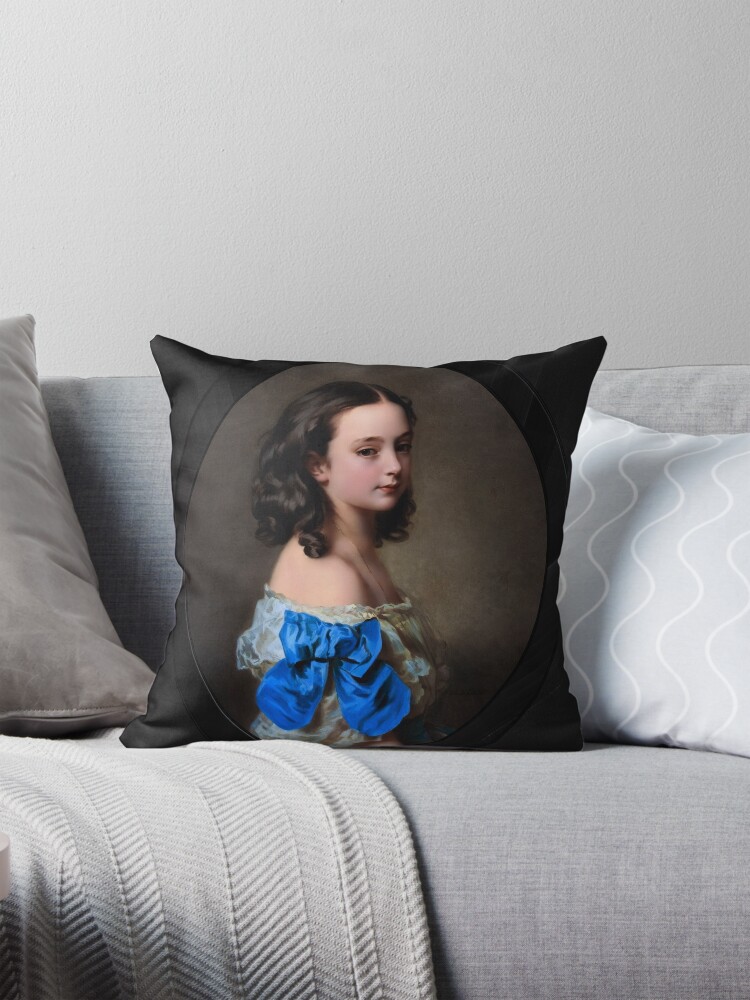
The central focus of the painting is a young girl, her head turned slightly toward the viewer, presenting a demure yet confident gaze. She exudes an aura of quiet nobility, despite the simplicity of her attire. With soft curls framing her face, her youthful features are rendered with an extraordinary sense of realism, highlighting the artist’s skill in capturing delicate details.
The girl is portrayed with an air of gentle grace, suggesting a harmonious blend of innocence and maturity. Her gaze seems both contemplative and serene, offering a glimpse into the composure expected of one of her status. The delicacy of her expression is a hallmark of Winterhalter’s ability to portray his subjects not just as they appeared, but as they were perceived by the social elite of the time.
The young girl’s features are classical in style, her oval face, rosy cheeks, and soft lips embody the delicate beauty typical of aristocratic women in the mid-19th century. Seu escuro, voluminous hair is arranged in soft waves, cascading down her shoulders. The subtlety of Winterhalter’s work allows the viewer to feel the texture of her hair, as though one could almost reach out and touch the smooth, dark strands.
The Attire and Symbolism of Clothing
The girl is dressed in a soft, off-the-shoulder white gown, which is complemented by a large, striking blue bow tied at the back of her waist. This garment, while modest in design, speaks volumes about her social standing, as the quality of the fabric and the precision of the bow suggest fine craftsmanship and noble origins. The white gown, a common symbol of purity and grace, juxtaposed with the bold, yet refined blue bow, conveys an interesting balance between youthful innocence and the emerging authority that the girl will likely inherit in her adulthood.
The blue bow, central to her attire, serves as a key element of the composition. Its vibrant hue contrasts beautifully with the neutral tones of the dress, creating visual interest and drawing attention to the girl’s back and the curves of her form. In many aristocratic portraits of the era, such symbolic details in clothing were often used to accentuate the subject’s stature and to impart a sense of individuality. The meticulous treatment of the fabric and its placement further reinforces the sense of elegance and order that Winterhalter aimed to capture in his portraits.
The Mood and Atmosphere of the Portrait
The mood of the painting is one of quiet introspection. The girl’s expression, combined with her delicate attire and the smooth, serene background, creates an atmosphere that is both intimate and regal. The soft light falling across her face lends a subtle glow to her skin, further enhancing the youthful, angelic qualities of her features. This softness is contrasted by the formality of her clothing and her poised demeanor, suggesting that she is not merely a child, mas alguém preparado para o peso de nobres responsabilidades.
O fundo é suave e discreto, com remos, lavagem gradiente de cor que permite ao espectador focar inteiramente na própria garota. A ausência de cenário detalhado ou qualquer distração no cenário direciona a atenção para o rosto do sujeito, enfatizando sua expressão e a maneira sutil como sua personagem é transmitida. A escolha de Winterhalter de manter o fundo mínimo também garante que o espectador permaneça envolvido com a humanidade do sujeito., sua forma delicada destacada contra a simplicidade do espaço que a rodeia.
The Technique and Materials
A técnica de Winterhalter é caracterizada pela atenção meticulosa aos detalhes e pela suavidade, superfície quase perfeita. Seu uso de tintas a óleo permite profundidade na renderização de luz e sombra, criando uma representação realista da pele da menina e das texturas suaves de seu vestido.
O retrato está imbuído de um senso de realismo que fala do domínio do claro-escuro de Winterhalter – sua capacidade de representar luz e sombra de uma forma que adiciona dimensionalidade à superfície bidimensional da tela..
Os tons de pele são renderizados com uma paleta suave, dando à jovem uma qualidade etérea. As transições entre luz e sombra em seu rosto são sutis, mas precisas, sugerindo que Winterhalter tinha uma compreensão apurada da anatomia humana e das maneiras pelas quais a luz interage com diferentes superfícies.
As pinceladas delicadas utilizadas no cabelo transmitem sua textura fina, while the folds of her gown are portrayed with a soft, yet careful hand, capturing the flow of the fabric as it drapes around her form.
Conclusão: A Portrait of Youth and Nobility
Em Portrait of a Young Girl Thought to Be Paula, Princess Essling, Duchess of Rivoli, Hermann Winterhalter encapsulates not only the physical beauty of the young girl but also the essence of aristocratic poise and refinement. The painting serves as a window into the world of European nobility during the 19th century, where youth and beauty were highly revered, yet accompanied by an underlying expectation of grace and responsibility.
Through his careful portrayal of this young girl, Winterhalter provides not just a likeness but a glimpse into the nobility of the era, presenting a figure poised to step into a world of authority while still possessing the innocence of childhood.
Portrait of a Young Girl Thought To Be Princess Essling is a retouched digital art old masters reproduction of a public domain image.
Biografia do artista
Informações abaixo de Wikipédia.org
Franz Xaver Winterhalter was born in the small village of Menzenschwand, (now part of Sankt Blasien), in Germany’s Black Forest[1] in the Electorate of Baden, on 20 April 1805.[2] He was the sixth child of Fidel Winterhalter (1773–1863), a farmer and resin producer in the village, and his wife Eva Meyer (1765–1838), a member of a long established Menzenschwand family.[2] His father was of peasant stock and was a powerful influence in his life. Of the eight brothers and sisters, only four survived infancy. Throughout his life Franz Xaver remained very close to his family, in particular to his brother Hermann (1808–1891), que também foi pintor.
After attending school at a Benedictine monastery in St. Blasien, Winterhalter left Menzenschwand in 1818 com a idade de 13 to study drawing and engraving.[4] He trained as a draughtsman and lithographer in the workshop of Karl Ludwig Schüler (1785–1852) in Freiburg im Breisgau. Em 1823, com a idade de 18, he went to Munich, sponsored by the industrialist Baron von Eichtal (1775–1850).
Em 1825, he was granted a stipend by Ludwig I, Grand Duke of Baden (1763–1830) and began a course of study at the Academy of Arts in Munich with Peter von Cornelius (1783–1867), whose academic methods made him uncomfortable. Winterhalter found a more congenial mentor in the fashionable portraitist Joseph Karl Stieler (1781–1858). Durante este tempo, he supported himself working as lithographer.
Winterhalter entered court circles when in 1828 he became drawing master to Sophie Margravine of Baden, at Karlsruhe.[6] His opportunity to establish himself beyond southern Germany came in 1832 when he was able to travel to Italy, 1833–1834, with the support of Grand Duke Leopold of Baden. In Rome he composed romantic genre scenes in the manner of Louis Léopold Robert and attached himself to the circle of the director of the French Academy, Horace Vernet. On his return to Karlsruhe he painted portraits of the Grand Duke Leopold of Baden and his wife, and was appointed painter to the grand-ducal court.
Nevertheless, he left Baden to move to France, where his Italian genre scene Il dolce Farniente attracted notice at the Salon of 1836. Il Decameron a year later was also praised; both paintings are academic compositions in the style of Raphael. In the Salon of 1838 he exhibited a portrait of the Prince of Wagram with his young daughter.
His career as a portrait painter was soon secured when in the same year he painted Louise Marie of Orleans, Queen of the Belgians, and her son. It was probably through this painting that Winterhalter came to the notice of Maria Amalia of the Two Sicilies, Queen of the French, mother of the Queen of the Belgians.