

Ripplin Rythm
“Ripplin Rhythm,” created by the renowned American artist Rolf Armstrong (1889 – 1960), stands as a testament to the vibrant beauty of pin-up art during the mid-20th century. Armstrong, a prominent figure in the golden era of American commercial art, expertly merges movement, Couleur, and emotion within this piece, offering a glimpse into the glamour and sensuality that defined the era.
Né dans 1889, Armstrong’s work was marked by a mastery of light and color, making his images highly sought after in advertisements, illustrations, and fine art. He utilized a unique blend of techniques that brought dynamism to his subjects, et “Ripplin Rhythm” encapsulates this with its fluid and energetic portrayal of a woman in motion.
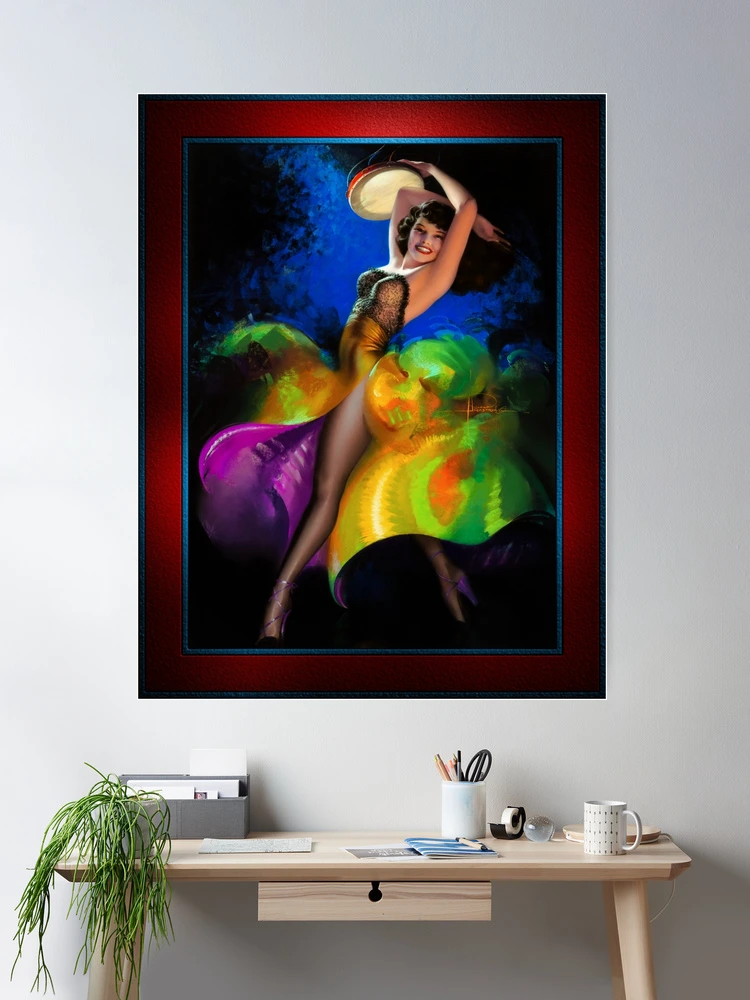
Table des matières
Sujet principal: The Vibrant Dancer
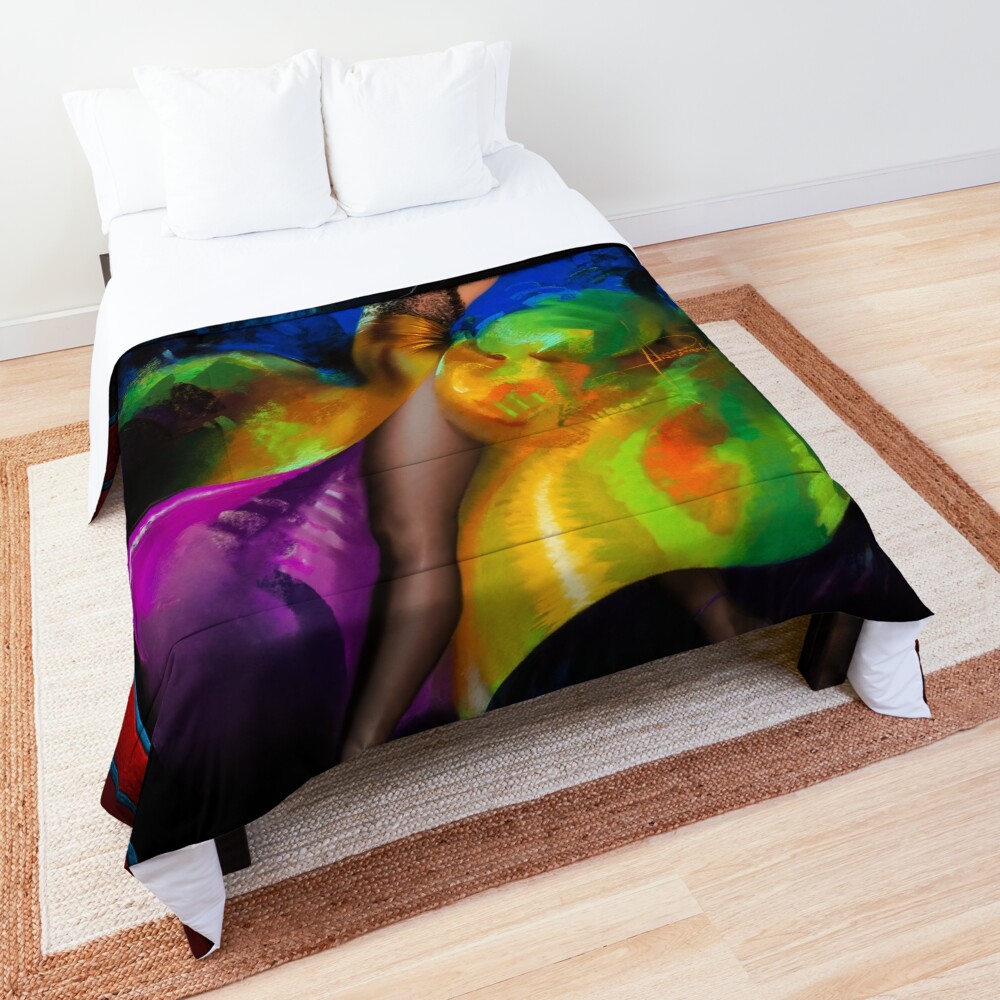
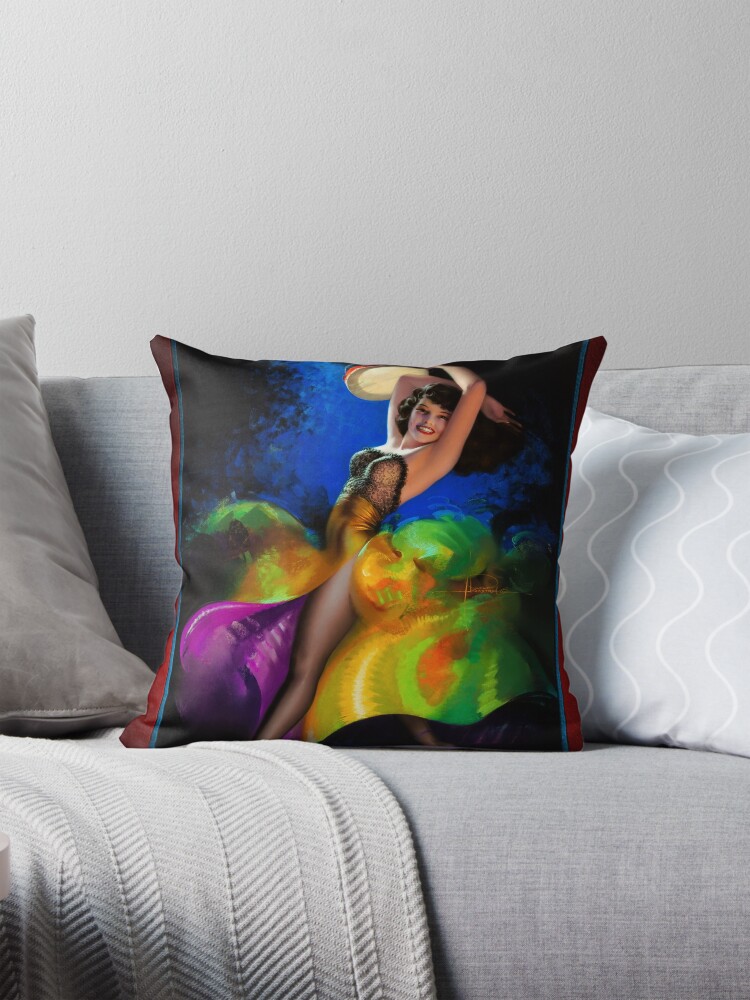
Au coeur de “Ripplin Rhythm” is a captivating depiction of a dancer in mid-performance. Le sujet, a woman, exudes confidence and joy as she spins gracefully, her flowing dress rippling around her body like the waves of an ocean. The dancer’s attire is a burst of color, with swirling shades of green, Jaune, and purple creating a striking contrast against the deep blue background.
The woman’s posture is elegant yet exuberant, her arms raised in a celebratory gesture as she holds a tambourine above her head. Her face radiates happiness, a wide smile revealing her playful spirit. Armstrong has captured not only her motion but also her essence, making her appear as though she is alive with energy and rhythm.
The woman’s vibrant costume, designed to reflect the rhythm of her movements, is a fusion of bold colors. The soft metallic sheen of her golden bodice catches the light, enhancing the dynamic flow of her skirt. Armstrong’s use of color in this piece is masterful, with each hue seemingly chosen to emphasize the woman’s graceful spinning and the lively atmosphere of her performance. The skirt, which flares out around her like an explosive flower, ripples with energy, suggesting the dancer’s movement and the pulse of the music she is engaged with.
The Objects: Tambourine and Flowing Garments
The tambourine held by the dancer is a key object in the painting, not only because it symbolizes the musical rhythm she embodies but also because it ties the composition together. The tambourine’s small yet intricate form contrasts the large, swirling mass of the dancer’s gown, yet it maintains a presence that complements the overall movement within the scene.
The circular shape of the tambourine subtly mirrors the curves and flow of her garments, creating a visual harmony between the two. This object, while seemingly simple, amplifies the sense of rhythm and dance in the composition.
The cascading layers of the dancer’s gown are another vital aspect of the work. Armstrong’s skillful handling of fabric and texture brings the dress to life, with each fold and curve appearing as if it is caught mid-movement. La robe, with its vibrant, rippling folds, seems to echo the fluidity of the dancer’s form. The luxurious colors and glossy textures of the skirt create a feeling of both elegance and freedom, enhancing the theme of lively celebration.
Terrain: The Colorful Background
Le fond de “Ripplin Rhythm” is one of the key elements that contribute to the piece’s overall mood. A deep blue hue forms the backdrop, providing a striking contrast to the warm colors of the dancer’s attire. This color choice highlights the subject and makes her appear as if she is emerging from a dreamlike or fantastical environment.
Armstrong uses the swirling shapes and dark tones in the background to evoke movement and rhythm, as if the air itself is alive with the same energy that drives the dancer. The fluidity of the colors in the background suggests motion, blending with the dancer’s own movements, creating a seamless connection between subject and environment.
Style: Art Deco and Glamour
“Ripplin Rhythm” is a quintessential example of Armstrong’s signature style, which draws heavily from Art Deco influences. The streamlined elegance of the figure, the dynamic compositions, and the use of bold, contrasting colors all reflect the Art Deco movement, which was characterized by its celebration of modernity, luxe, and glamour.
Le lisse, graceful lines of the dancer’s body and the geometric shapes within the composition convey a sense of sophistication and energy that are central to the Art Deco aesthetic. En même temps, the work also embodies the exuberance and glamour of the pin-up style, which Armstrong helped define. His portrayal of women was not only sensual but celebratory, et “Ripplin Rhythm” is a perfect example of this, as it captures a moment of joyous self-expression.
The dancer’s radiant smile and energetic pose speak to the optimistic and carefree mood of the era. Armstrong’s work is imbued with a sense of youthful vitality, and this painting exemplifies the vibrant energy of American culture during the 1940s. It reflects a time of confidence and joy, set against the backdrop of a world on the cusp of dramatic change.
Thème et humeur: Celebration of Movement and Music
Le thème de “Ripplin Rhythm” is centered around the celebration of movement, musique, et la féminité. Armstrong captures the essence of dance as an expression of joy and liberation, highlighting the dynamism and beauty of the human form in motion.
The artist has skillfully conveyed the idea that rhythm is not just a sound but a force that can be seen and felt in the movements of the body. The dancer’s bright smile and the lively swirl of her dress communicate a sense of freedom, playfulness, and enthusiasm, making the painting feel like an invitation to partake in the celebration.
The overall mood of the artwork is one of joy and excitement. Armstrong’s use of color and form conveys a sense of lightness and exuberance, and the dancer herself appears to be in the midst of a joyous performance, lost in the music and her own movement. The piece encapsulates a spirit of happiness, optimisme, and youthful vitality, evoking a time when life seemed to be filled with endless possibilities.
Conclusion
“Ripplin Rhythm” by Rolf Armstrong is more than just a beautiful portrait of a woman in motion; it is a vibrant celebration of life, Couleur, et musique. The dynamic composition, utilisation audacieuse de la couleur, and joyful expression of the dancer all contribute to a sense of energy and rhythm that makes the painting come alive. Armstrong’s mastery of movement and his ability to capture the spirit of an era make this work a timeless example of American art. Through the use of elegant forms, flowing garments, and vibrant hues, Armstrong successfully conveys the joy of dance, the celebration of femininity, and the power of music to inspire movement and expression.
L'Enchanteresse est une reproduction de maîtres anciens d'art numérique retouchée d'une image du domaine public.
Artiste Bio de Wikipedia.org
Rolf Armstrong est né John Scott Armstrong à Bay City, Michigan en avril 21, 1889, à Richard et Harriet (Scott) Armstrong. Son père était propriétaire de la Boy-Line Fire Boat Company, qui comprenait une ligne de paquebots. Certains ont été déployés à Chicago pour être utilisés à l'Exposition universelle de Chicago en 1893.
pourtant, l'entreprise et la famille du père étaient en difficulté, et la propriété familiale a été perdue à cause de la forclusion. Dans 1899, la famille a déménagé à Détroit, Michigan. Le père de Rolf est décédé en 1903, et un an plus tard, lui et sa mère ont déménagé à Seattle, Washington, sur les traces de son frère aîné, William, qui s'y était installé un an plus tôt. À présent, les intérêts artistiques de Rolf émergeaient à plus qu'un plaisir à temps partiel.
Il a déménagé à Chicago en 1908, où il a ensuite étudié à l'Art Institute. Il part ensuite pour New York, où il a étudié avec Robert Henri. Après un voyage à Paris en 1919 étudier à l'Académie Julian, il est retourné à New York et a créé un studio. Dans 1921 il est allé à Minneapolis pour étudier la production de calendriers à Brown & Bigelow.
Au cours des années 1920 et 1930, son travail est apparu sur de nombreuses partitions, ainsi que sur les couvertures de nombreux magazines, le plus célèbre pour les magazines de fans de cinéma tels que Photoplay et Screenland. Son travail se compose principalement de femmes; Mary Pickford, Bébé Daniels, et Greta Garbo ne sont que quelques-uns des nombreux qu'il a peints.
Le travail d'Armstrong pour la Pictorial Review était en grande partie responsable de ce magazine atteignant un tirage de plus de deux millions en 1926. Un an plus tard, il était l'artiste de calendrier le plus vendu chez Brown & Bigelow. Dans 1930, RCA l'a embauché pour peindre des pin-ups pour faire la publicité de leurs produits, et en 1933 le Thomas D. Murphy Calendar Company l'a signé pour produire une série de peintures pour leur ligne.
En mars 1940, Fleurs de bijou, une fille de Lumberton, Caroline du Nord, a envoyé une photo d'elle à Armstrong en réponse à une annonce qu'il avait publiée dans le New York Times. Armstrong, 50 à l'époque, était basé à l'Hôtel des Artistes sur West 67th Street à Manhattan depuis 1939, et je cherchais de nouveaux modèles.
Il a invité Flowers pour une interview. En mars 25, 1940, Flowers a commencé à modeler pour Armstrong. Leur collaboration professionnelle et leur amitié ont duré deux décennies. La première peinture, titré “Comment je vais?”, apparemment parce que les fleurs, peu habitué au mannequinat, a demandé à plusieurs reprises à Armstrong “Comment je vais?” pendant la séance de modelage, a été publié pour la première fois après le début de la Seconde Guerre mondiale.
c'était marron & Le calendrier le plus vendu de Bigelow pour 1942 à une époque où l'entreprise vendait des millions de calendriers en Amérique, et c'est devenu l'une des images les plus reproduites d'Armstrong. Les fleurs étaient populaires auprès des militaires américains pendant la Seconde Guerre mondiale, dont certains lui ont envoyé des lettres proposant le mariage. Les calendriers et les silhouettes de Flowers d'Armstrong ont été copiés sur des bombardiers et d'autres avions comme art du nez et peints sur des tourelles de chars.
Elle est devenue si connue pendant la guerre, bien que plus comme un visage célèbre que par son nom, qu'une lettre d'un militaire adressée simplement comme “Fleurs de bijou, La ville de New York” a été livré correctement. Pour de nombreux militaires américains à l'étranger, elle représentait le “Pourquoi nous nous battons” esprit. NOUS. Le président Franklin D. Le gouvernement de Roosevelt l'a enrôlée pour aider à promouvoir les obligations de guerre.
Le janvier 1, 1945 édition du magazine TIME inclus Armstrong's “Toast de la ville” peinture de fleurs dans un article sur Calendar Art. L'article a noté que les calendriers avec “peintures de fille” étaient “acheté massivement par les fonderies, ateliers d'usinage, concessionnaires d'approvisionnement automatique.”
Fleurs mariées en 1946. Elle et son mari vivaient dans plusieurs endroits alors qu'il tentait un certain nombre d'entreprises commerciales, y compris Laguna Beach, Californie, Greenville, Caroline du Sud, Réno, Nevada, où elle aurait travaillé comme croupière de cartes pendant un certain temps, et New York. Selon Michael Wooldridge, co-auteur de Pin up Dreams: L'art glamour de Rolf Armstrong, Armstrong l'a appelée plusieurs fois pendant la période où elle suivait son mari d'un endroit à l'autre, pour essayer de la persuader de retourner à New York et de devenir mannequin pour lui.
Sa carrière de mannequin s'est terminée avec la mort d'Armstrong en 1960. Il a laissé une grande partie de sa fortune personnelle à Flowers. Au total, Armstrong a créé environ cinquante à soixante œuvres en utilisant les fleurs comme modèle.
Rolf Armstrong est décédé en 1960 sur l'île d'Oahu, Hawaï comme l'un des meilleurs “afficher” artistes de la première moitié du XXe siècle.