

Ripplin Rythm
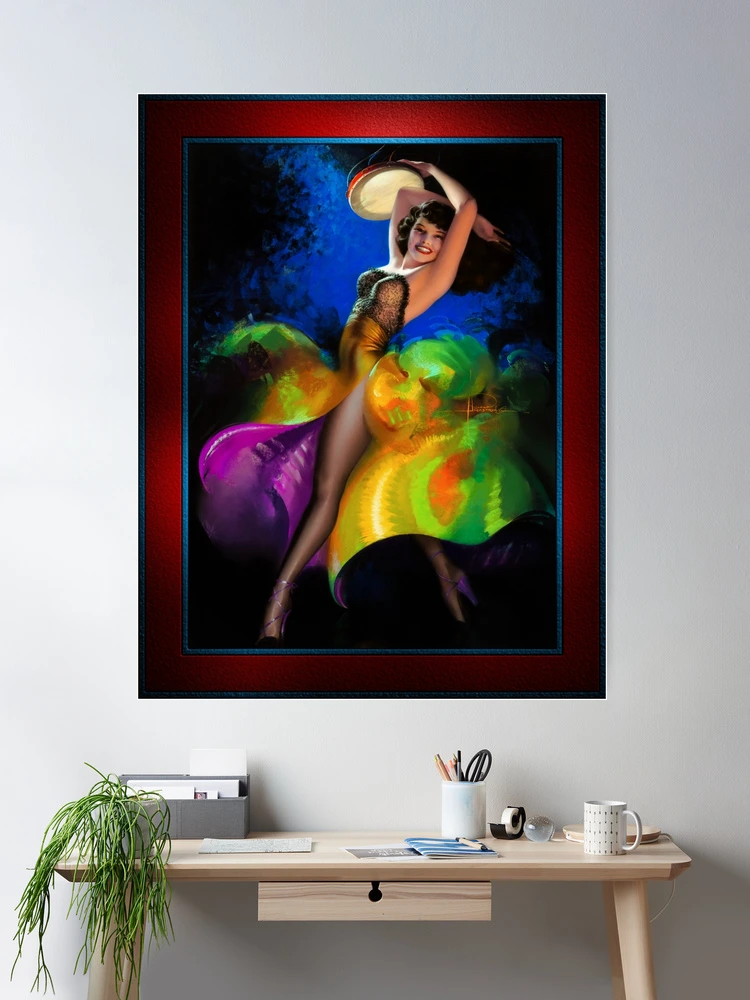
“Ripplin Rhythm,” created by the renowned American artist Rolf Armstrong (1889 – 1960), stands as a testament to the vibrant beauty of pin-up art during the mid-20th century. Armstrong, a prominent figure in the golden era of American commercial art, expertly merges movement, kleur, and emotion within this piece, offering a glimpse into the glamour and sensuality that defined the era.
Geboren in 1889, Armstrong’s work was marked by a mastery of light and color, making his images highly sought after in advertisements, illustrations, and fine art. He utilized a unique blend of techniques that brought dynamism to his subjects, en “Ripplin Rhythm” encapsulates this with its fluid and energetic portrayal of a woman in motion.
Inhoudsopgave
Hoofdonderwerp: The Vibrant Dancer
In het hart van “Ripplin Rhythm” is a captivating depiction of a dancer in mid-performance. Het onderwerp, a woman, exudes confidence and joy as she spins gracefully, her flowing dress rippling around her body like the waves of an ocean. The dancer’s attire is a burst of color, with swirling shades of green, geel, and purple creating a striking contrast against the deep blue background.
The woman’s posture is elegant yet exuberant, her arms raised in a celebratory gesture as she holds a tambourine above her head. Her face radiates happiness, a wide smile revealing her playful spirit. Armstrong has captured not only her motion but also her essence, making her appear as though she is alive with energy and rhythm.
The woman’s vibrant costume, designed to reflect the rhythm of her movements, is a fusion of bold colors. The soft metallic sheen of her golden bodice catches the light, enhancing the dynamic flow of her skirt. Armstrong’s use of color in this piece is masterful, with each hue seemingly chosen to emphasize the woman’s graceful spinning and the lively atmosphere of her performance. De rok, which flares out around her like an explosive flower, ripples with energy, suggesting the dancer’s movement and the pulse of the music she is engaged with.
The Objects: Tambourine and Flowing Garments
The tambourine held by the dancer is a key object in the painting, not only because it symbolizes the musical rhythm she embodies but also because it ties the composition together. The tambourine’s small yet intricate form contrasts the large, swirling mass of the dancer’s gown, yet it maintains a presence that complements the overall movement within the scene.
The circular shape of the tambourine subtly mirrors the curves and flow of her garments, creating a visual harmony between the two. This object, while seemingly simple, amplifies the sense of rhythm and dance in the composition.
The cascading layers of the dancer’s gown are another vital aspect of the work. Armstrong’s skillful handling of fabric and texture brings the dress to life, with each fold and curve appearing as if it is caught mid-movement. De jurk, with its vibrant, rippling folds, seems to echo the fluidity of the dancer’s form. The luxurious colors and glossy textures of the skirt create a feeling of both elegance and freedom, enhancing the theme of lively celebration.
Terrain: The Colorful Background
De achtergrond van “Ripplin Rhythm” is one of the key elements that contribute to the piece’s overall mood. A deep blue hue forms the backdrop, providing a striking contrast to the warm colors of the dancer’s attire. This color choice highlights the subject and makes her appear as if she is emerging from a dreamlike or fantastical environment.
Armstrong uses the swirling shapes and dark tones in the background to evoke movement and rhythm, as if the air itself is alive with the same energy that drives the dancer. The fluidity of the colors in the background suggests motion, blending with the dancer’s own movements, creating a seamless connection between subject and environment.
Stijl: Art Deco and Glamour
“Ripplin Rhythm” is a quintessential example of Armstrong’s signature style, which draws heavily from Art Deco influences. The streamlined elegance of the figure, the dynamic compositions, and the use of bold, contrasting colors all reflect the Art Deco movement, which was characterized by its celebration of modernity, luxe, and glamour.
De gladde, graceful lines of the dancer’s body and the geometric shapes within the composition convey a sense of sophistication and energy that are central to the Art Deco aesthetic. Tegelijkertijd, the work also embodies the exuberance and glamour of the pin-up style, which Armstrong helped define. His portrayal of women was not only sensual but celebratory, en “Ripplin Rhythm” is a perfect example of this, as it captures a moment of joyous self-expression.
The dancer’s radiant smile and energetic pose speak to the optimistic and carefree mood of the era. Armstrong’s work is imbued with a sense of youthful vitality, and this painting exemplifies the vibrant energy of American culture during the 1940s. It reflects a time of confidence and joy, set against the backdrop of a world on the cusp of dramatic change.
Thema en stemming: Celebration of Movement and Music
Het thema van “Ripplin Rhythm” is centered around the celebration of movement, muziek, and femininity. Armstrong captures the essence of dance as an expression of joy and liberation, highlighting the dynamism and beauty of the human form in motion.
The artist has skillfully conveyed the idea that rhythm is not just a sound but a force that can be seen and felt in the movements of the body. The dancer’s bright smile and the lively swirl of her dress communicate a sense of freedom, playfulness, and enthusiasm, making the painting feel like an invitation to partake in the celebration.
The overall mood of the artwork is one of joy and excitement. Armstrong’s use of color and form conveys a sense of lightness and exuberance, and the dancer herself appears to be in the midst of a joyous performance, lost in the music and her own movement. The piece encapsulates a spirit of happiness, optimisme, and youthful vitality, evoking a time when life seemed to be filled with endless possibilities.
Conclusie
“Ripplin Rhythm” by Rolf Armstrong is more than just a beautiful portrait of a woman in motion; it is a vibrant celebration of life, kleur, and music. The dynamic composition, bold use of color, and joyful expression of the dancer all contribute to a sense of energy and rhythm that makes the painting come alive. Armstrong’s mastery of movement and his ability to capture the spirit of an era make this work a timeless example of American art. Through the use of elegant forms, flowing garments, and vibrant hues, Armstrong successfully conveys the joy of dance, the celebration of femininity, and the power of music to inspire movement and expression.
The Enchantress is een geretoucheerde digitale kunst oude meesters reproductie van een afbeelding uit het publieke domein.
Kunstenaar bio van Wikipedia.org
Rolf Armstrong werd geboren als John Scott Armstrong in Bay City, Michigan in april 21, 1889, aan Richard en Harriet (Scott) Armstrong. Zijn vader was eigenaar van de Boy-Line Fire Boat Company, die een lijn van passagiersschepen omvatte. Sommige werden ingezet in Chicago voor gebruik op de Chicago World's Fair daar in 1893.
Echter, het bedrijf en het gezin van de vader hadden het moeilijk, en de familieboerderij ging verloren door afscherming. In 1899, het gezin verhuisde naar Detroit, Michigan. Rolf's vader stierf in 1903, en een jaar later verhuisden hij en zijn moeder naar Seattle, Washington, in de voetsporen treden van zijn oudste broer, Willem, die daar een jaar eerder was verhuisd. Inmiddels waren Rolfs artistieke interesses uitgegroeid tot meer dan een parttime plezier.
Hij verhuisde naar Chicago in 1908, waar hij later studeerde aan het Art Institute. Daarna ging hij naar New York, waar hij studeerde bij Robert Henri. Na een reis naar Parijs in 1919 studeren aan de Académie Julian, hij keerde terug naar New York en richtte een studio op. In 1921 hij ging naar Minneapolis om kalenderproductie te studeren bij Brown & Bigelow.
Tijdens de jaren 1920 en 1930, zijn werk verscheen op veel bladmuziek, evenals op de covers van vele tijdschriften, het meest bekend voor filmfanmagazines zoals Photoplay en Screenland. Zijn werk bestaat voornamelijk uit vrouwen; Mary Pickford, Bebe Daniels, en Greta Garbo zijn slechts enkele van de vele die hij schilderde.
Armstrongs werk voor de Pictorial Review was er grotendeels verantwoordelijk voor dat dat tijdschrift een oplage van meer dan twee miljoen per jaar bereikte 1926. Een jaar later, hij was de bestverkopende kalenderkunstenaar bij Brown & Bigelow. In 1930, RCA huurde hem in om pin-ups te schilderen om reclame te maken voor hun producten, en in 1933 de Thomas D. Murphy Calendar Company heeft hem getekend om een reeks schilderijen voor hun lijn te produceren.
In maart 1940, Juweel Bloemen, een meisje uit Lumberton, Noord Carolina, stuurde een foto van zichzelf naar Armstrong als reactie op een advertentie die hij in de New York Times had geplaatst. Armstrong, 50 op dat moment, was gevestigd in het Hotel des Artistes op West 67th Street in Manhattan sinds 1939, en was op zoek naar nieuwe modellen.
Hij nodigde Flowers uit voor een interview. op maart 25, 1940, Flowers begon te modelleren voor Armstrong. Hun professionele samenwerking en vriendschap duurde twee decennia. Het eerste schilderij, met een adellijke titel “Hoe gaat het met mij?”, naar verluidt omdat Flowers, niet gewend aan modellenwerk, herhaaldelijk gevraagd Armstrong “Hoe gaat het met mij?” tijdens de modellensessie, werd voor het eerst gepubliceerd nadat de Tweede Wereldoorlog was begonnen.
Het was Brown & De bestverkochte kalender van Bigelow voor 1942 in een tijd dat het bedrijf miljoenen kalenders in Amerika verkocht, en het werd een van Armstrongs meest gereproduceerde foto's. Flowers was populair bij Amerikaanse militairen tijdens de Tweede Wereldoorlog, van wie sommigen haar brieven stuurden met een huwelijksaanzoek. Armstrongs kalenders en silhouetten van bloemen werden gekopieerd op bommenwerpers en andere vliegtuigen als neuskunst en geschilderd op tankkoepels.
Ze werd zo bekend tijdens de oorlog, hoewel meer als een beroemd gezicht dan bij naam, dat de brief van een militair eenvoudig was geadresseerd als: “Juweel Bloemen, New York City” werd correct geleverd. Voor veel Amerikaanse militairen in het buitenland, zij vertegenwoordigde de “Waarom we vechten?” geest. ONS. President Franklin D. De regering van Roosevelt schakelde haar in om oorlogsobligaties te helpen bevorderen.
de januari 1, 1945 editie van TIME magazine inclusief Armstrong's “Toast van de stad” schilderij van bloemen in een artikel over kalenderkunst. Het artikel merkte op dat kalenders met “meisjes schilderijen” waren “zwaar gekocht door gieterijen, machine winkels, auto-supply dealers.”
Bloemen getrouwd in 1946. Zij en haar man woonden op verschillende plaatsen terwijl hij een aantal zakelijke ondernemingen probeerde, inclusief Laguna Beach, Californië, Greenville, zuid Carolina, Reno, Nevada, waar ze naar verluidt een tijdlang als kaartdealer heeft gewerkt, en New York City. Volgens Michael Wooldridge, co-auteur van Pin up Dreams: De glamourkunst van Rolf Armstrong, Armstrong belde haar een aantal keer tijdens de periode dat ze haar man van plaats tot plaats volgde, om te proberen haar over te halen terug te keren naar New York en voor hem te modelleren.
Haar modellencarrière eindigde met de dood van Armstrong in 1960. Hij liet een groot deel van zijn persoonlijke rijkdom na aan Flowers. In totaal, Armstrong maakte ongeveer vijftig tot zestig werken met Flowers als model.
Rolf Armstrong stierf in 1960 op het eiland Oahu, Hawaii als een van de beste “vastpinnen” kunstenaars uit de eerste helft van de twintigste eeuw.