

Mer agitée avec des navires c1834
Mer agitée avec des navires c1834″ de Théodore Gudin (1802 – 1880)
La peinture Mer agitée avec des navires, créé dans 1834 par l'artiste français Théodore Gudin, capture le brut, nature tumultueuse de la mer qui s'écrase contre les navires pris dans ses puissantes houles. Théodore Gudin, connu pour ses paysages marins, donne vie à sa profonde compréhension de la vie maritime et des environnements nautiques dans ce portrait dramatique. Le travail, peint au début de sa carrière, démontre sa maîtrise de la capture des aspects à la fois violents et sereins de l'océan, ainsi que la vie de ceux qui naviguent dans ses eaux imprévisibles.
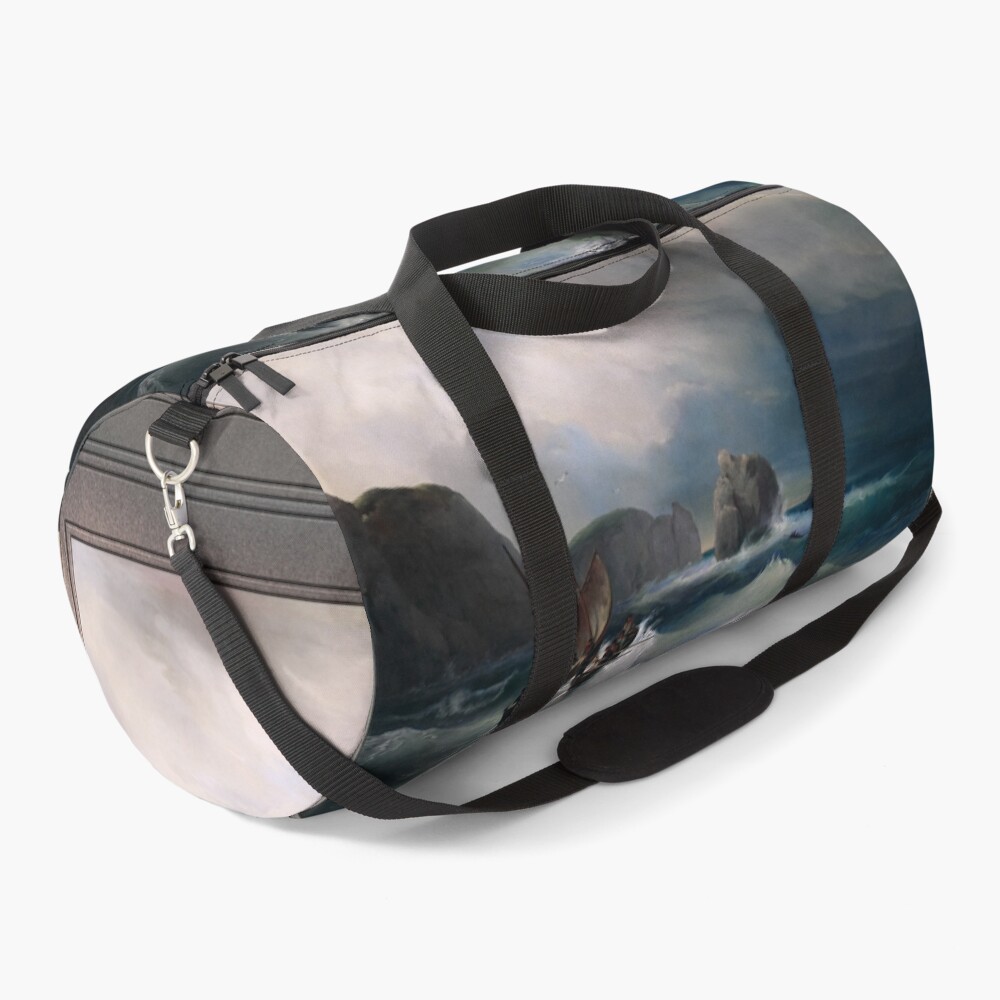
Table des matières
Sujet principal: La lutte entre l'homme et la nature
Au coeur de Mer agitée avec des navires is the battle between human endeavor and the untamable force of nature. A small group of sailors is depicted in a boat, braving the crashing waves with determination. Their vessel, a sturdy wooden ship, is helmed by several figures whose taut expressions and focused actions suggest the dire situation they are facing. The sailors, positioned toward the foreground, labor tirelessly to control their ship amidst the violent tides, with some of the figures rowing while others brace themselves against the ocean’s relentless pull.
The ship they are struggling to steer is not fully depicted, but the viewer can sense its looming presence as the sailors face the mighty forces of the sea. Le contraste saisissant entre la petitesse du bateau et l’immensité de l’océan rappelle la vulnérabilité humaine face à l’immense puissance de la nature.. Au loin, un autre navire fait naufrage, sa coque brisée visible dans les eaux turbulentes, victime tragique de la tempête, illustrant les périls de la vie en mer.
Éléments de terrain et d’arrière-plan: Un océan agité et un littoral accidenté
L'arrière-plan est dominé par une mer vaste et agitée. L’utilisation par Gudin des vagues tourbillonnantes, peint dans des tons de vert et de bleu, évoque la force et l'énergie de l'eau. La mer semble s'étendre à l'infini à l'horizon, où le ciel et l'eau se fondent dans un ensemble homogène, union orageuse. Les vagues sont épaisses de mouvement, capturant la puissance brute de la nature alors qu'ils atteignent leur apogée et s'effondrent. The high waves are painted with dynamic brushwork that gives them a three-dimensional quality, as though they might leap off the canvas and engulf the viewer.
Au loin, jagged cliffs rise sharply from the ocean, serving as an imposing reminder of the rugged coastlines that often challenge sailors. The rocky outcrops, painted with muted grays and browns, loom large in the composition. The cliffs are not only symbolic of the perilous environment sailors must navigate but also act as a dramatic contrast to the violently churning sea. The sea and sky appear restless, their tension palpable, as they communicate the chaos and danger of the scene.
The sky above the sea is dominated by heavy, nuages sombres, painted in a mixture of grays and whites. The atmosphere is thick and oppressive, with the storm seeming to grow ever more powerful as it rages on. A few birds can be seen flying through the storm clouds, their fragile existence an almost poetic counterpoint to the overwhelming power of the waves below.
Matériaux et techniques: Le pinceau habile de Gudin et son utilisation de la lumière
Gudin employs a variety of techniques to bring this dramatic scene to life. His brushwork is bold and confident, especially in the rendering of the waves. The swirling movement of the water is captured with thick, swirling strokes that give the ocean a sense of dynamic motion. The texture of the waves feels palpable, almost as if the viewer could feel the spray of saltwater from the canvas.
The light in the painting plays a crucial role in heightening the mood. The painting is lit from a source beyond the horizon, with the light breaking through the dark clouds in places, lancer un soft, almost ethereal glow on the surface of the water. This light serves to accentuate the contrast between the darkness of the storm and the fleeting moments of clarity that emerge during the tempest. The interplay of light and shadow on the sailors and their boat adds depth and drama, illuminating the tension of their struggle against the storm.
The material qualities of the painting are rich, with Gudin using oils to achieve a highly detailed, textured surface that allows for dramatic contrasts between light and dark. The smoothness of the sky contrasts with the rough, thick texture of the ocean’s waves. This juxtaposition adds to the sense of conflict and chaos in the scene, intensifying the mood.
Thème et humeur: Une lutte pour la survie
The overriding theme of Mer agitée avec des navires is one of struggle and survival. Gudin’s depiction of the sailors’ efforts against the raging sea emphasizes the fragility of life and the strength of the human will. The shipwreck in the distance acts as a grim reminder of the consequences of failing to overcome nature’s power. Encore, the sailors in the boat press on, rowing with determination, their perseverance symbolizing resilience in the face of overwhelming odds.
The mood of the painting is intense and fraught with tension. The violent, turbulent ocean and the oppressive sky create an atmosphere of imminent danger. L'obscurité, heavy clouds above the water seem to mirror the uncertainty and peril that the sailors face. En même temps, the small, human figures in the boat evoke a sense of quiet defiance. Their struggle, though seemingly hopeless in the face of such overwhelming odds, is imbued with dignity and purpose. Gudin’s work is not merely a depiction of nature’s power but also a tribute to human endurance and the will to survive.
Rough Sea with Ships is a remastered digital art old masters reproduction of a public domain image that is available as a canvas print online.
Biographie de l'artiste dérivée de Wikipedia.org
Théodore est né à Paris France et lui et son frère aîné Jean-Louis (1799 – 1823), a été élevé par sa mère qui était veuve.
Bien qu'il ait été inscrit dans une école navale en France, il abandonne ses études et entreprend un voyage à New York aux Etats-Unis où il se mêle aux bonapartistes (personne qui a activement participé ou défendu le mouvement conservateur, monarchiste) en exil.
Dans 1819 Gudin a décidé de rejoindre la marine américaine et est devenu membre de l'équipage du Manchester Packet., une 250 tonne brick (un voilier avec deux mâts carrés).
Puis dans 1822 il revient à Paris et s'inspire de son frère devenu élève du peintre français Horace Vernet (1789 – 1863); a décidé de poursuivre une carrière dans l'art, et a pu occuper un poste dans les ateliers de la peintre française Anne-Louis Girodet (1767 – 1824).
Cette même année, il fait ses débuts au Salon; mais l'année suivante, 1823 les choses prendraient une tournure tragique, car lui et son frère ont été impliqués dans un naufrage sur la Seine en France, où son frère s'est noyé. Cet événement aura un profond impact sur lui pour le reste de sa vie..
Dans 1824 il expose au Salon un tableau représentant des navires qui l'ont emmené en visite aux États-Unis et remporte le soutien du futur roi Louis Philippe Ier. (1773 – 1850).
Dans 1828 il a été commandé par le roi Charles X (1754 – 1836) peindre une représentation de l'enseigne Hippolyte Bisson (1796 – 1827) qui, l'année précédente, had blown up his ship rather than surrender it to pirates.
Shortly after completing his commission, Gudin went with his friend French Navy officer Abel Aubert du Petit-Thouars, to participate in the Algerian Expedition (1830 – 1903), where he made numerous sketches of his adventure.
After returning from the Algerian Expedition, he was awarded the title of “Peintre de la Marine” at the court of Louis Philippe; and over the next several years made painting trips to Italy, Switzerland and Russia.
He was then made a Baron by the King, and was commissioned to produce ninety paintings on French naval history for the Palace of Versailles; a monumental task that apparently undermined his health.
Dans 1841 he was named an officer in the Legion of Honor and following an exhibition in Berlin in 1845 he received the Cross Pour le Mérite.