

La perte de l'Indien Kent
“La perte de l'Indiaman Kent,” peint en 1857 de l'artiste français Jean Antoine Théodore Gudin (1802–1880), est une représentation magistrale d’une catastrophe maritime, capturer le moment dramatique de la lutte finale d'un navire contre la férocité de la nature. Le tableau est un exemple exceptionnel de la capacité de Gudin à évoquer les dures réalités de la vie navale., résumer à la fois la grandeur et la tragédie de la mer. Réputé pour son travaux maritimes, Les peintures de Gudin représentaient souvent la puissance écrasante de l’océan et l’intense drame humain qui s’y déroulait., Et cette pièce ne fait pas exception. “La perte de l'Indiaman Kent” témoigne du poids émotionnel et du réalisme éclatant qui caractérisaient ses œuvres ultérieures.
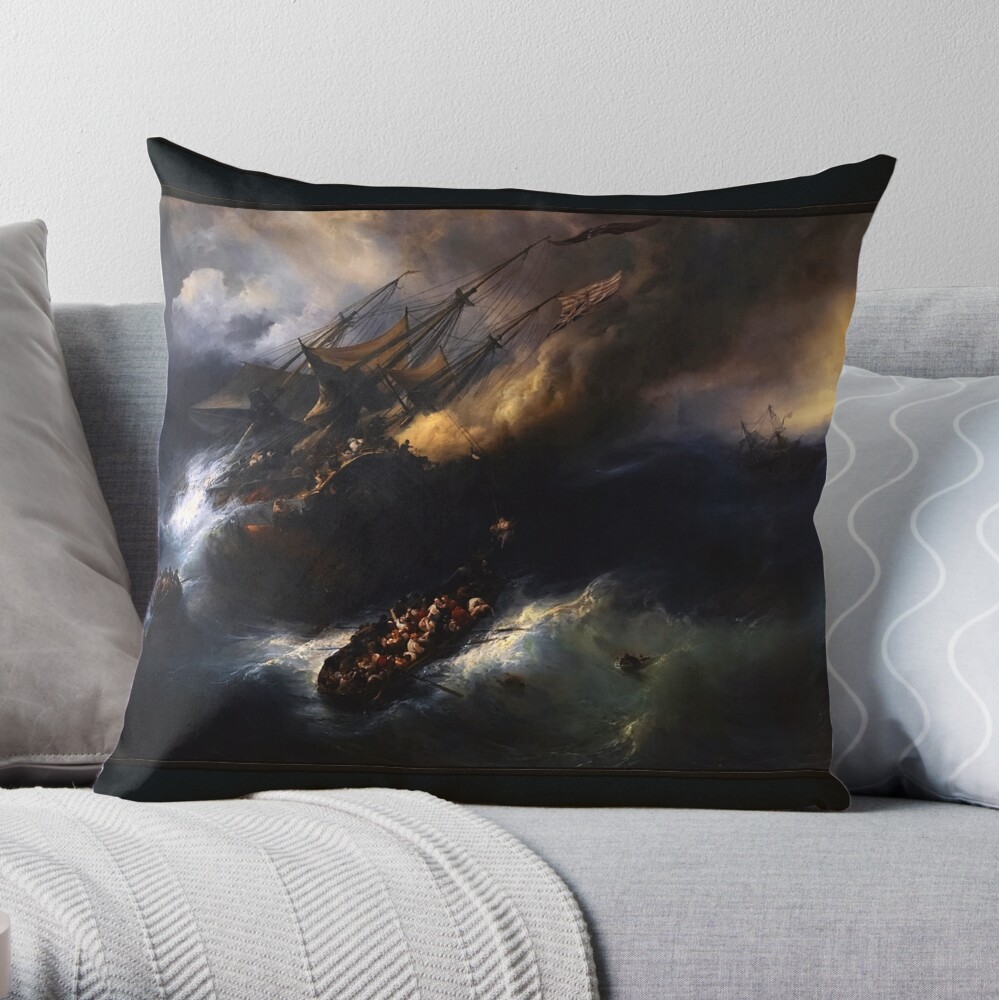
Table des matières
Sujet et thème principal
Au centre du tableau se trouve Indiaman Kent, condamné., un navire de la Compagnie britannique des Indes orientales qui a connu son destin lors d'un voyage tumultueux au milieu du XIXe siècle. La grande coque du navire, orné de voiles gonflées, lutte contre les vagues violentes, vacillant dangereusement comme s'il était sur le point de couler. Les turbulences de l'océan et le ciel orageux au-dessus créent un sentiment de catastrophe imminente..
L'Indiaman Kent est représenté avec ses voiles déployées, se penchant dangereusement face aux forces écrasantes de la nature. L’état précaire du navire est accentué par les vagues qui s’écrasent contre ses flancs et par la position inclinée du navire., comme si ça pouvait se briser à tout moment. La lutte est palpable, creating an atmosphere of tension, uncertainty, and impending doom.
The surrounding scene conveys a sense of futility as human efforts to survive are contrasted with the immutable, unstoppable power of the natural world. The waves, sombre et inquiétant, appear to be closing in, and the sky above is painted with tumultuous clouds, suggesting that the storm is far from over. The raging sea and chaotic skies reflect the hopelessness and desperation of the sailors aboard the ship as they battle the elements.
Objets et terrain
The painting’s foreground is dominated by the tumultuous ocean, its waves captured in various shades of blue, vert, et blanc. The waves are churning and crashing, creating a dynamic texture that amplifies the sense of motion. The sheer size and power of the waves dwarf the ship, emphasizing the fragile relationship between man-made structures and the vast, uncontrollable natural world. The white foam of the waves contrasts sharply against the darker hues of the sea, illustrating the violent turbulence of the water.
Off to the side of the painting, the viewer can see a smaller boat that is perhaps trying to escape or rescue those aboard the stricken Indiaman Kent. This boat, manned by several sailors, faces its own struggle against the waves. It is a poignant symbol of human perseverance and hope, though in the context of the larger storm, it appears hopelessly small and vulnerable. The crew members aboard the boat are rendered with detailed expressions of concentration and fear, embodying the desperation of those trying to survive the disaster.
Le ciel au-dessus, filled with dark, nuages tourbillonnants, adds to the overwhelming sense of chaos. The use of light and shadow in the sky suggests the presence of a fierce storm, with the occasional streak of sunlight breaking through the clouds, offering little comfort to the figures below. The landscape beyond the ship is obscured by the storm, suggesting that the vastness of the ocean extends infinitely in all directions, leaving the survivors isolated in a world defined only by the elements.
Matériaux et techniques artistiques
Gudin’s technique is evident in the vivid textures and dramatic contrasts that dominate the scene. The artist uses thick, expressive brushstrokes to convey the fury of the sea and the wind, with the turbulent water rendered in bold, sweeping motions that create a sense of fluidity and movement. The billowing sails of the ship are painted with intricate detail, their edges curling as the wind fights to tear them apart. The texture of the water contrasts with the smooth, controlled rendering of the ship, emphasizing its vulnerability in the face of nature’s power.
The sky is painted with a deep, almost otherworldly intensity, with the dark clouds swirling in a way that suggests both the violence of the storm and the inevitability of the ship’s destruction. The light that occasionally pierces the sky serves as a dramatic contrast to the overall darkness of the scene, adding to the emotional tension of the composition. Gudin’s use of color — from the dark, moody blues and greens of the sea to the warm golden hues of the sun breaking through the clouds — contributes to the painting’s emotional weight. This stark contrast highlights the despair and hope that coexist within the scene.
Style, Humeur, et ambiance
“La perte de l'Indiaman Kent” is a prime example of the Romantic style, which was characterized by an emphasis on the sublime and the dramatic aspects of nature. Dans ce tableau, the theme of human struggle against the forces of nature is central, as the ship’s fate lies at the mercy of the storm. Gudin captures the emotional intensity of the scene, focusing on the terror and helplessness of the crew aboard the ship. The chaotic movement of the waves and the dark, stormy sky create a mood of tension and anxiety, drawing the viewer into the tragic moment.
The mood of the painting is one of impending doom, as the ship’s desperate struggle to stay afloat seems futile against the relentless onslaught of the storm. There is a sense of helplessness in the faces of the sailors, whose attempts to control the ship seem futile in the face of nature’s wrath. Encore, the painting also conveys a sense of awe and respect for the power of the sea, as the forces of nature are portrayed with overwhelming intensity.
Conclusion
Jean Antoine Théodore Gudin’s “La perte de l'Indiaman Kent” is a compelling portrayal of maritime tragedy, rendered with remarkable attention to detail and a deep understanding of the natural world. The dramatic composition, intense emotional weight, et le rendu vivant de la mer agitée font de cette peinture un puissant témoignage de la puissance de la nature et de la vulnérabilité de l'humanité face à elle.. La capacité de Gudin à capturer à la fois la majesté et la terreur de la mer, avec l'expérience humaine de lutter contre cela, c'est ce qui rend cette pièce si évocatrice et durable.
Histoire derrière l'événement
Informations dérivées de Musées royaux Greenwhich
L'East Indiaman Kent appartenait à Stewart Marjoribanks et entra en service auprès de la Compagnie des Indes orientales en 1820. L'Indiaman Kent transportait 700 gens, principalement des soldats du 31ème régiment et leurs familles, et il était commandé par Henry Cobb; et était en voyage au Bengale, Bombay et la Chine.
La perte de l'Indiaman Kent commence dans 1825, en février 19, le navire a quitté les Downs un troisième voyage au Bengale puis en Chine; during the 27th and 28th of February it encountered a storm, and on March 1, in the Bay of Biscay the ship accidentally caught fire.
It was reported that there were individuals trying to steal liquor in her hold using a naked light (match, candle…) to see in the darkness that was responsible for the fire.
Efforts were made to put out the fire by scuttling the lower ports to flood the hold, but due to the fear of the ship sinking the ports had to be shut.
A sailor was sent aloft, presumably to the crows-nest; and reported another vessel in the vicinity. Thus a complex rescue effort was undertaken to ferry passengers and crew through the mountainous seas to the brig ‘Cambrian’, captained by Captain Cooke which was bound for Vera Cruz with its passengers of Cornish miners.
Though the majority of the passengers made it off the ship; some though did not survive the two day / three night journey to Falmouth; most of the dead being children.
The Loss Of The Indiaman Kent is a remastered digital art old masters reproduction of a public domain image that is available for purchase online as a impression sur toile.
Cette création d'art numérique, comme toutes les œuvres d'art disponibles sur le site Web Xzendor7, elles sont disponibles à l'achat en ligne dans une variété de formats de matériaux, y compris des impressions sur toile., impressions acryliques, impressions métalliques, gravures sur bois, impressions encadrées, affiches, et sous forme d'impressions sur toile roulées dans une variété de tailles de 12 pouces à 72 pouces en fonction de la taille de l'œuvre d'art réelle et de la boutique d'impression à la demande auprès de laquelle vous choisissez d'acheter l'art.
L’œuvre d’art est également disponible sur une large gamme de vêtements pour hommes et femmes., tasses, fourre-tout, écharpes, cahiers et journaux et de nombreux produits de décoration intérieure.
Biographie de l'artiste
Informations ci-dessous dérivées de Wikipedia.org
Théodore est né à Paris France et lui et son frère aîné Jean-Louis (1799 – 1823), a été élevé par sa mère qui était veuve.
Bien qu'il ait été inscrit dans une école navale en France, il abandonne ses études et entreprend un voyage à New York aux Etats-Unis où il se mêle aux bonapartistes (personne qui a activement participé ou défendu le mouvement conservateur, monarchiste) en exil.
Dans 1819 Gudin a décidé de rejoindre la marine américaine et est devenu membre de l'équipage du Manchester Packet., une 250 tonne brick (un voilier avec deux mâts carrés).
Puis dans 1822 il revient à Paris et s'inspire de son frère devenu élève du peintre français Horace Vernet (1789 – 1863); a décidé de poursuivre une carrière dans l'art, et a pu occuper un poste dans les ateliers de la peintre française Anne-Louis Girodet (1767 – 1824).
Cette même année, il fait ses débuts au Salon; mais l'année suivante, 1823 les choses prendraient une tournure tragique, car lui et son frère ont été impliqués dans un naufrage sur la Seine en France, où son frère s'est noyé. Cet événement aura un profond impact sur lui pour le reste de sa vie..
Dans 1824 il expose au Salon un tableau représentant des navires qui l'ont emmené en visite aux États-Unis et remporte le soutien du futur roi Louis Philippe Ier. (1773 – 1850).
Dans 1828 il a été commandé par le roi Charles X (1754 – 1836) peindre une représentation de l'enseigne Hippolyte Bisson (1796 – 1827) qui, l'année précédente, had blown up his ship rather than surrender it to pirates.
Shortly after completing his commission, Gudin went with his friend French Navy officer Abel Aubert du Petit-Thouars, to participate in the Algerian Expedition (1830 – 1903), where he made numerous sketches of his adventure.
After returning from the Algerian Expedition, he was awarded the title of “Peintre de la Marine” at the court of Louis Philippe; and over the next several years made painting trips to Italy, Switzerland and Russia.
He was then made a Baron by the King, and was commissioned to produce ninety paintings on French naval history for the Palace of Versailles; a monumental task that apparently undermined his health.
Dans 1841 he was named an officer in the Legion of Honor and following an exhibition in Berlin in 1845 he received the Cross Pour le Mérite.